A reliable full-name meaning has not been established here. The recorded Irish and English forms are given without an unsupported translation.
Recorded forms
Ceatharlach· Irish · main form · validated name
Carlow· English · main form
Place & story
Valleys and a mountain boundary
Lewis’s topographical account contrasts the broad Barrow and Slaney valleys with rising ground towards Mount Leinster and the Blackstairs. It identifies Sculloge Gap as a passage through the ridge. These features give the county a more varied shape than its small area suggests. River routes and a mountain crossing could connect communities across county boundaries, while nearby settlements on opposite sides of the ridge experienced different routes to market.[2]
A changing set of divisions
The directory’s administrative account lists Carlow, Idrone, St Mullins, Rathvilly and Forth among the county’s baronial names. It notes Idrone’s division in 1802 and the further division of St Mullins in 1834. Such changes are important when reading a dated property record. An East, West, North or South qualifier may belong to a specific administrative arrangement, not simply describe the direction of a place from the nearest town.[3]
Brownshill’s enormous capstone
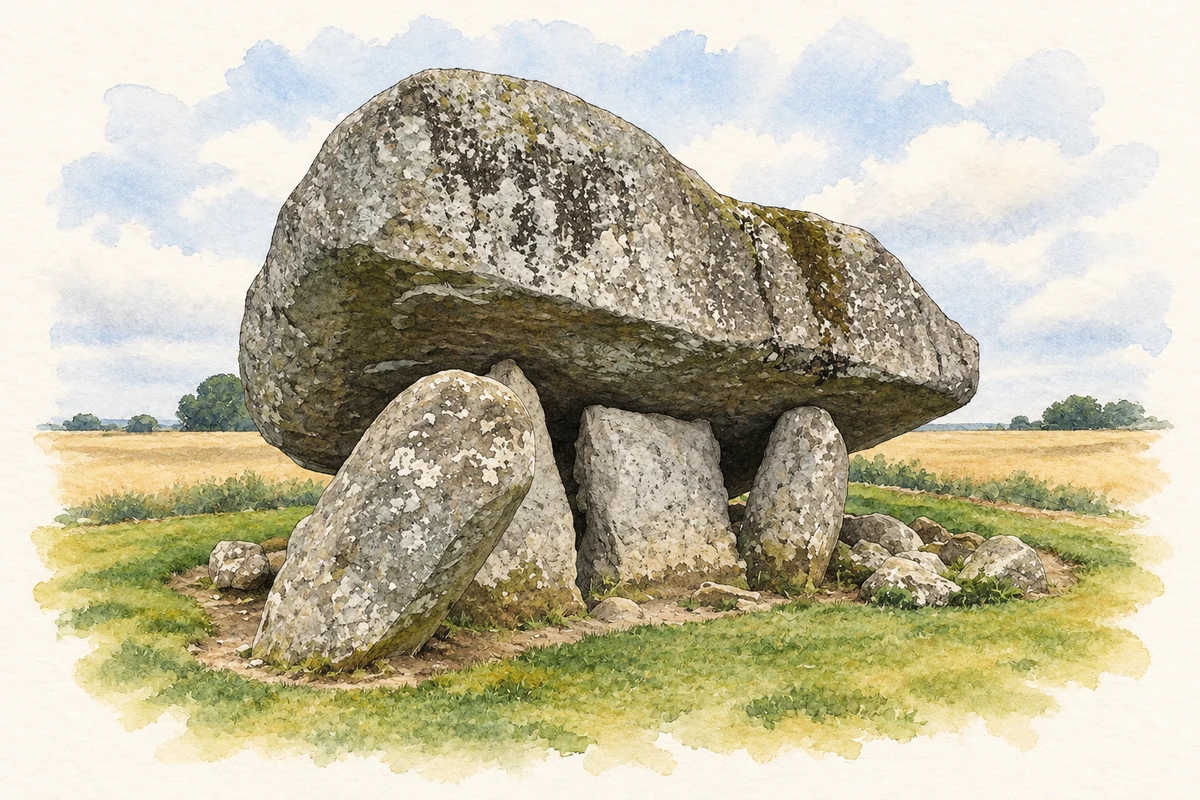
Brownshill, east of Carlow town, is a portal tomb distinguished by its immense granite capstone. OPW gives approximate dimensions of 4.7 by 6.1 by 2 metres and an estimated weight exceeding 100 tonnes. The monument has not been excavated, so its individual burial history cannot simply be supplied from finds at other tombs. Its surviving stones nevertheless make the labour and engineering of Neolithic communities unusually tangible. The tomb belongs to the county’s deep past, separate from the later towns and administrative divisions described in nineteenth-century directories.[4]
People & connections
John Tyndall at Leighlinbridge
The scientist John Tyndall was born at Leighlinbridge on 2 August 1820 and received much of his early education at Ballinabranagh. He worked with the Ordnance Survey before pursuing science in Britain and Germany. His experiments on the absorption of heat by gases became important to understanding the atmosphere. The Royal Society elected him a fellow in 1852. His Carlow association is anchored in a particular birthplace and schooling; his later scientific work took place within a much wider European career. A memorial at Leighlinbridge commemorates that connection.[5][6]
Figures cover the whole county including its cities. CSO recommends this series for long-term comparison, although minor boundary changes have occurred.
View population figures
County Carlow, including its cities — census population
Brownshill Portal Tomb, County Carlow illustration: based on a reference by Eirian Evans. AI-assisted watercolour and ink adaptation; cream paper margins added, incidental clutter omitted and fine details simplified. Licence: CC BY-SA 2.0.
 placenames