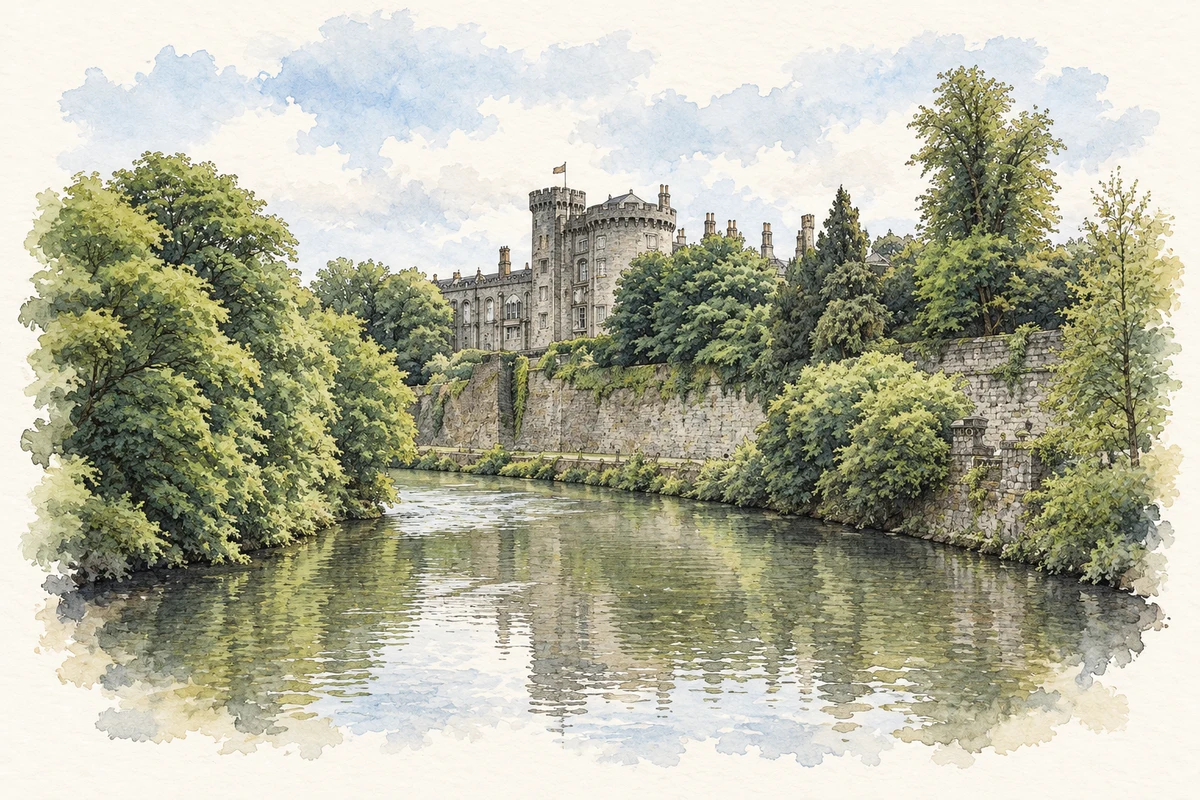
The county's castle and abbeys preserve patronage and craftsmanship, while a philosopher's childhood and a comic proverb add different kinds of association.
Illustration, Kilkenny Castle and the River Nore
⊕Recorded locationKilkenny52.60211° N · 7.27361° WInteractive map supplied by OpenStreetMap.
These Irish name elements are associated with this record in the Logainm glossary.
An element’s translation is a clue, rather than a complete explanation of the name. Its form and meaning depend on local history and the full Irish name.
Recorded forms
Cill Chainnigh· Irish · main form · validated name
Kilkenny· English · main form
Place & story
The Butlers' principal seat
Kilkenny Castle served as the principal seat of the Butler family for almost six centuries. The Office of Public Works traces its medieval origins and later Victorian remodelling, including the picture gallery built for the family's paintings. The present interiors therefore belong to several periods of occupation and restoration. The castle was a household and a place of display as well as a military stronghold.[2]
Jerpoint's sculptors
Near Thomastown, Jerpoint Abbey offers another record of patronage. The twelfth-century Cistercian church combines Romanesque and early Gothic features, while the tower and cloister belong to the fifteenth century. The OPW highlights carved tombs associated with the O'Tunney school, figures in the cloister and images of knights, saints and animals. Its sculpture preserves stoneworking from several centuries.[3]
People & connections
George Berkeley's childhood
George Berkeley, later the philosopher and bishop of Cloyne, spent his childhood at Dysart Castle near Thomastown. The Dictionary of Irish Biography places his birth in or near Kilkenny city in 1685 and records his entry to Kilkenny College in 1696. Those are specific county connections before his studies at Trinity College Dublin and later career elsewhere.[4]
Folklore & tradition
The cats that left only tails
John Johnson Marshall's 1924 collection records the saying about fighting like Kilkennycats: the animals supposedly fought until only their tails remained. He also gives a later explanatory story involving soldiers concealing a forbidden catfight from an officer. These are comic and proverbial tales associated with Kilkennycity, within the county. They are not evidence that cats literally ate one another or a reliable account of military behaviour in 1798. The proverb's survival is firmer than any single proposed origin.[5]
Figures cover the whole county including its cities. CSO recommends this series for long-term comparison, although minor boundary changes have occurred.
View population figures
County Kilkenny, including its cities — census population
Kilkenny Castle and the River Nore illustration: based on a River Nore and Kilkenny Castle by Jeff Buck. AI-assisted watercolour and ink adaptation; cream paper margins added, incidental clutter omitted and fine details simplified. Licence: CC BY-SA 2.0.
 placenames