A reliable full-name meaning has not been established here. The recorded Irish and English forms are given without an unsupported translation.
Recorded forms
Lú· Irish · main form · validated name
Louth· English · main form
Place & story
A smaller scale of naming
Louth County Council’s Field Names Project records names associated with farming, industry, wildlife, archaeology and relative position. Grouped by townland and civil parish, they preserve a smaller scale of local naming than the county’s principal settlements.[2]
Language needs a local context
The project found particularly strong Irish-language naming in its Omeath material. Its recorded forms, localities and informant information preserve evidence of usage in a district with a distinctive linguistic history.[2]
People & connections
Oliver Plunkett’s Drogheda shrine
St Peter’s Church in Drogheda preserves the shrine of Oliver Plunkett, Archbishop of Armagh, who was executed at Tyburn in 1681. The archdiocese’s account records the later movement of the relic to Drogheda, his canonisation in 1975 and Pope John Paul II’s visit in 1979. This is a continuing religious and commemorative association within County Louth, distinct from Plunkett’s birthplace at Loughcrew in County Meath.[3]
Folklore & tradition
The Cooley landscape of the Táin
The medieval Táin Bó Cúailnge gives the Cooley landscape a central place in the story of Queen Medb’s cattle raid. Dunn’s 1914 translation preserves this literary geography, including the ford at Ardee.[4]
Figures cover the whole county including its cities. CSO recommends this series for long-term comparison, although minor boundary changes have occurred.
View population figures
County Louth, including its cities — census population
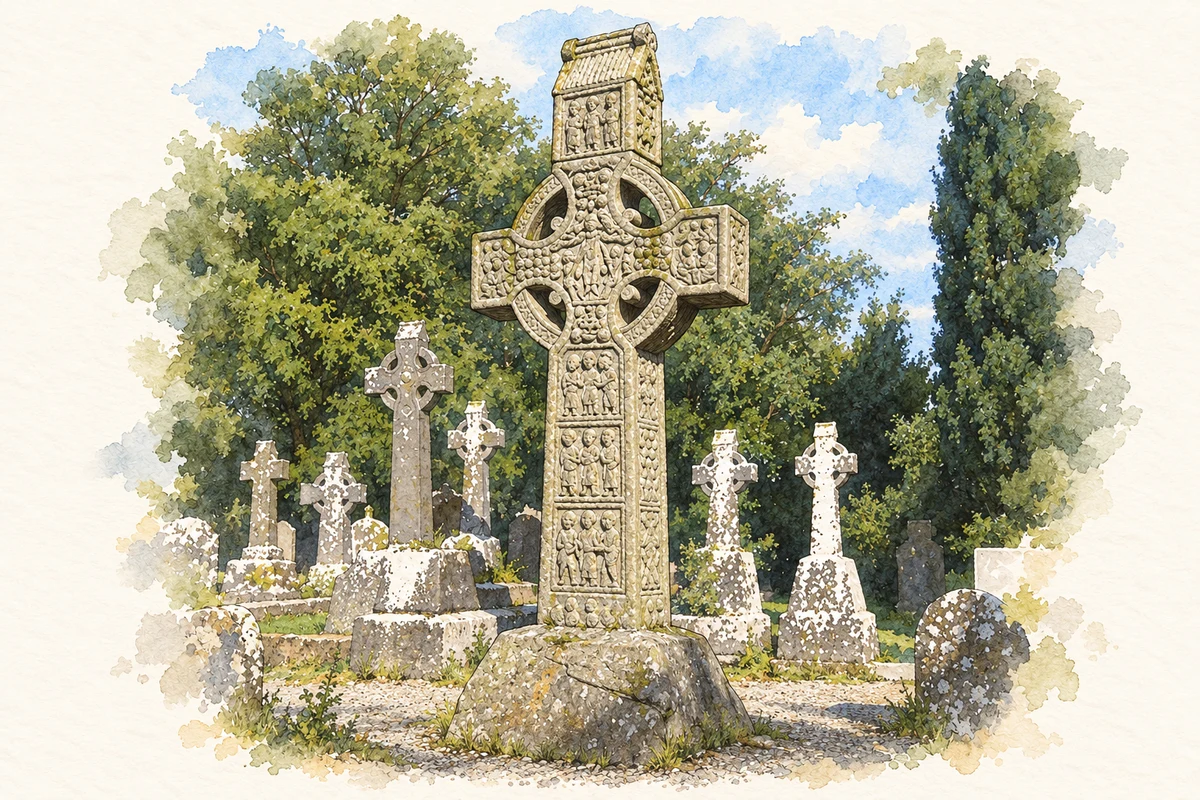
Muiredach’s High Cross, Monasterboice illustration: based on a reference by Christopher Hilton. AI-assisted watercolour and ink adaptation; cream paper margins added, incidental clutter omitted and fine details simplified. Licence: CC BY-SA 2.0.
 placenames