Waterford’s river valleys and coast connect monastic sites, fishing harbours and the birthplace of Robert Boyle. Its local traditions belong to particular communities within that wider county.
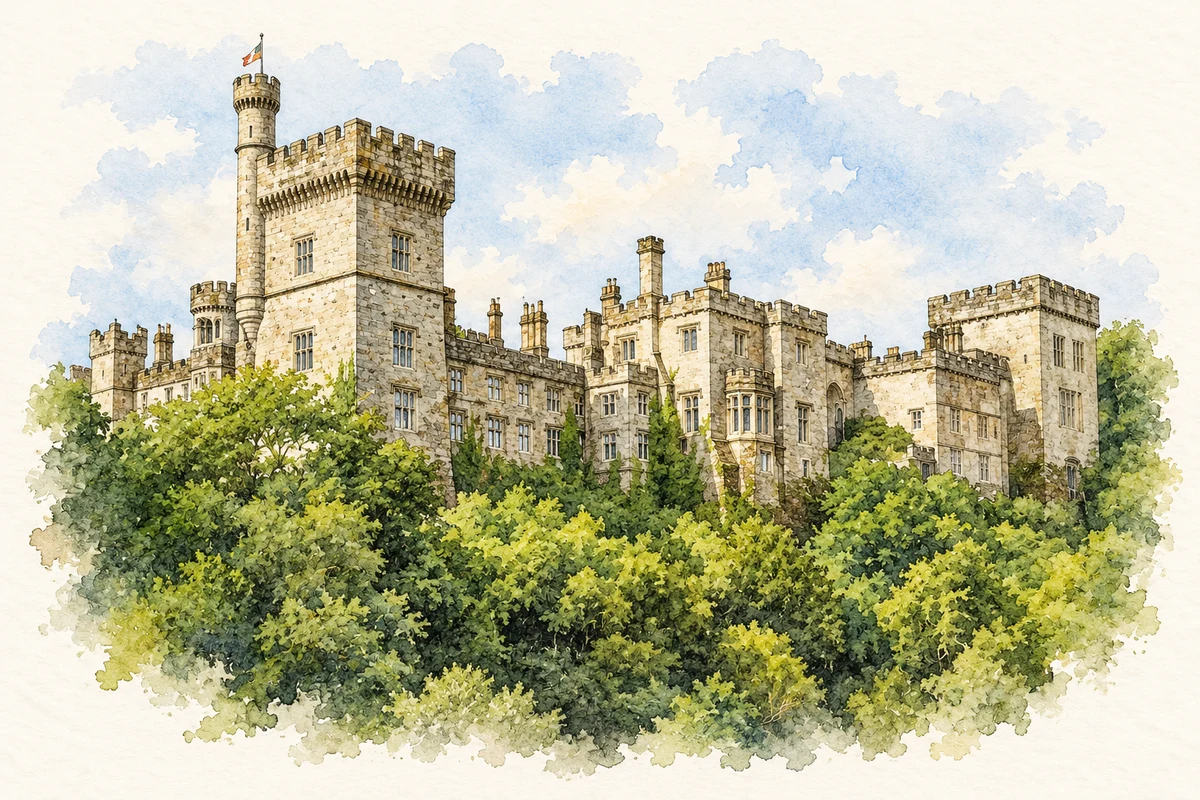
Illustration, Lismore Castle, County Waterford
⊕Recorded locationWaterford52.15358° N · 7.55860° WInteractive map supplied by OpenStreetMap.
These Irish name elements are associated with this record in the Logainm glossary.
An element’s translation is a clue, rather than a complete explanation of the name. Its form and meaning depend on local history and the full Irish name.
Recorded forms
Port Láirge· Irish · main form · validated name
Waterford· English · main form
Place & story
County, city and the Déise
The historical name Déise gives the county a regional identity older than its modern administrative arrangements. Lewis’s 1837 county entry discusses that territory while treating Waterford city as a separate jurisdiction for population purposes. His descriptions of the coast, river approaches and neighbouring counties help locate the region, but the remote migration stories in an antiquarian county history should not be treated as a fully established account of its origins.[2]
People & connections
Robert Boyle at Lismore
Robert Boyle was born at Lismore Castle on 25 January 1627. The Birkbeck Robert Boyle Project identifies the birthplace and places his childhood within the household of Richard Boyle and Catherine Fenton. His later education and scientific career largely unfolded elsewhere. Lismore’s connection is therefore precise: it was the birthplace and early home of a natural philosopher whose investigations became important to the history of chemistry, rather than the location of all his later experiments.[5][6]
Ardmore’s surviving monastery
At Ardmore the round tower, cathedral ruins and oratory preserve several periods of ecclesiastical building. The Office of Public Works dates the cathedral to the late twelfth and early thirteenth centuries and the tower to the twelfth century. Biblical scenes carved into the cathedral’s Romanesque arcading and the surviving ogham stones add detail beyond the distant silhouette. The site is associated with St Declan, but the surviving structures are much later than the saint’s traditional lifetime.[7]
Folklore & tradition
A coastal charm at Tramore
The Metal Man above Tramore acquired a popular marriage tradition: a successful circuit of three hops around its pillar was said to bring a wedding within a year. Waterford County Museum preserves an approximately 1920 postcard bearing that claim.[8]
Different kinds of harbour
The county’s maritime places did not all serve the same functions. Lewis’s Dungarvan entry describes fishing, a harbour and the relationship with Abbeyside, while his Waterford city account centres on the defended port on the Suir. Together they show the importance of distinguishing the smaller coastal communities from the city. County-wide history becomes more informative when its events and occupations retain those local settings.[3][4]
Figures cover the whole county including its cities. CSO recommends this series for long-term comparison, although minor boundary changes have occurred.
View population figures
County Waterford, including its cities — census population
Lismore Castle, County Waterford illustration: based on a Castles of Munster: Lismore, Waterford (4) by Mike Searle. AI-assisted watercolour and ink adaptation; cream paper margins added, incidental clutter omitted and fine details simplified. Licence: CC BY-SA 2.0.
 placenames