 placenames
Ballintemple
Baile an Teampaill
Ballintemple’s surviving heritage joins a modest burial ground with the limestone industry and the final home of mathematician George Boole.
The name
These Irish name elements are associated with this record in the Logainm glossary.
An element’s translation is a clue, rather than a complete explanation of the name. Its form and meaning depend on local history and the full Irish name.
Recorded forms
- Baile an Teampaill · Irish · main form · validated name
- Ballintemple · English · main form
Place & story
The old parish churchyard
A ruined church at Ballintemple was recorded during Bishop Dive Downes's diocesan visitation in 1699. Research by C. J. F. MacCarthy, reviewed in the Cork Historical and Archaeological Society journal, found relatively little documentary evidence for the site. Its medieval dedication remains disputed. MacCarthy also challenged the familiar association with the Knights Templar and Hospitallers. The churchyard's history is therefore best approached through its surviving records, without presenting the military-order tradition as established fact. [2]
Stone from Beaumont Quarry
Beaumont Quarry supplied limestone from the Little Island Formation, including the building stone known as Beaumont dove. Geological Survey Ireland places the beginning of quarrying between 1830 and 1850 and its closure in the 1960s. Stone from the quarry is thought to have been used in several Cork landmarks. Exposed faces and caves survive among the regenerated grassland, leaving a visible record of an industry that helped build the expanding city. [3]
Lichfield Cottage’s Gothic decoration
Lichfield Cottage on Blackrock Road was built around 1830. Its decorative bargeboards, pointed openings and small trefoil details exemplify the picturesque Gothic taste used for nineteenth-century suburban houses. The National Inventory of Architectural Heritage identifies it as an example of Strawberry Hill Gothic, where medieval-looking ornament serves a domestic building. Its association with George Boole adds historical significance to the house's distinctive architecture. [4]
George Boole’s final home
George Boole lived in Ballintemple while teaching at Queen's College Cork, where he had become the first professor of mathematics in 1849. He died in December 1864 and was buried at Saint Michael's in neighbouring Blackrock. His work on algebraic logic became foundational to modern computing. A plaque unveiled at Lichfield Cottage in 1984 commemorates his residence, distinguishing his local home from the college where he taught and the earlier Cork lodgings associated with his major book. [5]
Geographic information
- Place type
- Population centre
- County
- Cork
- Barony
- Cork
- Civil parish
- Saint Finbar's
- Coordinates
- 51.89050, -8.43580 (approximate)
- Logainm ID
- 1165430 ↗
Sources & further reading
- Logainm.ie — Ballintemple. Place names and geographic record, licensed under CC BY 4.0.
- Review of The Old Parish Church at Ballintemple, journal volume 103 (1998), pages 174–175 · Kieran Burke, Cork Historical and Archaeological Society
- Beaumont Quarry: County Geological Site Report CC002 · Geological Survey Ireland
- Lichfield Cottage, registration 20868114 · National Inventory of Architectural Heritage
- Professor George Boole · University College Cork Heritage Services
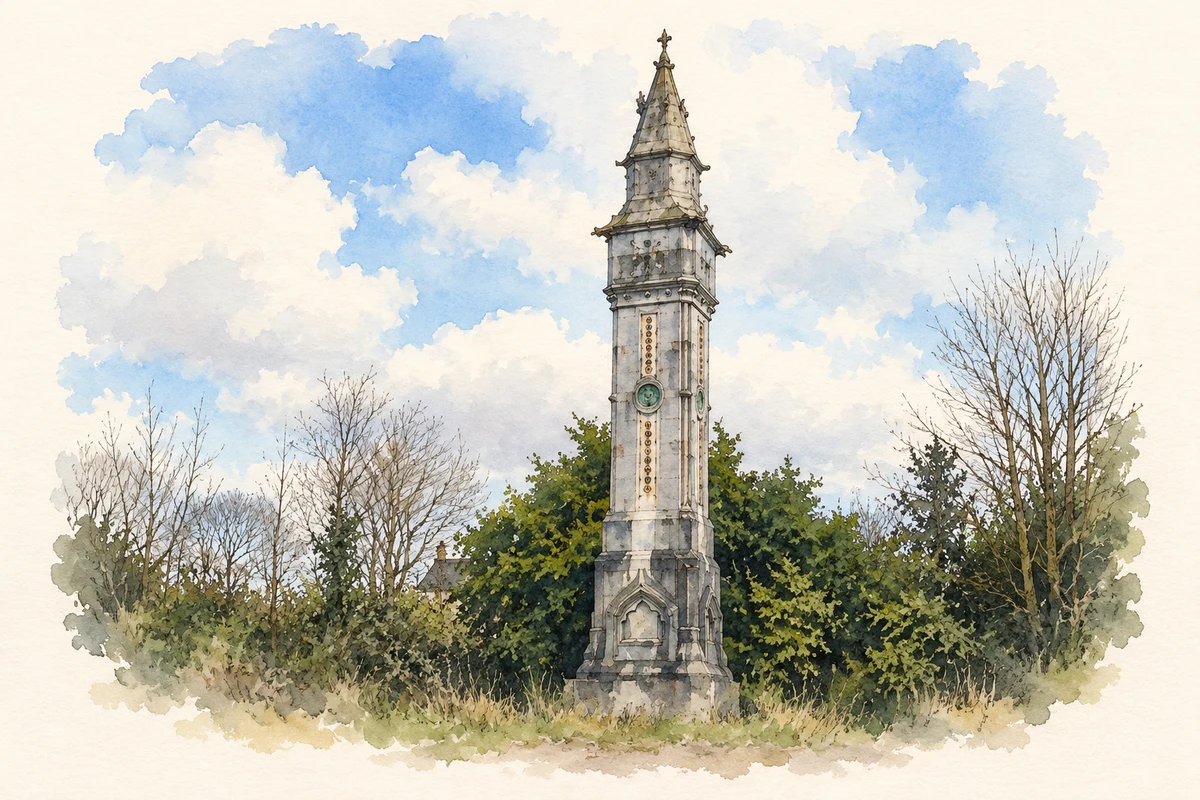
- McCarthy Monument, near Ballintemple, Cork illustration: based on a McCarthys Monument by Hywel Williams. AI-assisted watercolour and ink adaptation; cream paper margins added, incidental clutter omitted and fine details simplified. Licence: CC BY-SA 2.0.
Name record retrieved 2026-10-25 · Source record modified 2025-01-10. How this page was prepared.