Keady's textile history and domestic singing tradition meet in the lives of Sarah and Tommy Makem, whose music reached audiences far beyond County Armagh.
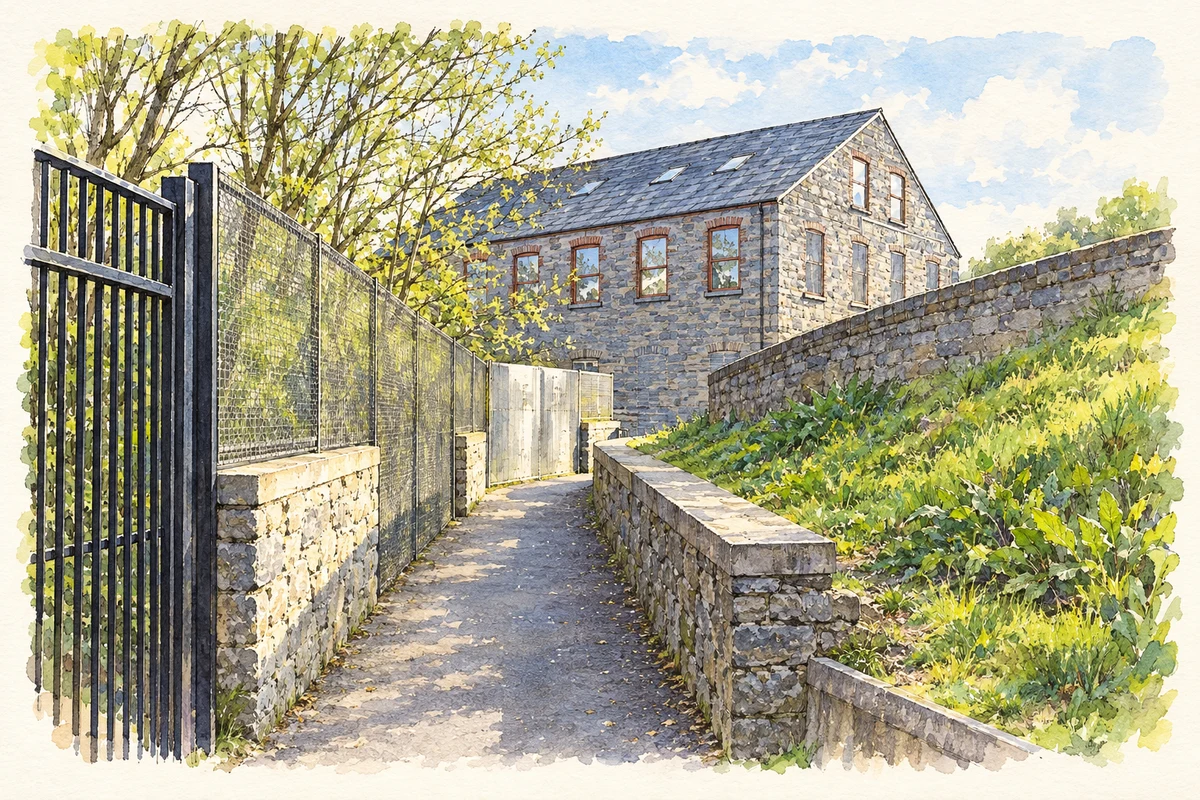
Illustration, Old Mill, Keady, 2020 — reconstruction
⊕Recorded locationKeady54.24771° N · 6.69587° WInteractive map supplied by OpenStreetMap.
A reliable full-name meaning has not been established here. The recorded Irish and English forms are given without an unsupported translation.
Recorded forms
An Céide· Irish · main form · validated name
Keady· English · main form
Place & story
A family house filled with song
Sarah Makem's Keady home welcomed relatives, neighbours and visiting musicians for singing, conversation and stories. Her maternal family, the Greenes, already had a long local musical tradition. Sarah and her husband Peter both worked in linen mills, and their household belonged to a town where industrial and farming communities met. Recordings made by collectors in the 1950s carried Sarah's singing beyond these domestic gatherings. Her performance of As I Roved Out became the theme for the BBC programme of that name, bringing a Keady voice into many other homes.[2]
People & connections
Tommy Makem meets Liam Clancy
Tommy Makem was born in Keady in 1932 and worked in linen mills after leaving school. In 1955 he met Liam Clancy when the latter accompanied song collector Diane Hamilton to the Makem house. That local encounter preceded their later collaboration in the United States. Tommy emigrated in December of the same year and eventually became internationally known with the Clancy Brothers. The family's experience connects the transmission of songs at home with migration and the growth of a professional folk-music career.[2]
The old mill on Kinelowen Street
Keady Mill provides a physical reminder of the town's industrial history. The building is described in the borough council's appointed property agent's record as a former corn and flax mill dating to about the 1750s. Its accommodation extends over four levels, including basement and lower-ground floors. A later use as a heritage centre and café gave the industrial building a community role. It should be distinguished from the various linen mills where members of the Makem family worked; the biographical sources do not identify this particular building as their workplace.[3]
Both censuses use the same 2015 settlement boundary. These exact counts cover usual residents in the settlement, rather than local government districts or historic counties. Other NISRA tables may use approximate counts.
View population figures
KEADY — Settlement 2015 (N11000073) — census population
The report states that these figures use the district as constituted in 1926. This is a historical urban administrative area, separate from the modern settlement boundary and usual-resident population.
View population figures
Keady Urban District — 1926 boundary — census population
The published 2001 KS01 settlement count uses an earlier geography and disclosure-control methods. It is not rebased to the 2015 settlement used for 2011 and 2021. The geographic matching file can contain a different 2001 count; the figure shown here comes from KS01.
View population figures
Keady — KS01 Settlement (2005 geography) — census population
 placenames