 placenames
Douglas
Dúglas
Textile manufacture and the people behind its churches give Douglas a history rooted in work as well as suburban growth.
The name
A reliable full-name meaning has not been established here. The recorded Irish and English forms are given without an unsupported translation.
Recorded forms
- Dúglas · Irish · main form · validated name
- Douglas · English · main form
Place & story
A village making sails and rope
Samuel Lewis described Douglas in 1837 as two detached groups of buildings on the upper and lower roads from Cork. He traced its sailcloth manufacture to weavers from Fermanagh who settled here in 1726. Competition from mechanised English factories had weakened that trade by his day, but manufacture continued. Rope-making, flour mills and brick-making also employed the district. Bricks travelled inland and by small craft to Cork, linking the village’s working landscape to the harbour. [2]
From flax to wool
The Douglas Tidy Towns heritage trail follows the later mill owners through a change of material and fortune. The Pollocks turned from flax towards wool and tweed before their business closed in 1885. John Morrogh, who had made money in South African diamond mining, then bought the mill and installed a steam engine. It produced tweed, serge and other woollen cloth, including material for the first Irish Volunteers’ uniforms. Morrogh also represented a Cork constituency at Westminster from 1889 to 1893; his connection with Douglas is commemorated in stained glass in Saint Columba’s Church. [3]
Women who helped build Saint Luke’s
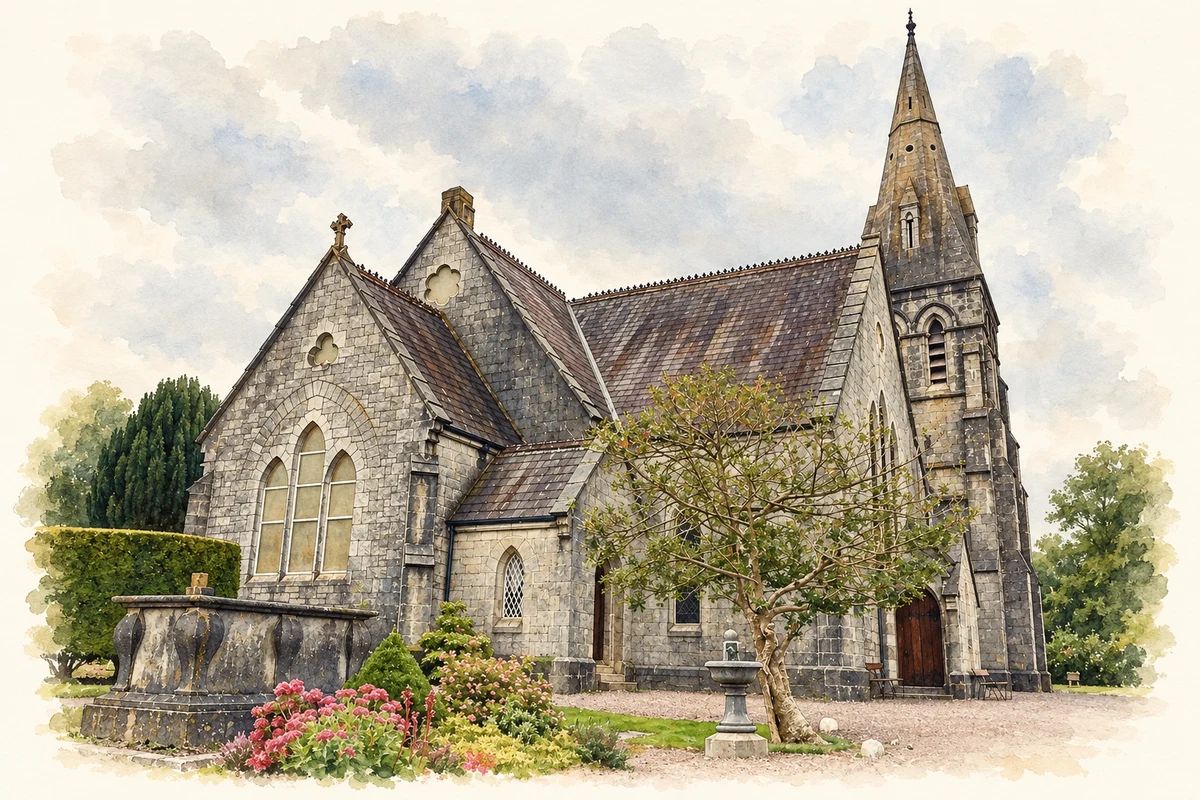
The present Saint Luke’s Church was consecrated in August 1875, replacing an eighteenth-century building. Canon Samuel Hayman led the campaign for the new church. Mary, Henrietta and Susannah Reeves of Tramore House were prominent fundraisers and gave a memorial window in the north transept. The church’s glass also includes a Good Shepherd window by Catherine O’Brien of An Túr Gloine. These named patrons and artist give the church’s restrained architecture a more personal history. [4]
Lives recorded in the churchyard
Saint Luke’s graveyard holds figures connected with Cork’s commercial and intellectual life. John Arnott, founder of Arnotts in Dublin and a former Lord Mayor of Cork, is commemorated by an obelisk. Antiquarian and librarian Richard Caulfield is also buried here. An older grave belongs to the Besnards, the Huguenot business family whose Julius Besnard owned the Douglas flax mills by 1783 and helped build the church that preceded the present Saint Luke’s. [5]
Geographic information
- Place type
- Population centre
- County
- Cork
- Barony
- Kerrycurrihy
- Civil parish
- Carrigaline
- Coordinates
- 51.87331, -8.46468 (approximate)
- Logainm ID
- 1166058 ↗
Sources & further reading
- Logainm.ie — Douglas. Place names and geographic record, licensed under CC BY 4.0.
- Douglas, A Topographical Dictionary of Ireland (1837) · Samuel Lewis
- Heritage Trail: Douglas Mills · Douglas Tidy Towns
- St Luke’s Church, Douglas · Cork City Council Heritage Office
- Heritage Trail: St Luke’s Church of Ireland Graveyard · Douglas Tidy Towns
- St Luke's Church, Douglas, Cork illustration: based on a County Cork - St Luke's Church - 20180906110244.jpg by Michael O'Sheil. AI-assisted watercolour and ink adaptation; cream paper margins added, incidental clutter omitted and fine details simplified. Licence: CC BY-SA 4.0; adapted illustration distributed under the same licence.

Name record retrieved 2026-10-25 · Source record modified 2025-01-10. How this page was prepared.