 placenames
Annadorn
Eanach Dorn
Annadorn’s surviving tomb and nineteenth-century descriptions connect prehistoric burial, the McCartans and the United Irishmen.
The name
These Irish name elements are associated with this record in the Logainm glossary.
An element’s translation is a clue, rather than a complete explanation of the name. Its form and meaning depend on local history and the full Irish name.
Recorded forms
- Eanach Dorn · Irish · main form
- Annadorn · English · main form
Place & story
A chamber beneath the capstone
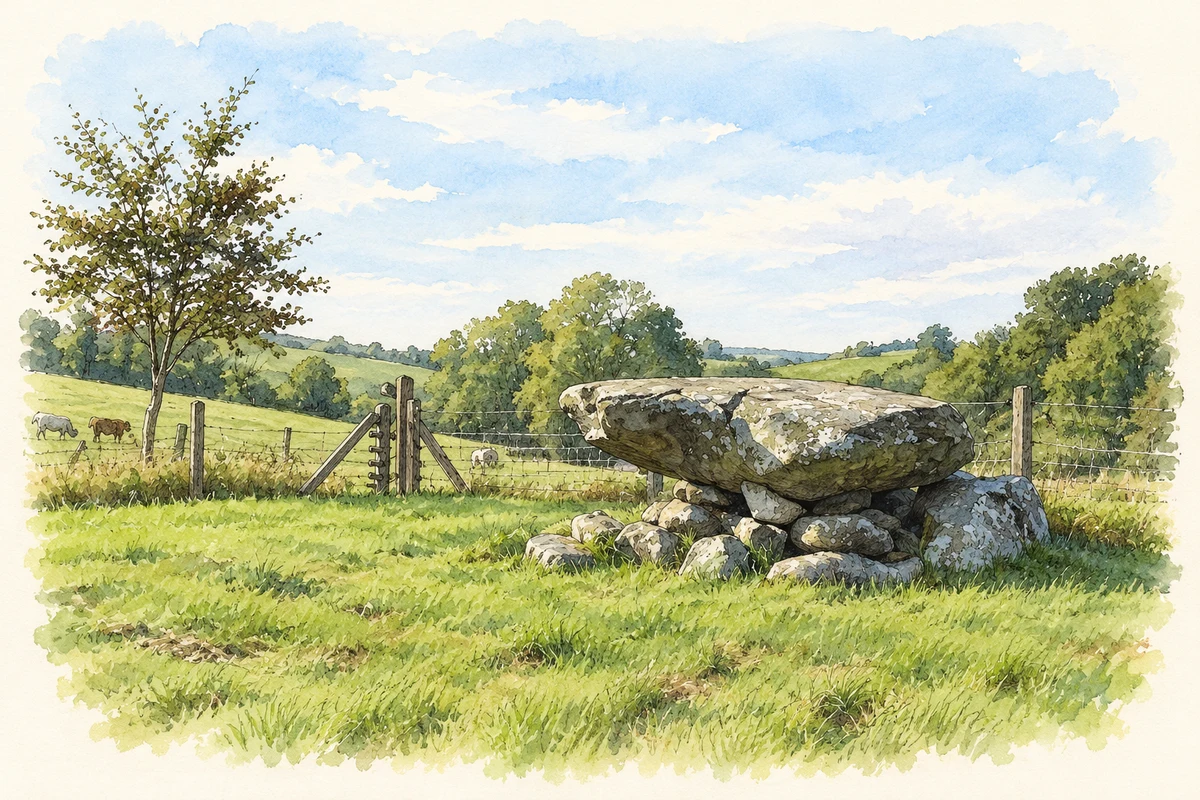
Annadorn’s megalithic monument retains three upright side stones and a capstone that has shifted slightly from its original position. These enclose a rectangular burial chamber. Although commonly called a dolmen, its classification remains uncertain: the Department for Communities notes an early account of a circular cairn and a roofed passage leading into it. That description suggests a passage tomb, whose surrounding mound and entrance passage have largely disappeared. [2]
Thomas Russell’s platform
The Department for Communities also records a much later use of the monument: Thomas Russell addressed United Irishmen from it in 1803. The association belongs to the renewed revolutionary activity after the rising of 1798. The stone structure thus served as a public speaking platform as well as surviving as an archaeological landmark, giving the same site a place in two very different periods of local history. [2]
The McCartans and Castle Hill
Samuel Lewis’s 1837 account, under the spelling Anadorn, described a former McCartan castle on a mound known as Castle Hill. He linked the family’s loss of its surrounding estates to participation in the Earl of Tyrone’s rebellion. His description preserves the association between the earthwork and the former territorial family; it should be read as a nineteenth-century historical account, rather than evidence that a standing castle survived there in his day. [3]
A road village with two fairs
Lewis counted 93 inhabitants in the village, which stood on the road linking Ballynahinch and Hillsborough with Downpatrick. He reported that Colonel Forde had recently bought it and begun improvements, and listed fairs on 14 May and 8 November. These details locate Annadorn within the movements of travellers and agricultural trade. The village population is distinct from the larger townland totals sometimes quoted in later local histories. [3]
Geographic information
Sources & further reading
- Logainm.ie — Annadorn. Place names and geographic record, licensed under CC BY 4.0.
- Annadorn Dolmen · Department for Communities
- Anadorn, Topographical Dictionary of Ireland, 1837 · Samuel Lewis; historical text hosted by GB Historical GIS, University of Portsmouth
- Annadorn Dolmen, County Down illustration: based on a Annadorn Dolmen, Loughinisland (2 October 2014) by Eric Jones. AI-assisted watercolour and ink adaptation; cream paper margins added, incidental clutter omitted and fine details simplified. Licence: CC BY-SA 2.0.
Name record retrieved 2026-10-25 · Source record modified 2019-10-08. How this page was prepared.