 placenames
Stranorlar
Srath an Urláir
Stranorlar’s churches and former rail connections preserve a history of expanding congregations, regional transport and the early Home Rule movement.
The name
These Irish name elements are associated with this record in the Logainm glossary.
An element’s translation is a clue, rather than a complete explanation of the name. Its form and meaning depend on local history and the full Irish name.
Recorded forms
- Srath an Urláir · Irish · main form · validated name
- Stranorlar · English · main form
Place & story
A meeting point for different railway gauges
The Finn Valley Railway opened from Strabane to Stranorlar in September 1863 on the Irish broad gauge. Later extensions towards Donegal used a narrower three-foot gauge, creating difficulties when goods had to be transferred at Stranorlar. The museum history identifies these mixed-gauge operations as a reason for converting the Finn Valley route. Further lines reached Killybegs in 1893 and Glenties in 1895, placing Stranorlar within a growing network connecting the Finn Valley with western Donegal. [2]
Saint John’s enlarged in 1863
Saint John’s Church of Ireland originated in 1729–33, with major extensions in 1863 adding a chancel, transepts and vestry. The later sections introduced carefully dressed sandstone surrounds and Gothic window tracery. The older nave and tower remained part of the enlarged church, producing a building with clearly different phases. Its churchyard contains eighteenth-century recumbent gravestones alongside later upright and table monuments, some enclosed by decorative iron railings. [3]
Isaac Butt’s childhood and burial
Isaac Butt (1813–79) spent most of his childhood in Stranorlar, although he was born at the rectory in Glenfin. He became a barrister, defended Young Ireland and Fenian prisoners, and helped establish the Home Government Association in 1870. His political outlook evolved from conservatism towards Home Rule, while his later leadership faced challenges from more confrontational parliamentary colleagues. After his death near Dublin in 1879, he was buried in Stranorlar’s churchyard, returning him to the town closely associated with his early life. [4]
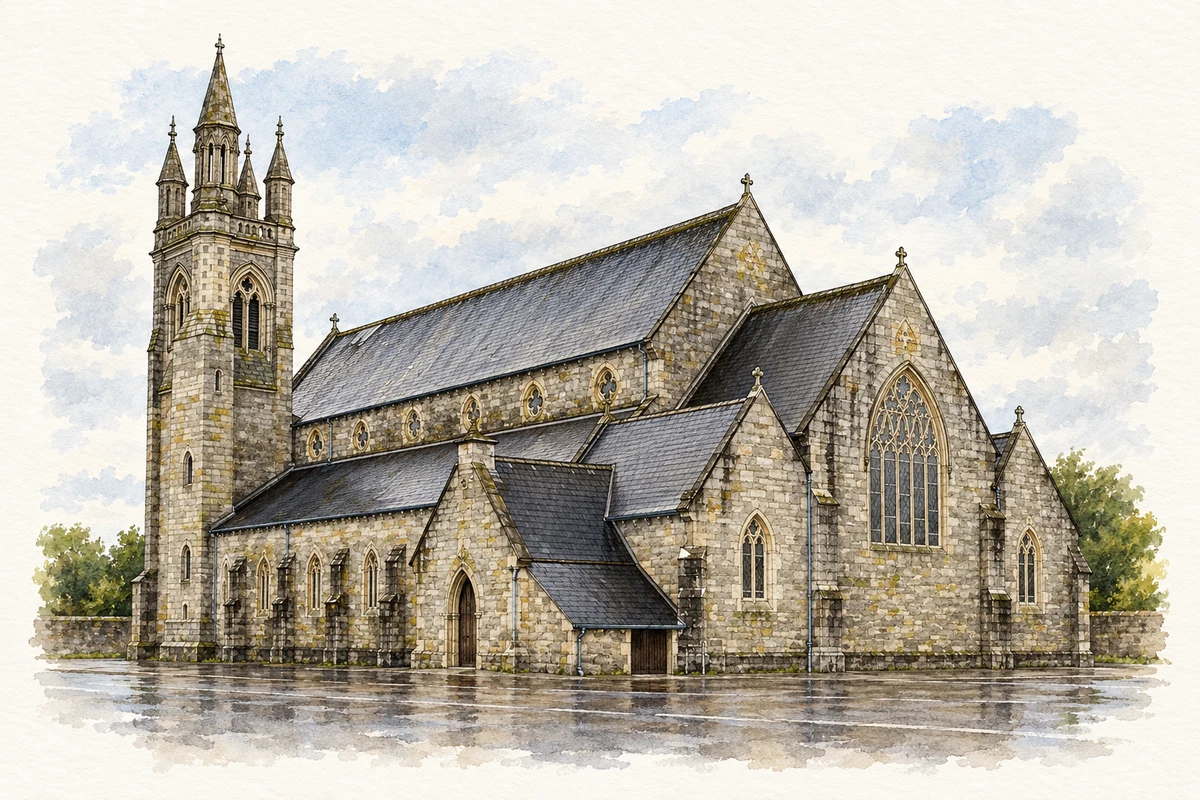
The Church of Mary Immaculate
The main body of the Catholic Church of Mary Immaculate opened in 1862, replacing an earlier church at Chapel Lane. Later work added furnishings and altered the interior: in 1896, William Patrick O’Neill carved an altar to designs by William Henry Byrne, and the Byrne practice supervised flooring and repairs in 1911. The sequence illustrates how the large Gothic church continued to develop after its initial opening, with architectural work and specialist carving contributing distinct layers. [5]
Geographic information
Sources & further reading
- Logainm.ie — Stranorlar. Place names and geographic record, licensed under CC BY 4.0.
- The Railways of Donegal: County Donegal Railway · Donegal Railway Museum
- Saint John’s Church, register 40838040 · National Inventory of Architectural Heritage
- Butt, Isaac · Philip Bull, Dictionary of Irish Biography
- Church of Mary Immaculate, register 40838023 · National Inventory of Architectural Heritage
- Church of Mary Immaculate, Stranorlar, County Donegal illustration: based on a File:Church in Stranorlar - geograph.org.uk - 483051.jpg by Kay Atherton. AI-assisted watercolour and ink adaptation; cream paper margins added, incidental clutter omitted and fine details simplified. Licence: CC BY-SA 2.0.

Name record retrieved 2026-10-25 · Source record modified 2025-01-10. How this page was prepared.