 placenames
Dún Laoghaire
Dún Laoghaire’s growth followed a major harbour project, with granite piers, mail services and maritime institutions shaping the town.
The name
These Irish name elements are associated with this record in the Logainm glossary.
An element’s translation is a clue, rather than a complete explanation of the name. Its form and meaning depend on local history and the full Irish name.
Recorded forms
- Dún Laoghaire · Irish · main form · validated name
- Dún Laoghaire · English · main form
Place & story
Building the harbour
Construction of the great harbour took place between 1817 and 1842. The Harbour Company's history places the workers at the centre of that achievement: up to a thousand labourers a year quarried, moved and laid stone in difficult and dangerous conditions. Granite travelled from Dalkey by an industrial railway. The surviving piers are therefore a record of labour and transport engineering as well as a setting for ships. Their construction helped transform a small coastal settlement into a substantial town. [2]
Kingstown and the mail route
George IV's departure from the harbour in 1821 prompted the name Kingstown, retained until 1920. In 1826 the mail-packet base moved here from Howth. Carlisle Pier and its later rail connection made it possible to transfer between the boats and trains within the harbour. These links gave the town a national role in carrying passengers and correspondence across the Irish Sea, beyond its local residential and seaside functions. [2]
The Mariners’ Church becomes a museum
The foundation stone of the Mariners' Church was laid in 1836, and consecration followed in June 1843. Trustees maintained it through pew rents and offerings, providing a large church that included seating for seamen and poorer worshippers. It closed for worship on Easter Day 1972. The Maritime Institute then pursued its conversion to a museum with the approval of parishioners. The National Maritime Museum's home thus preserves a building originally created for the harbour's religious community. [3]
The last voyage of the Leinster
Captain William Birch commanded RMS Leinster when it left Carlisle Pier for Holyhead on 10 October 1918. Its passengers included civilians and military personnel, while postal workers sorted mail aboard. Torpedo attacks sank the ship in the Irish Sea. Survivors were landed at Victoria Wharf, where medical staff and ambulances awaited them; others found shelter in local hotels. The town's connection with the disaster includes both the departure point and the reception of those rescued, not simply a shipwreck offshore. [4]
Geographic information
Sources & further reading
- Logainm.ie — Dún Laoghaire. Place names and geographic record, licensed under CC BY 4.0.
- Construction of Dún Laoghaire Harbour · Dún Laoghaire Harbour Company
- Mariners’ Church: History · Canon Victor G. Stacey, National Maritime Museum of Ireland
- RMS Leinster: The Sinking · RMS Leinster commemoration and research project
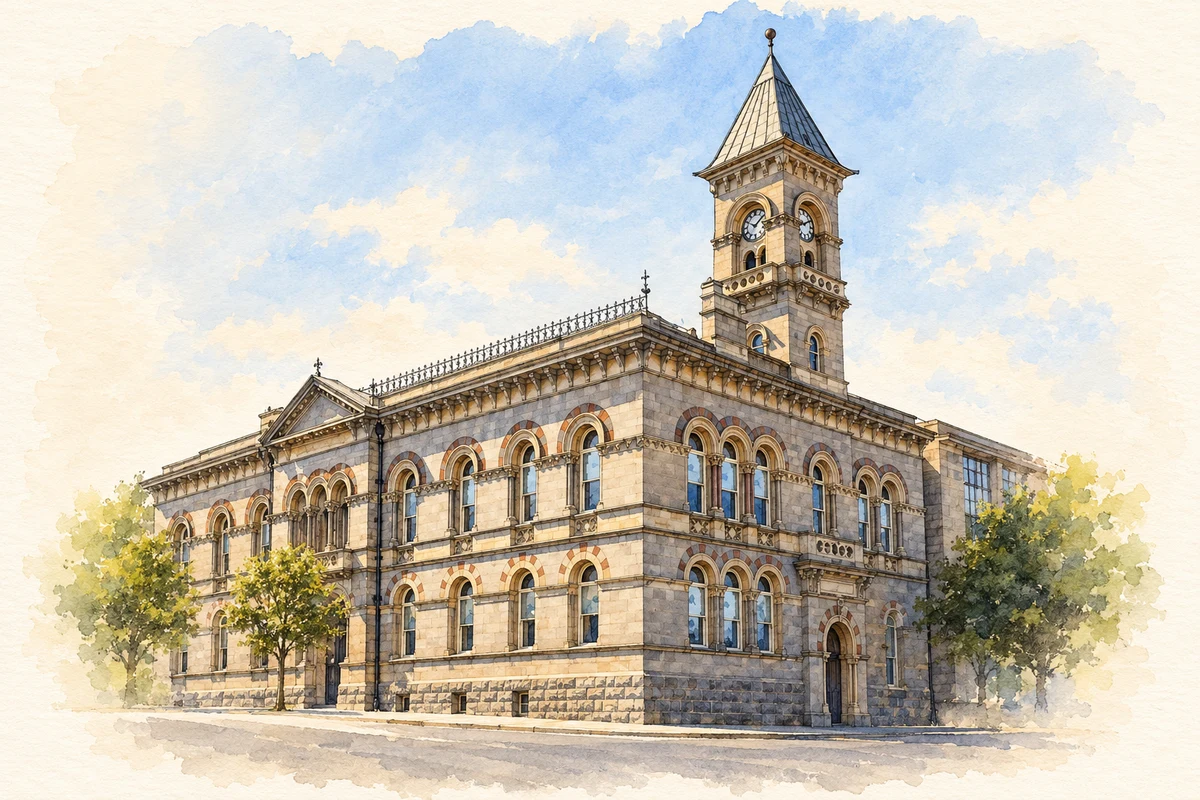
- Dún Laoghaire Town Hall, County Dublin illustration: based on a The Old Courthouse, Dún Laoghaire by David Dixon. AI-assisted watercolour and ink adaptation; cream paper margins added, incidental clutter omitted and fine details simplified. Licence: CC BY-SA 2.0.
Name record retrieved 2026-10-25 · Source record modified 2026-09-19. How this page was prepared.