The Rosscahill district contains Ross House, the family home associated with writer Violet Martin. Its estate landscape and Killannin's twentieth-century church reveal different periods of building and patronage in this part of Galway.
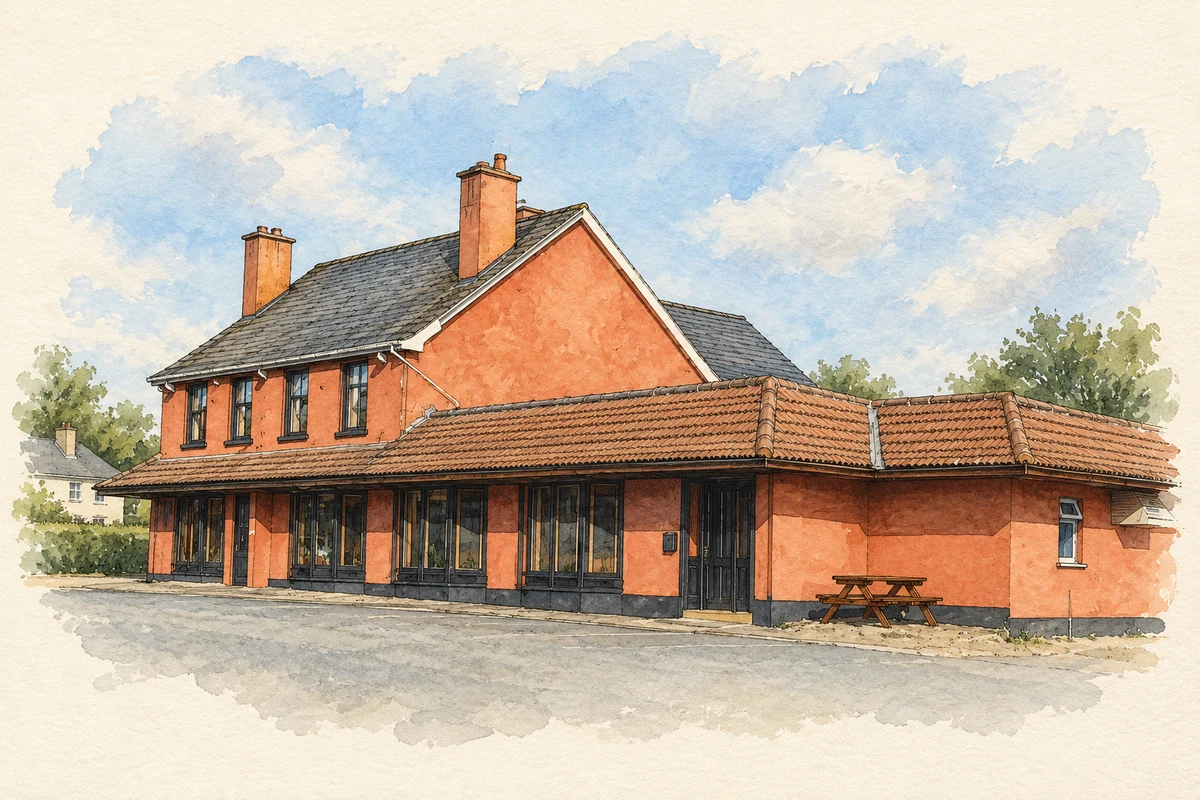
Illustration, Kinnevey’s pub, Rosscahill
⊕Recorded locationRosscahill53.38730° N · 9.24333° WInteractive map supplied by OpenStreetMap.
These Irish name elements are associated with this record in the Logainm glossary.
An element’s translation is a clue, rather than a complete explanation of the name. Its form and meaning depend on local history and the full Irish name.
Recorded forms
Ros Cathail· Irish · main form · validated name
Rosscahill· English · main form
Place & story
Ross House and its demesne
Ross House stands beside Ross Lake in a landscape long associated with the Martin family. The national garden survey records an older fortified building incorporated within the later house, together with courtyard ranges, a chapel, walled gardens, a boathouse and an icehouse. Parkland slopes from the house towards the water, with woodland extending through other parts of the former demesne. Although the estate has been divided, these features preserve the arrangement of a substantial country-house landscape in which the lake, working buildings and gardens each had a role.[2]
People & connections
Violet Martin and her writing partnership
Ross House was the home of Violet Martin, who wrote as Martin Ross in partnership with her cousin Edith Somerville. Their work ranged from the humorous Irish R.M. stories to the novel The Real Charlotte. Research presented by Dublin City Libraries also draws attention to their correspondence, including letters to their literary agent James Pinker, to Lady Gregory and to one another. The letters reveal the business and creative work behind the joint authorship. Rosscahill's connection with Violet gives the district a place in the history of a particularly durable Irish literary collaboration.[2][3]
Killannin's church of 1969
The Church of the Immaculate Heart of Mary at Killannin opened on 2 February 1969. T. J. Cullen and Company designed it for Father J. O'Reilly, and James Farragher and Company of Tuam built it at a cost of£60,000. Patrick Maloney, a former parishioner working at Cape Kennedy in the United States, donated the site. Its open interior and freestanding Connemara-marble altar reflect the changes in Catholic church design after the Second Vatican Council. An eight-metre bell tower and a covered link to the presbytery complete the composition.[4]
Both counts use the 2016 settlement boundary, allowing like-for-like comparison. CSO supplies the 2022 count on this older boundary for comparison only. The official 2022 Built Up Area has different boundaries.
View population figures
Rosscahill — Census 2016 settlement footprint — census population
These are the historical areas published in the 2006 census report. Boundaries may differ between censuses and from modern settlements. Legal towns, environs and suburbs are shown separately; none has been combined into a modern settlement total.
View population figures
Rosscahill, Galway — Census town, CSO 2006 report — census population
These figures use different area definitions. Read the boundary note before comparing them.
Rosscahill, Galway
Published census settlement populations
306people · 2016
Settlement boundaries changed during this period. Differences may reflect boundary changes as well as population change. Where a 2011 legal-town-and-environs count is shown, it has not been recalculated onto the 2016 settlement boundary.
 placenames