 placenames
Mallusk
Maigh Bhloisce
Mallusk’s old burial ground preserves memories of United Irishmen and precautions against grave robbing. The former Hyde Park textile works reveal another side of the village’s history before modern industrial expansion.
The name
These Irish name elements are associated with this record in the Logainm glossary.
An element’s translation is a clue, rather than a complete explanation of the name. Its form and meaning depend on local history and the full Irish name.
Recorded forms
- Maigh Bhloisce · Irish · main form · validated name
- Mallusk · English · main form
Place & story
The old burial ground
Mallusk Cemetery occupies the site of an earlier medieval church, although no church foundations survive. Its older north-western corner contains gravestones dating to the eighteenth century, including one for John Black, who died in 1766. Stone carving, iron railings and yew trees distinguish this older area from the more regularly laid-out later graves. The official Historic Buildings Record describes an interdenominational cemetery, preserving memorials from several centuries of the surrounding community. [2]
Watching the graves
Around 1830 a committee of farmers built a two-storey house for graveyard attendants and watchers, according to Ordnance Survey memoir material cited in the official record. The family occupied the lower floor while the upper floor allowed graves to be watched. An iron lantern holder provided another precaution. These arrangements responded to the theft of bodies for medical dissection before the Anatomy Act of 1832 altered the legal supply of bodies. [2]
United Irishmen remembered
Jemmy Hope and members of his family are buried at Mallusk, alongside members of the Bigger or Biggar families. The North of Ireland Family History Society identifies these graves as part of the cemetery’s connection with the United Irishmen and the rebellion of 1798. Its memorial-recording project covered both the older burial plot and the later planned section, preserving inscriptions that connect individual families with the political history of the area. [3]
The Hyde Park print-field
Samuel Lewis’s 1837 description of Mallusk, then written Molusk or Moblusk, recorded a large textile-finishing works called Hyde Park Print-field. Owned by the Batt firm, it employed more than two hundred people finishing muslin for British and overseas markets. The same firm helped support a school where forty-six children received free teaching. Lewis’s account places manufacturing and education together in the village’s nineteenth-century life, well before the area acquired its modern industrial estates. [4]
Geographic information
- Place type
- Population centre
- County
- Antrim
- Barony
- Belfast Lower
- Civil parish
- Templepatrick
- Within
- Grange of Mallusk
- Coordinates
- 54.67849, -5.99982 (approximate)
- Logainm ID
- 1167397 ↗
Sources & further reading
- Logainm.ie — Mallusk. Place names and geographic record, licensed under CC BY 4.0.
- Mallusk Cemetery: HB21/01/006, record 14220 · Historic Environment Division, Department for Communities
- Mallusk Memorials: the cemetery recording project · North of Ireland Family History Society
- Molusk: Samuel Lewis’s Topographical Dictionary of Ireland, 1837 · Samuel Lewis; A Vision of Britain through Time
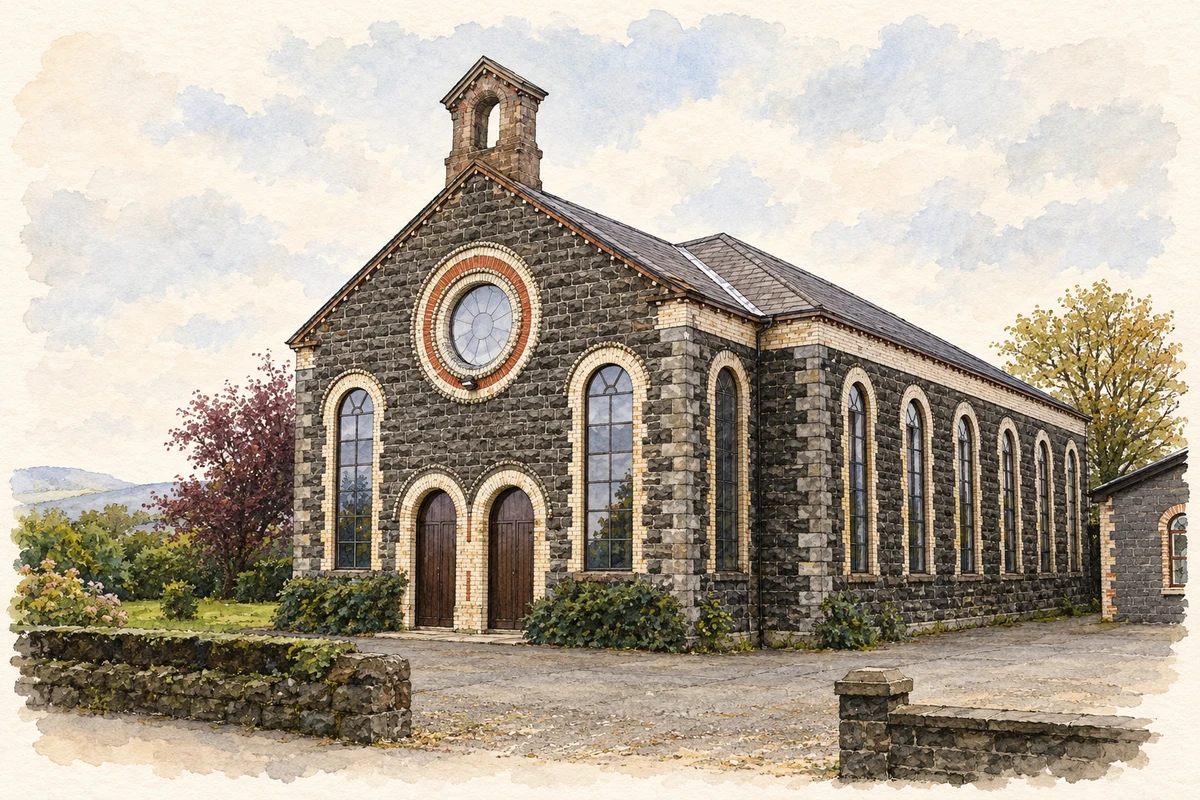
- Hyde Park Presbyterian Church, Mallusk Road, County Antrim illustration: based on a Hyde Park Presbyterian Church by Kenneth Allen. AI-assisted watercolour and ink adaptation; cream paper margins added, incidental clutter omitted and fine details simplified. Licence: CC BY-SA 2.0.
Name record retrieved 2026-10-25 · Source record modified 2021-05-26. How this page was prepared.