 placenames
Garryowen
Garraí Eoin
Garryowen’s name travelled through fiction, song and sport, while the district’s housing history records more immediate struggles over everyday living conditions.
The name
These Irish name elements are associated with this record in the Logainm glossary.
An element’s translation is a clue, rather than a complete explanation of the name. Its form and meaning depend on local history and the full Irish name.
Recorded forms
- Garraí Eoin · Irish · main form · validated name
- Garryowen · English · main form
Place & story
A garden remembered through song
John Johnson Marshall's 1924 collection of popular rhymes describes an old public garden in Garryowen frequented by Limerick's young people. He retells the reputation of its unruly visitors for damaging lamps and door knockers, linking these exploits with the well-known Garryowen air. This is a recorded popular account of the song's background, rather than proof of every incident or the identity of its composer. It preserves the district's place in the city's humorous and boisterous self-image. [2]
Gerald Griffin’s literary setting
The opening scenes of Gerald Griffin's The Collegians are set in Garryowen. Dion Boucicault subsequently drew on Griffin's novel for The Colleen Bawn. The connection gives the district a precise role in Irish literary history: a setting within the novel that supplied material for a celebrated stage work. It does not make the neighbourhood the location of every event underlying the story. [2]
The founding of Garryowen Football Club
Garryowen Football Club was formally constituted at the Athenaeum in Upper Cecil Street on 19 September 1884, after discussions involving local organisers including the Prendergast brothers and Michael Joyce. Its name came from the Garryowen district. The club played at the Markets Field before moving to Dooradoyle in 1958. That move explains why a team carrying the neighbourhood's name has its later home elsewhere in Limerick. [3]
The occupation of Garryowen Villas
On 13 March 1922, residents of overcrowded housing, led by the Limerick City Workers' Housing Association, occupied former military homes at Garryowen Villas. Forty adults and eighty-seven children moved into twenty-seven houses previously used by Royal Engineers' families. Historian John O'Callaghan places this action alongside the city's simultaneous political and military stand-off over the Treaty. The episode shows families pursuing better accommodation amid national upheaval, making housing a central part of Garryowen's history. [4]
Geographic information
- Place type
- Population centre
- County
- Limerick
- Barony
- Clanwilliam
- Barony
- Limerick City
- Civil parish
- Saint John's
- Civil parish
- Saint Lawrence's
- Coordinates
- 52.65372, -8.60592 (approximate)
- Logainm ID
- 123634 ↗
Sources & further reading
- Logainm.ie — Garryowen. Place names and geographic record, licensed under CC BY 4.0.
- Garryowen: Popular Rhymes and Sayings of Ireland (1924), chapter X · John Johnson Marshall
- Garryowen Football Club: our history · Garryowen Football Club
- Shadow boxing: the Limerick Stand-Off, March 1922 · John O’Callaghan, RTÉ History
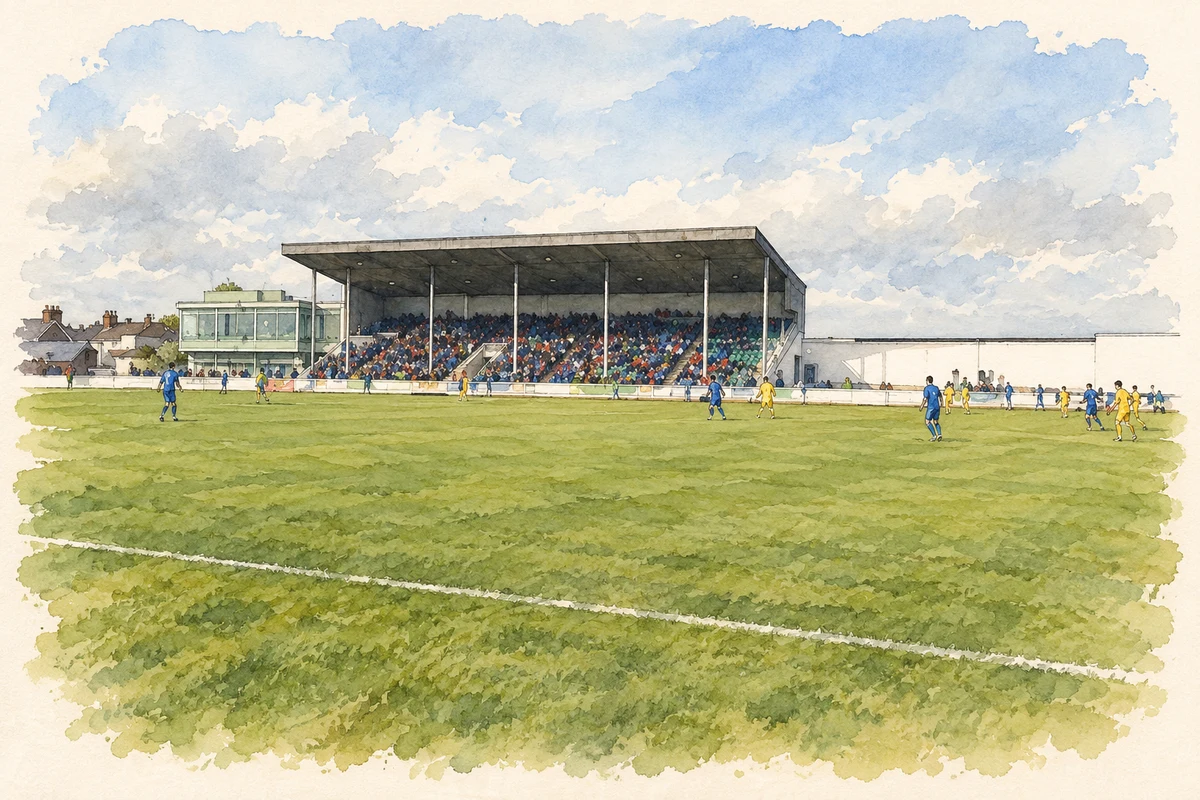
- Markets Field stadium, Garryowen, Limerick illustration: based on a Market's Field, Limerick soccer's spiritual home by vincent campbell. AI-assisted watercolour and ink adaptation; cream paper margins added, incidental clutter omitted and fine details simplified. Licence: CC BY-SA 2.0.
Name record retrieved 2026-10-25 · Source record modified 2025-01-10. How this page was prepared.