These Irish name elements are associated with this record in the Logainm glossary.
An element’s translation is a clue, rather than a complete explanation of the name. Its form and meaning depend on local history and the full Irish name.
Recorded forms
Sráid an Mhuilinn· Irish · main form · validated name
Millstreet· English · main form
Place & story
An inn, a mill and the road
Lewis's 1837 account traces Millstreet's growth from an inn, a mill and five cabins before 1736 to a town of 312 houses. Its position on routes from Cork to Killarney and Mallow to Kenmare made passing traffic important to its economy. A long main street and smaller branching streets accommodated the growing settlement south of the Blackwater, surrounded by the hills of Muskerry.[2]
Markets and flour mills
Thursday markets in winter chiefly handled pigs, while fairs brought cattle and horses as well. A brewery opened in 1835, and large flour mills encouraged farmers to grow wheat. The courthouse and adjoining lock-up supported local administration; infantry occupied substantial barracks after disturbances in 1822. Lewis also noted Drishane's parish church above the town, built in 1798 through the patronage of the Wallis family. Trade, estate ownership and government institutions all shaped the nineteenth-century town.[2]
People & connections
Niamh Kavanagh's winning night
On 15 May 1993 Millstreet hosted the Eurovision Song Contest. Its equestrian centre was converted into a television venue, with a vast illuminated set and the technical equipment needed for an international live broadcast. RTÉ's contemporary report followed the preparations by designers, directors and presenter Fionnuala Sweeney. Niamh Kavanagh won for Ireland with In Your Eyes, securing the country's fifth Eurovision victory. The event gave the small market town a place in broadcasting history and a memorable connection with audiences across Europe.[3]
Both counts use the 2016 settlement boundary, allowing like-for-like comparison. CSO supplies the 2022 count on this older boundary for comparison only. The official 2022 Built Up Area has different boundaries.
View population figures
Millstreet — Census 2016 settlement footprint — census population
These are the historical areas published in the 2006 census report. Boundaries may differ between censuses and from modern settlements. Legal towns, environs and suburbs are shown separately; none has been combined into a modern settlement total.
View population figures
Millstreet, Cork — Census town, CSO 2006 report — census population
These are the historical areas published in the 1996 census report. Boundaries may differ between censuses and from modern settlements. Legal towns, environs and suburbs are shown separately; none has been combined into a modern settlement total.
View population figures
Millstreet, Cork — Census town, CSO 1996 report — census population
Figures cover the historical town area printed in the 1986 report. Boundaries may have changed between censuses. Legal town, environs and suburb totals remain separate and differ from modern settlement boundaries.
View population figures
Millstreet, Cork — Census town, CSO 1986 report — census population
These figures use different area definitions. Read the boundary note before comparing them.
Millstreet, Cork
Published census settlement populations
1,555people · 2016
Settlement boundaries changed during this period. Differences may reflect boundary changes as well as population change. Where a 2011 legal-town-and-environs count is shown, it has not been recalculated onto the 2016 settlement boundary.
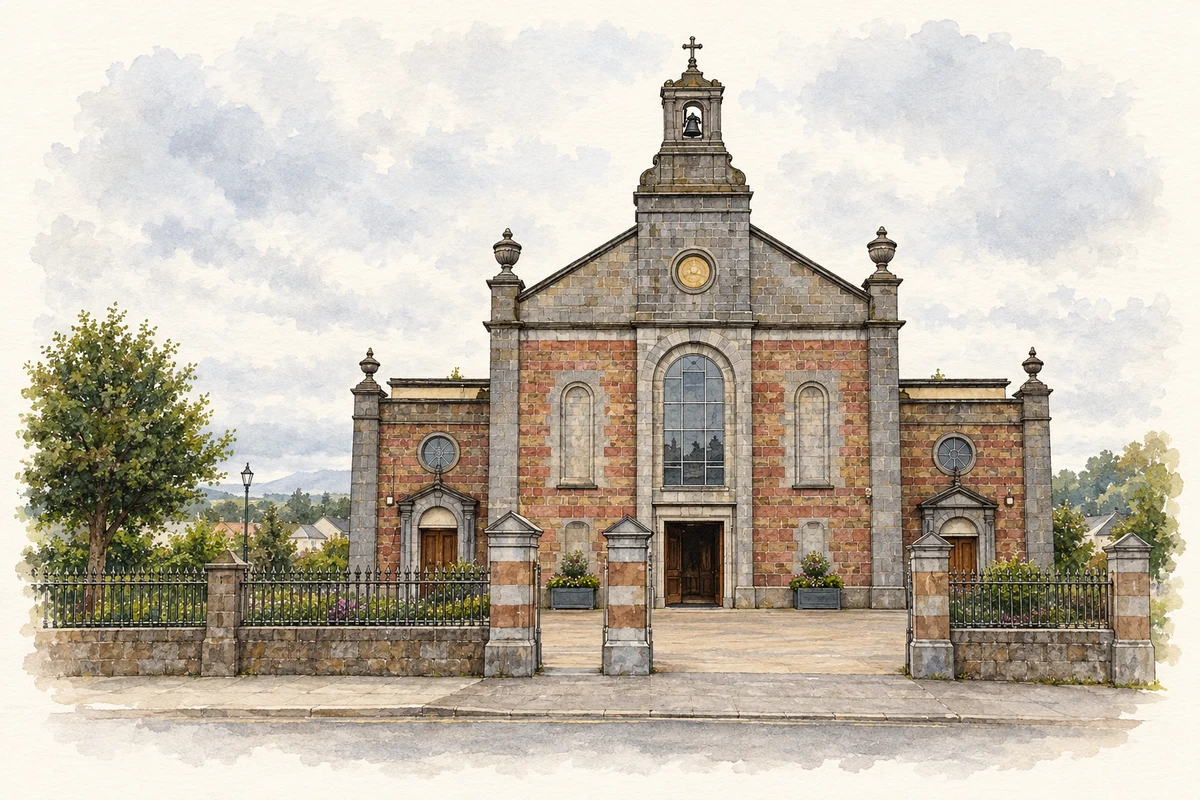
St Patrick's Church, Millstreet, County Cork illustration: based on a St. Patrick's church, Millstreet by Jonathan Thacker. AI-assisted watercolour and ink adaptation; cream paper margins added, incidental clutter omitted and fine details simplified. Licence: CC BY-SA 2.0.
 placenames