 placenames
Bayside
Cois Bá
Bayside’s housing courts, parish and community recordings tell the story of a Dublin suburb planned around shared space from the 1960s.
The name
These Irish name elements are associated with this record in the Logainm glossary.
An element’s translation is a clue, rather than a complete explanation of the name. Its form and meaning depend on local history and the full Irish name.
Recorded forms
- Cois Bá · Irish · main form · validated name
- Bayside · English · main form
Place & story
An unusual plan for suburban living
Bayside was planned in 1963, but negotiations over its unfamiliar layout delayed construction. Historian Ruth McManus identifies its design with the Radburn approach: paired houses and short terraces arranged around grassed courts, with pedestrian routes and open spaces between them. Curving roads discouraged through traffic. This deliberate separation of walking routes and vehicle movement made the suburb a distinctive experiment within the housing expansion around Dublin. [2]
Homes for different households
The Wates development included two-bedroom houses intended for couples beginning married life and older people whose children had left home. McManus also records shared greens compensating for smaller individual gardens, and underground services where possible. These were practical choices about daily life and household needs. The estate's architectural interest lies in the arrangement of ordinary homes and communal space, as much as in any single prominent building. [2]
The Church of the Resurrection
Bayside's Catholic parish was constituted from Baldoyle in November 1971. The Church of the Resurrection followed in 1972, designed by Nolan and Quinlan. Paul D. Walker's study of post-war church building identifies it as an early example of an archdiocesan brief to reduce construction costs, with accommodation for about nine hundred people. The church belongs to the same period of rapid community formation as the surrounding housing. [3] [4]
Residents recording their own beginnings
Artist Karen Lee worked with Bayside Community Centre to preserve memories of the suburb's early years. Her documentary Bayside Stories invited some of the first residents to describe their experiences on camera. A related audio tour, Homestory, was researched by Tom Donnellan and narrated by Deirdre Miller. The centre dates the suburb's beginnings to 1967. These projects make residents' recollections part of the local historical record, while remaining distinct from the planning documents and architectural studies. [5]
Geographic information
Sources & further reading
- Logainm.ie — Bayside. Place names and geographic record, licensed under CC BY 4.0.
- Suburban and urban housing in the twentieth century, pages 276 and 279 · Ruth McManus, Proceedings of the Royal Irish Academy 111C (2011)
- Bayside parish: history · Archdiocese of Dublin
- Developments in Catholic churchbuilding in the British Isles 1945–1980, volume 2 page 481 · Paul D. Walker, University of Sheffield PhD thesis (1985)
- Bayside Blog: Homestory and Bayside Stories · Bayside Community Centre
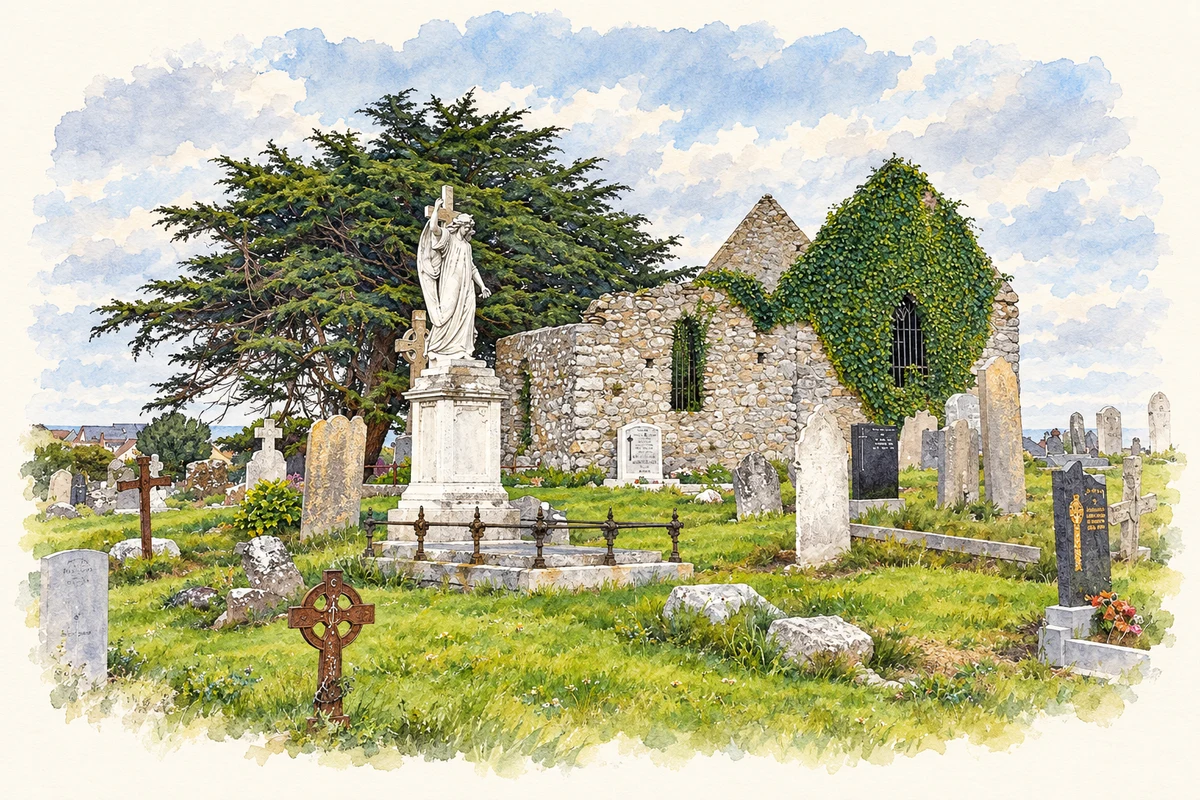
- Ruins of Kilbarrack Church, Bayside, Dublin illustration: based on a Kilbarrack Lower Church, Bayside, Dublin, Ireland by Drnxh. AI-assisted watercolour and ink adaptation; cream paper margins added, incidental clutter omitted and fine details simplified. Licence: CC BY-SA 4.0.

Name record retrieved 2026-10-25 · Source record modified 2024-06-28. How this page was prepared.