These Irish name elements are associated with this record in the Logainm glossary.
An element’s translation is a clue, rather than a complete explanation of the name. Its form and meaning depend on local history and the full Irish name.
Recorded forms
Baile Átha Cliath· Irish · main form
Dublin· English · main form
Place & story
A trading town takes shape
Dublin began as one of the fortified Viking bases established in 841 and developed into a town during the tenth century. Excavated burials at Kilmainham and Islandbridge contained swords, weights, scales and metalworking tools, alongside Scandinavian women’s brooches and equipment for spinning and sewing. The finds illuminate a population of warriors, traders, craftspeople and families. Within the town, high-quality metalworking was concentrated around Christchurch Place, and ornaments made from amber, glass, jet and precious metals reflect its trading connections. Post-and-wattle houses, wooden vessels and blacksmiths’ tools also preserve traces of daily work.[2]
The public life of St Audoen’s
St Audoen’s is Dublin’s surviving medieval parish church. Dedicated to the seventh-century bishop of Rouen, it stood within the walled city and served public as well as devotional purposes: papal bulls were announced here and public penances performed. The Guild Chapel of St Anne recalls the importance of organised trades and religious associations in urban life. A fifteenth-century monument commemorates Roland Fitz-Eustace, Lord Portlester, and his wife Margaret. The building places named people and communal ceremonies within the medieval street pattern around High Street and Corn Market.[3]
People & connections
Jonathan Swift at St Patrick’s
Jonathan Swift was born in Dublin in 1667, entered Trinity College in 1682 and became Dean of St Patrick’s Cathedral in 1713. Gulliver’s Travels appeared in 1726 during his long tenure as dean. He was buried in the cathedral after his death in 1745, close to Esther Johnson, known as Stella. His bequest helped establish St Patrick’s Hospital for people with mental illness. Trinity’s collections preserve his death mask and a marble bust commissioned by students, while his burial and epitaph remain part of the cathedral’s history.[4]
Dublin city and suburbs — Census 2016 settlement footprint
Population within 2016 settlement boundaries
1,261,562people · 2022
Both counts use the 2016 settlement boundary, allowing like-for-like comparison. CSO supplies the 2022 count on this older boundary for comparison only. The official 2022 Built Up Area has different boundaries.
View population figures
Dublin city and suburbs — Census 2016 settlement footprint — census population
Dublin City, Dublin — City administrative area, CSO 2006 report
2002–2006: city administrative area
506,211people · 2006
These are the historical areas published in the 2006 census report. Boundaries may differ between censuses and from modern settlements. Legal towns, environs and suburbs are shown separately; none has been combined into a modern settlement total.
View population figures
Dublin City, Dublin — City administrative area, CSO 2006 report — census population
These are the historical areas published in the 2006 census report. Boundaries may differ between censuses and from modern settlements. Legal towns, environs and suburbs are shown separately; none has been combined into a modern settlement total.
View population figures
Dublin Greater Suburbs, Dublin — Dublin greater suburbs only, CSO 2006 report — census population
Dublin City, Dublin — City administrative area, CSO 1996 report
1991–1996: city administrative area
481,854people · 1996
These are the historical areas published in the 1996 census report. Boundaries may differ between censuses and from modern settlements. Legal towns, environs and suburbs are shown separately; none has been combined into a modern settlement total.
View population figures
Dublin City, Dublin — City administrative area, CSO 1996 report — census population
These are the historical areas published in the 1996 census report. Boundaries may differ between censuses and from modern settlements. Legal towns, environs and suburbs are shown separately; none has been combined into a modern settlement total.
View population figures
Dublin Greater Suburbs, Dublin — Dublin greater suburbs only, CSO 1996 report — census population
Dublin, Dublin — City administrative area, CSO 1986 report
1981–1986: city administrative area
502,749people · 1986
Figures cover the historical town area printed in the 1986 report. Boundaries may have changed between censuses. Legal town, environs and suburb totals remain separate and differ from modern settlement boundaries.
View population figures
Dublin, Dublin — City administrative area, CSO 1986 report — census population
Figures cover the historical town area printed in the 1986 report. Boundaries may have changed between censuses. Legal town, environs and suburb totals remain separate and differ from modern settlement boundaries.
View population figures
Dublin, Dublin — Dublin greater suburbs only, CSO 1986 report — census population
These figures use different area definitions. Read the boundary note before comparing them.
Dublin city and suburbs, Dublin
Published census settlement populations
1,173,179people · 2016
Settlement boundaries changed during this period. Differences may reflect boundary changes as well as population change. Where a 2011 legal-town-and-environs count is shown, it has not been recalculated onto the 2016 settlement boundary.
View population figures
Dublin city and suburbs, Dublin — census population
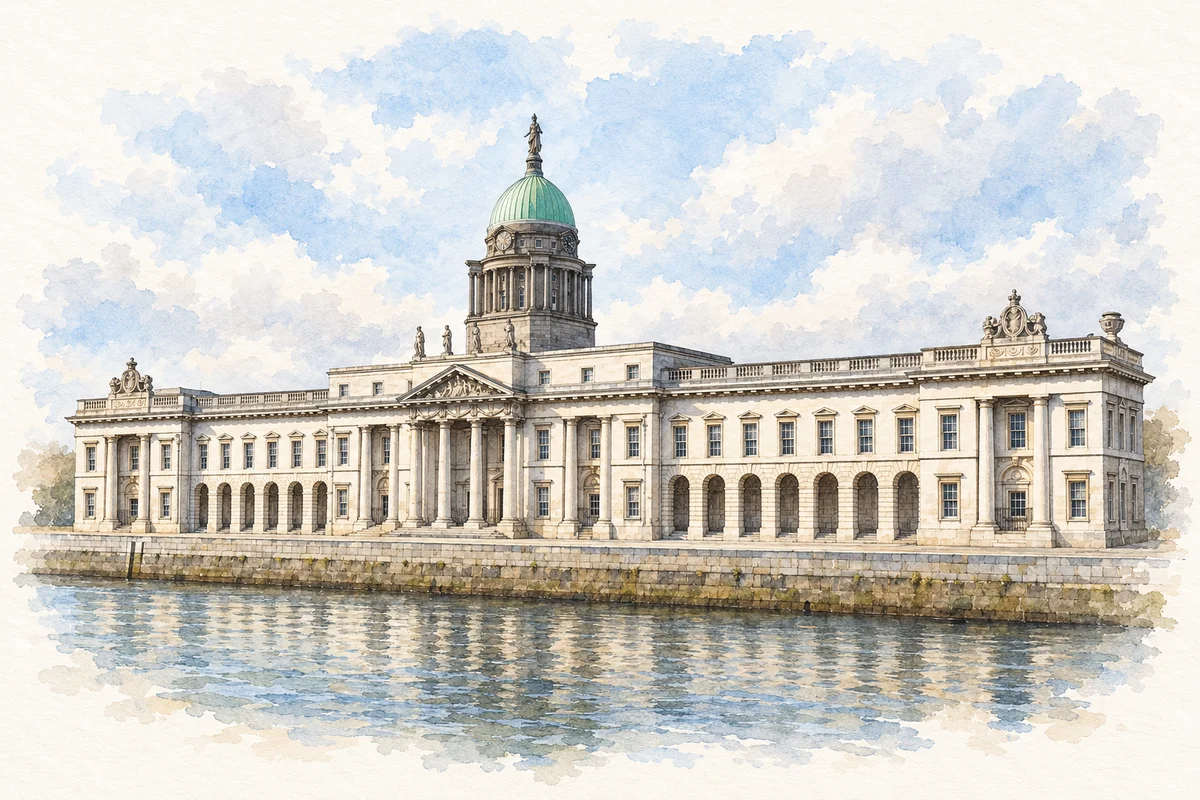
The Custom House, Dublin illustration: based on a reference photograph by Creevylea. AI-assisted watercolour and ink adaptation; clutter removed, cream paper margins added and fine details simplified. Licence: CC BY-SA 4.0.
 placenames