Waterford’s port brought people, goods and ideas into the city. Its monuments connect medieval power with Thomas Francis Meagher and the traditions of everyday food.
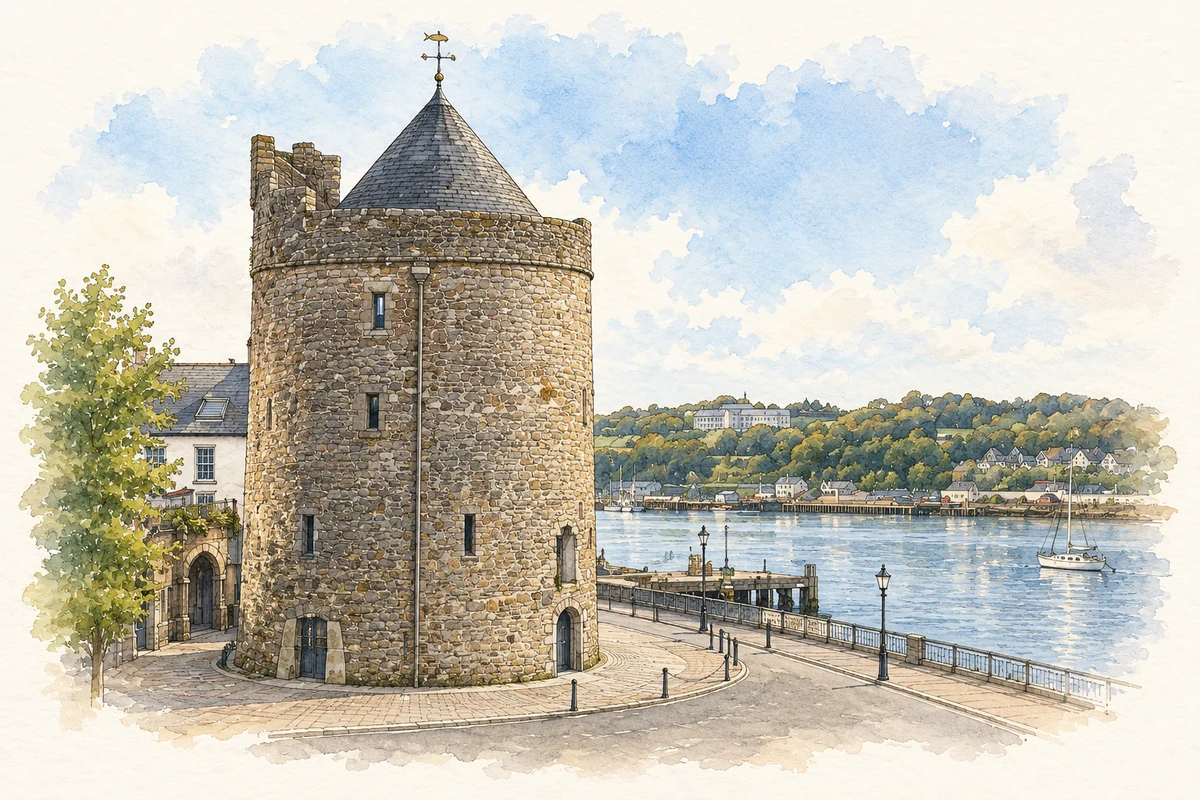
Illustration, Reginald’s Tower
⊕Recorded locationWaterford52.24908° N · 7.10847° WInteractive map supplied by OpenStreetMap.
These Irish name elements are associated with this record in the Logainm glossary.
An element’s translation is a clue, rather than a complete explanation of the name. Its form and meaning depend on local history and the full Irish name.
Recorded forms
Port Láirge· Irish · main form · validated name
Waterford· English · main form
Place & story
The Suir and the city
Lewis’s nineteenth-century account places Waterford at the meeting of St John’s River and the Suir and distinguishes the city from its wider jurisdiction. That setting helps explain its long importance as a port. The riverfront was a place of arrival and exchange, while the defended urban centre held civic and religious institutions. Waterford’s historical reach therefore extended beyond its walls without making every event in the surrounding county an event inside the city.[2]
Strongbow and Aoife
Waterford Treasures identifies the marriage of Richard de Clare, known as Strongbow, and Aoife in Waterford in August 1170 as a pivotal moment in the Anglo-Norman conquest. The marriage has subsequently been depicted in art and commemorated through performance. The historical connection belongs to medieval Waterford; the buildings visible around Cathedral Square today include much later work.[3]
People & connections
Thomas Francis Meagher and the tricolour
Thomas Francis Meagher was born in Waterford in 1823. His political career took him through the Young Ireland movement, transportation to Van Diemen’s Land and a later life in America. Waterford County Museum connects him with the appearance of the tricolour at the Wolfe Tone meeting house on the Mall in March 1848. The city remembers a native whose life reached far beyond Ireland, while the Mall supplies a precise local setting for the flag association.[4]
Folklore & tradition
The blaa and the French Church
The blaa is part of Waterford’s food identity. Waterford Treasures connects the bread’s history with the French Protestant refugees who settled in the city and worshipped in part of the old Franciscan friary, known as the French Church. The tradition adds kitchens, bakeries and migration to a city story often told mainly through towers and political events.[5]
Waterford city and suburbs — Census 2016 settlement footprint
Population within 2016 settlement boundaries
60,200people · 2022
Both counts use the 2016 settlement boundary, allowing like-for-like comparison. CSO supplies the 2022 count on this older boundary for comparison only. The official 2022 Built Up Area has different boundaries.
View population figures
Waterford city and suburbs — Census 2016 settlement footprint — census population
These figures use different area definitions. Read the boundary note before comparing them.
Waterford city and suburbs, Waterford
Published census settlement populations
53,504people · 2016
Settlement boundaries changed during this period. Differences may reflect boundary changes as well as population change. Where a 2011 legal-town-and-environs count is shown, it has not been recalculated onto the 2016 settlement boundary.
View population figures
Waterford city and suburbs, Waterford — census population
Reginald’s Tower illustration: based on a reference by Cailínréalta. AI-assisted watercolour and ink adaptation; warm cream paper margins; incidental modern clutter removed and fine details simplified. Licence: CC BY-SA 4.0.
 placenames