A reliable full-name meaning has not been established here. The recorded Irish and English forms are given without an unsupported translation.
Recorded forms
Sligeach· Irish · main form · validated name
Sligo· English · main form
Place & story
Between Lough Gill and the bay
Lewis places Sligo near the seaward end of the Garavogue, connecting Lough Gill with the bay and Atlantic. The river brought the market town into a wider trading network. Port and county institutions gathered around the crossing and waterfront, while the inland lake supplied another route into the surrounding district.[2]
The friary called Sligo Abbey
The familiar Abbey name belongs to a former Dominican friary established around 1252. NIAH records a church, rood screen, tower, cloister remains and monuments from several periods. The site contains elaborate tomb sculpture and a fifteenth-century high altar. Its surviving spaces preserve both the communal life of the friars and the memorials of later patrons.[3][5]
People & connections
Charlotte Stoker remembers cholera
Charlotte Thornley Stoker experienced Sligo’s cholera epidemic of 1832 and wrote her recollections in 1873. Her account became the centre of a historical trail launched in 2019, with site-specific signs at places including St John’s Cathedral, the Abbey visitor centre, the library and the hospital. Charlotte was Bram Stoker’s mother, but her testimony has value in its own right: it preserves a woman’s later memory of fear, illness and disruption in the town where she grew up.[4]
Folklore & tradition
The bell beneath Lough Gill
The OPW records a legend that worshippers saved the friary’s silver bell during the seventeenth-century violence by throwing it into Lough Gill. In the story, its sound can still be heard by someone entirely free from sin. The tale joins the town’s medieval church to the lake beyond it, carrying a memory of threatened sacred objects through a supernatural image of sound beneath water.[5]
Both counts use the 2016 settlement boundary, allowing like-for-like comparison. CSO supplies the 2022 count on this older boundary for comparison only. The official 2022 Built Up Area has different boundaries.
View population figures
Sligo — Census 2016 settlement footprint — census population
These figures use different area definitions. Read the boundary note before comparing them.
Sligo, Sligo — 2011 legal town and environs; 2016 census settlement
Published census settlement populations
19,199people · 2016
Settlement boundaries changed during this period. Differences may reflect boundary changes as well as population change. Where a 2011 legal-town-and-environs count is shown, it has not been recalculated onto the 2016 settlement boundary.
View population figures
Sligo, Sligo — 2011 legal town and environs; 2016 census settlement — census population
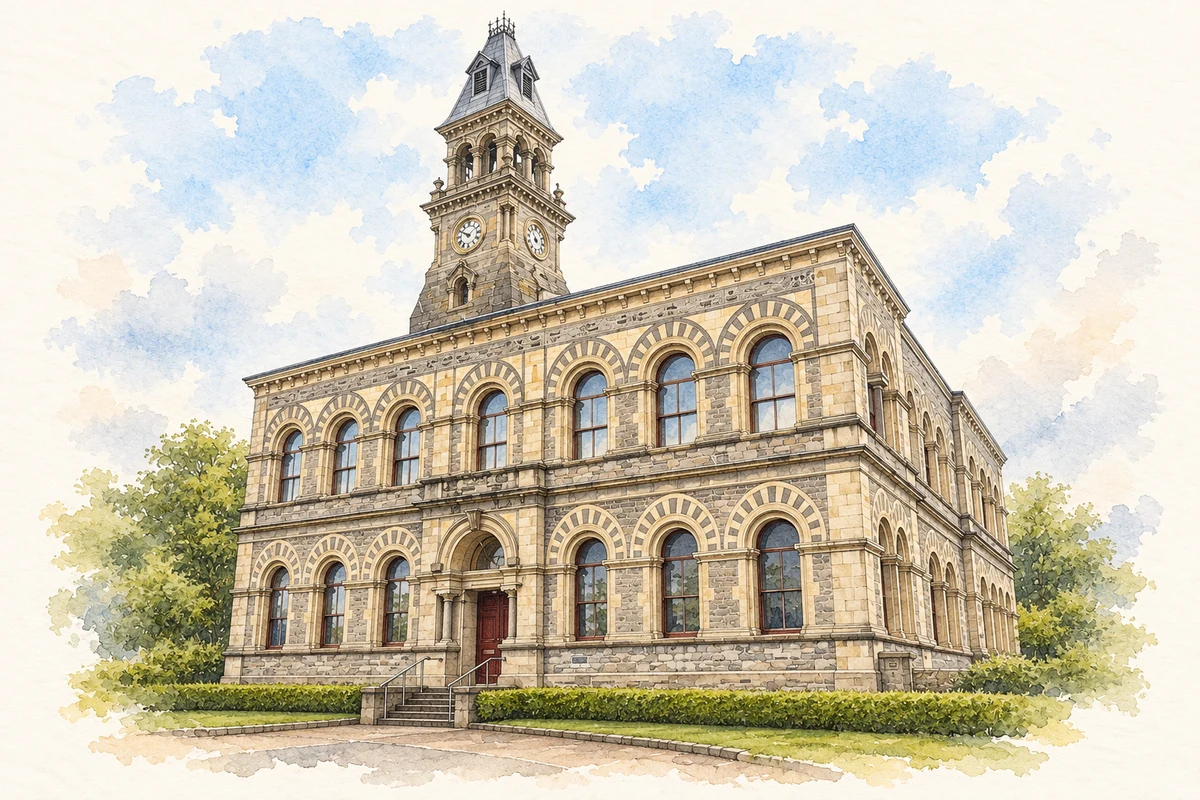
Sligo Town Hall illustration: based on a reference by Gareth James. AI-assisted watercolour and ink adaptation; warm cream paper margins; incidental modern clutter removed and fine details simplified. Licence: CC BY-SA 2.0.
 placenames