These Irish name elements are associated with this record in the Logainm glossary.
An element’s translation is a clue, rather than a complete explanation of the name. Its form and meaning depend on local history and the full Irish name.
Recorded forms
Cill Chainnigh· Irish · main form
Kilkenny· English · main form
Place & story
A city on the Nore
Lewis’s 1837 entry places Kilkenny on the Nore and the mail-coach road towards Cork. It describes the city, including Irishtown, as a county of itself, while also identifying it as the chief town of the surrounding county. These are different geographical and legal scales. The city’s river setting helps locate it; its unusual civic description helps explain why historical population and property records may use boundaries unlike a modern county map.[2]
Church and stronghold
The dictionary associates the name with Canice and the transfer of the see of Ossory, while also mentioning another proposed explanation. It then describes a fortress occupied by Strongbow’s followers and destruction during conflict in 1173. Religious authority and a defended settlement thus form separate strands in the account. This profile does not adopt Lewis’s alternative linguistic conjectures or every early date as settled; a name’s historical explanation requires evidence beyond resemblance between words.[2]
People & connections
Alice Kyteler and Petronilla de Meath
The 1324 prosecution of Alice Kyteler and her associates is a documented episode of religious persecution. Kyteler was a wealthy Kilkenny woman whose marriages and business interests placed her within the town’s commercial elite. The trial involved a struggle between ecclesiastical and secular authority, including the imprisonment of Bishop Richard de Ledrede. Accusations of supernatural wrongdoing belong to the prosecution’s beliefs and allegations; they do not establish that magic occurred.[3]
Kyteler escaped, but Petronilla de Meath was tortured and burned on 3 November 1324. Kilkenny’s heritage programme marked the seven-hundredth anniversary in 2024. The building known as Kyteler’s Inn is traditionally associated with Alice, yet the National Monuments Service survey dates much of its upper fabric to the late sixteenth or seventeenth century.[3][4]
Both counts use the 2016 settlement boundary, allowing like-for-like comparison. CSO supplies the 2022 count on this older boundary for comparison only. The official 2022 Built Up Area has different boundaries.
View population figures
Kilkenny — Census 2016 settlement footprint — census population
These figures use different area definitions. Read the boundary note before comparing them.
Kilkenny, Kilkenny — 2011 legal town and environs; 2016 census settlement
Published census settlement populations
26,512people · 2016
Settlement boundaries changed during this period. Differences may reflect boundary changes as well as population change. Where a 2011 legal-town-and-environs count is shown, it has not been recalculated onto the 2016 settlement boundary.
View population figures
Kilkenny, Kilkenny — 2011 legal town and environs; 2016 census settlement — census population
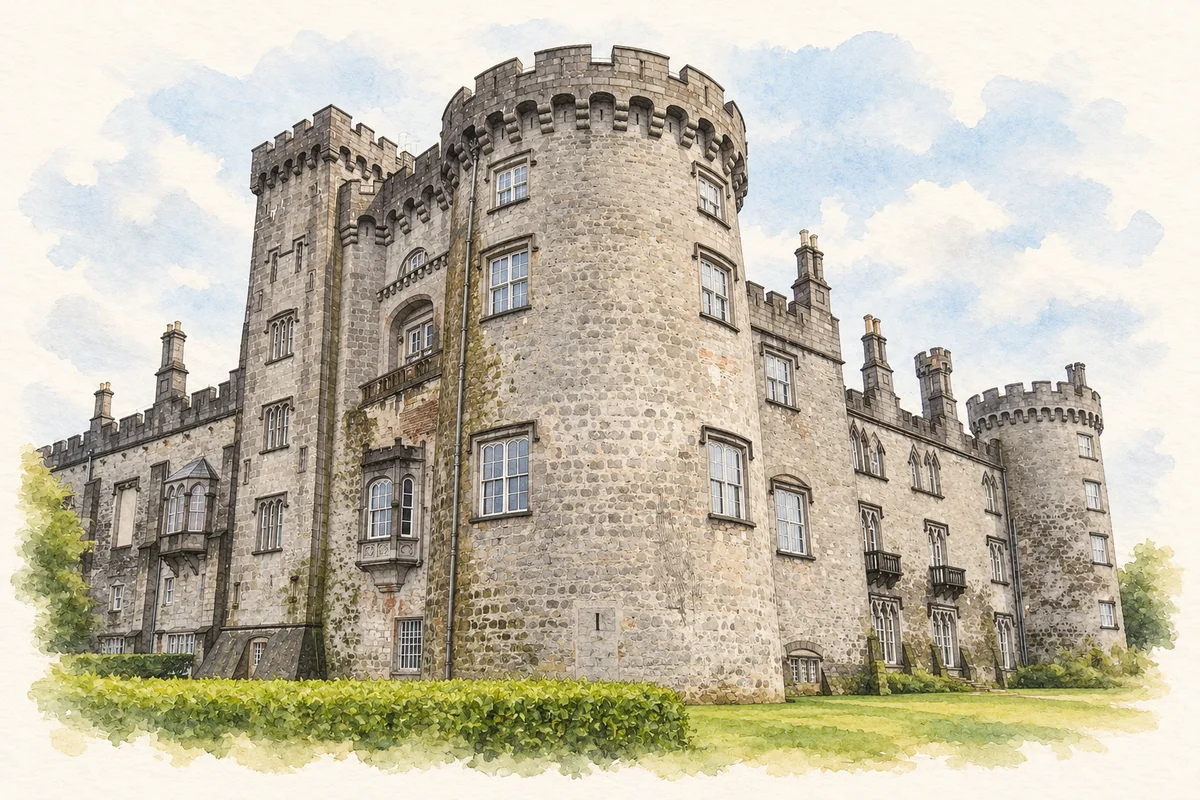
Kilkenny Castle illustration: based on a reference by Jorge1767. AI-assisted watercolour and ink adaptation; paper margins added, lamps and flagpole removed, fine details simplified. Licence: Public domain (PD-self).
 placenames