 placenames
Dripsey Model Village
Modh-Shráidbhaile na Druipsí
The Model Village’s distinctive history lies in the close connection between workers’ homes, textile production and the fortunes of Dripsey Woollen Mills.
The name
These Irish name elements are associated with this record in the Logainm glossary.
An element’s translation is a clue, rather than a complete explanation of the name. Its form and meaning depend on local history and the full Irish name.
Recorded forms
- Modh-Shráidbhaile na Druipsí · Irish · main form · non-validated name
- Dripsey Model Village · English · main form
Place & story
A workforce living near the mill
Karen O’Rourke’s 1986 study of wool describes Dripsey as a self-contained Model Village beside the woollen mills. The account recorded forty-three employees, thirty-three men and ten women, most living in the village. This close relationship between residence and employment gives the settlement its particular industrial character: the mill supported a community whose everyday geography centred on the workplace. These figures describe the period of the study, providing a snapshot of the workforce shortly before the business closed. [2]
From raw fibre to finished cloth
The mill operated as a vertical producer, carrying out successive stages from fibre to fabric. O’Rourke recorded a varied range including furnishing and clothing tweeds, blankets, travelling rugs and knitting wool, with exports reaching European and overseas markets. Keeping these processes together allowed changes in colour and design within one business. The variety of products also helps explain how a relatively small workforce could serve customers well beyond the surrounding Cork countryside. [2]
The pressures behind the 1988 closure
Aideen Russell’s 1996 study of Cork’s woven-textile industry examined Dripsey’s difficulties through interviews and contemporary reporting. It records the mill’s closure in 1988 after losses and an unsuccessful application for financial support. Reduced government and health-board purchases affected a business that had supplied institutional furnishings, while inflation had weakened competitiveness. Russell also noted the constraints of the older machinery and the wide product range. The end of production thus followed commercial and financial pressures, bringing a major change to the village’s employment base. [3]
Geographic information
Sources & further reading
- Logainm.ie — Dripsey Model Village. Place names and geographic record, licensed under CC BY 4.0.
- Wool: Dripsey Woollen Mills, page 46 · Karen O’Rourke, National College of Art and Design, 1986
- An examination of the nature and scope of the woven textile industry in Cork, 1996: Dripsey · Aideen Russell, National College of Art and Design, 1996
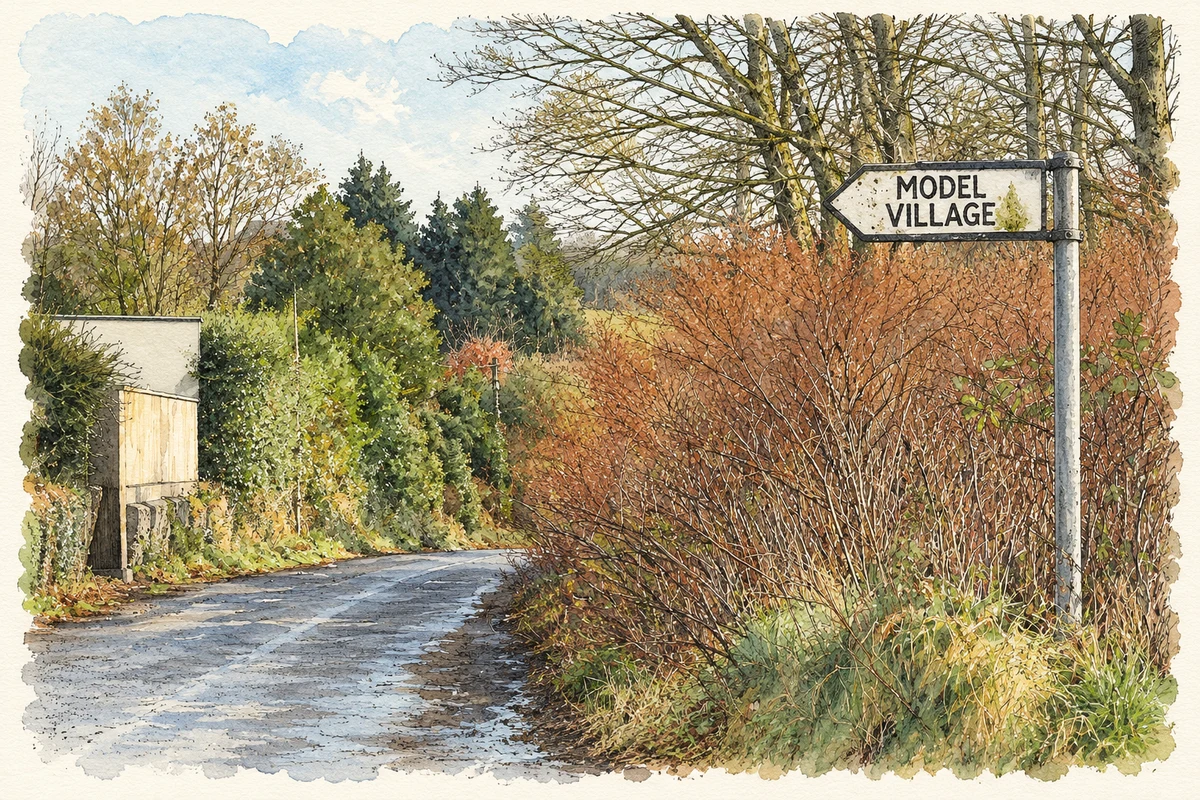
- Lane and direction sign, Dripsey Model Village illustration: based on a ModelVillageDripsey by Sarah777. AI-assisted watercolour and ink adaptation; cream paper margins added, incidental clutter omitted and fine details simplified. Licence: Public domain.

Name record retrieved 2026-10-25 · Source record modified 2016-08-18. How this page was prepared.