These Irish name elements are associated with this record in the Logainm glossary.
An element’s translation is a clue, rather than a complete explanation of the name. Its form and meaning depend on local history and the full Irish name.
Recorded forms
Ard Mhacha· Irish · main form · validated name
Armagh· English · main form
Place & story
A city defined by learning
Lewis's nineteenth-century account presents it as an ecclesiastical centre associated with Patrick, schools and repeated rebuilding after fires and attacks. The cathedral's foundation belongs to the Patrician tradition, while the later institutions demonstrate the city's enduring role in education. The city's relationship with the nearby royal site of Emain Macha adds a second, pre-Christian focus to its historical landscape.[2]
Folklore & tradition
Macha and the king's horses
In Thomas Rolleston's 1911 retelling of the Ulster Cycle, a farmer boasts that his wife Macha can outrun the king's horses. Although pregnant, she is forced to race to save him. She wins, gives birth to twins and pronounces a curse: at moments of greatest danger, Ulster's fighting men will be overcome by the pains of childbirth. The tale is associated with Emain Macha, now Navan Fort outside Armagh.[3]
People & connections
Richard Robinson's observatory
Archbishop Richard Robinson founded and endowed Armagh Observatory in 1790. Its surviving archive includes deeds, accounts, instrument drawings and records of observations. The institution's early directors included James Archibald Hamilton, followed in the nineteenth century by Thomas Romney Robinson and John Louis Emil Dreyer. These were people whose working lives were anchored in Armagh: their connection is an institutional and scientific one, distinct from the legendary figures whose names belong to the surrounding landscape.[4]
People & connections
Measuring stars and wind
Thomas Romney Robinson's work at the observatory combined astronomy with an interest in meteorology. The institution's own history describes his development of the cup anemometer for measuring wind speed. It also records the laborious stellar measurements that culminated in his 1859 Armagh catalogue. Telescopes and instruments were important, but so were the repeated observations and calculations carried out by Robinson and his assistants. This scientific history gives Armagh another distinctive inheritance alongside its cathedrals and the stories attached to Macha's name.[5][6]
Both censuses use the same 2015 settlement boundary. These exact counts cover usual residents in the settlement, rather than local government districts or historic counties. Other NISRA tables may use approximate counts.
View population figures
ARMAGH — Settlement 2015 (N11000051) — census population
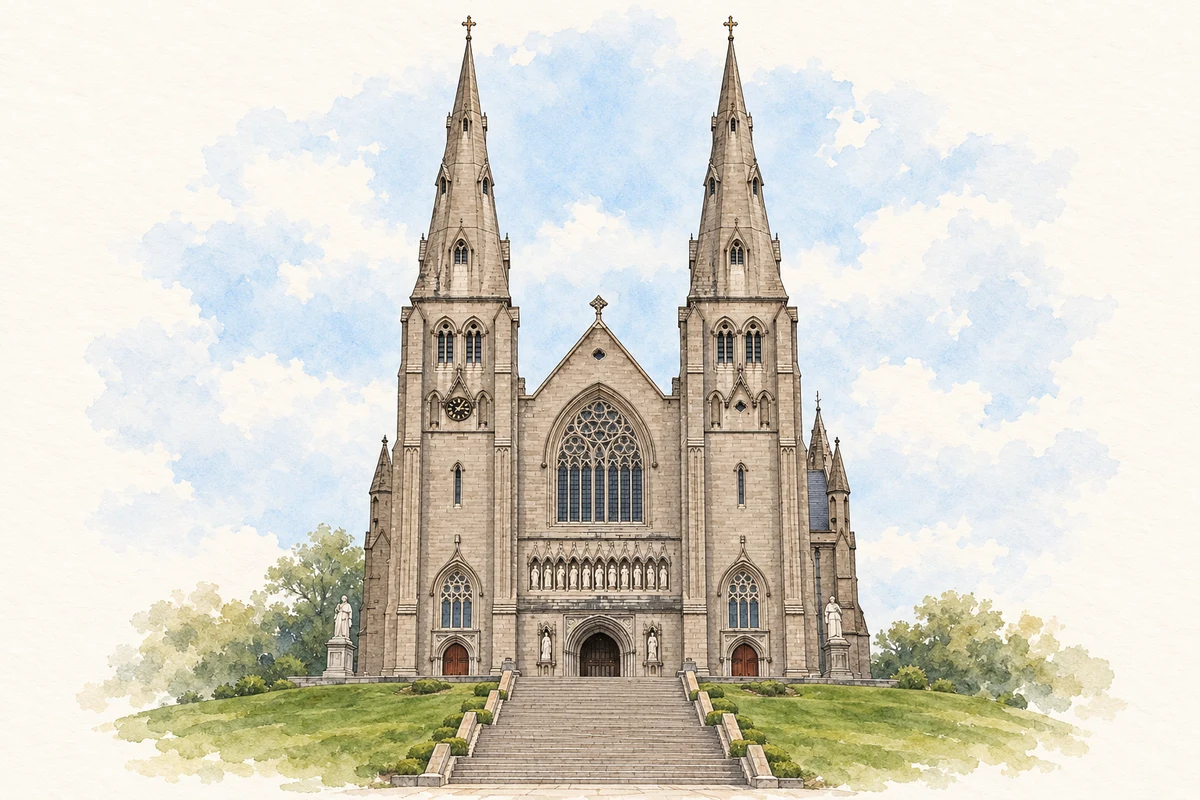
St Patrick’s Roman Catholic Cathedral illustration: based on a reference by JohnArmagh. AI-assisted watercolour and ink adaptation; warm cream paper margins; incidental modern clutter removed and fine details simplified. Licence: CC BY-SA 3.0.
 placenames