These Irish name elements are associated with this record in the Logainm glossary.
An element’s translation is a clue, rather than a complete explanation of the name. Its form and meaning depend on local history and the full Irish name.
Recorded forms
Baile Monaidh· Irish · main form · validated name
Ballymoney· English · main form
Place & story
A civic building paid for locally
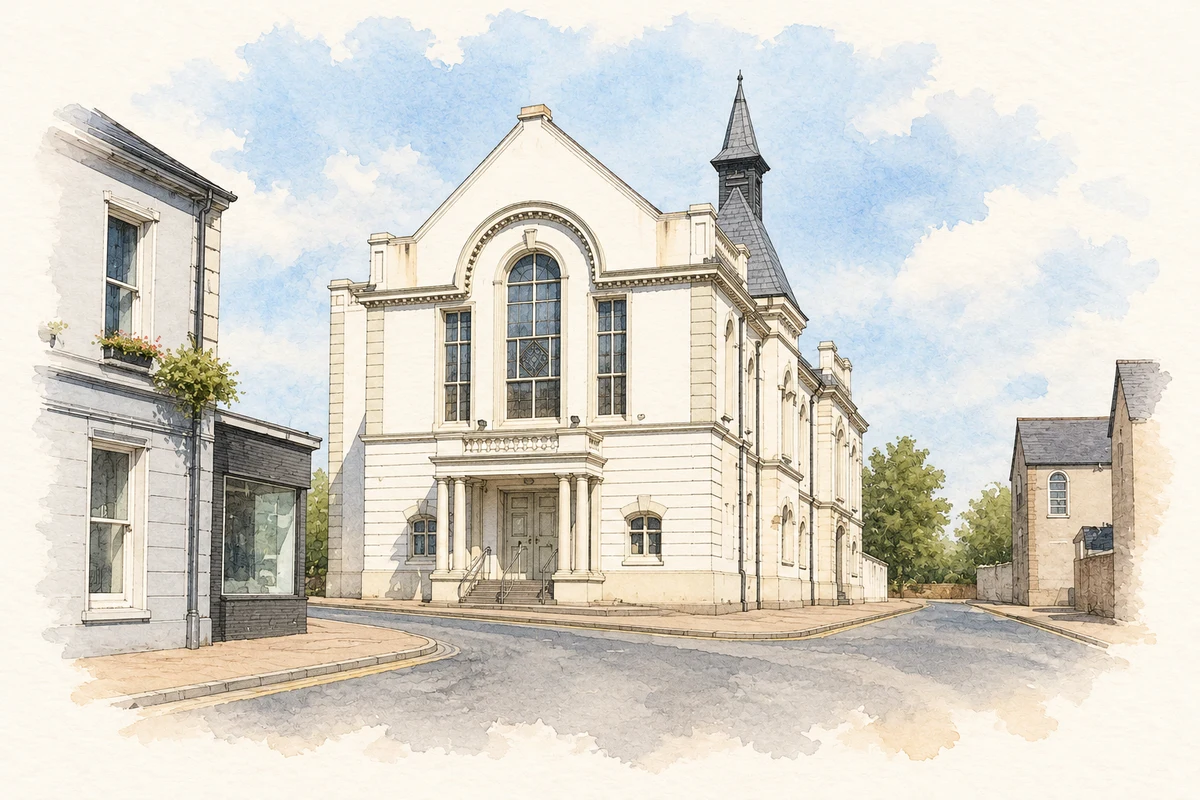
Ballymoney’s Town Hall began as a project for new Assembly Rooms in 1863. The plans combined a reading room or library, chambers for the Town Commissioners, a public function room and space for the museum. Public subscriptions raised £1,300, with a bazaar contributing further funds. The building opened in August 1866. Its original programme joined learning, local government and public entertainment within one civic address.[2]
Reopening and performance
By the early twentieth century the Assembly Rooms were known as the Town Hall. Repairs became urgent in 1932, leading to a substantial renovation and a reopening on 16 February 1934. A new stage strengthened its role as a performance venue. Ballymoney Drama Festival began within a fortnight of that reopening.[2]
People & connections
George Shiels and the local stage
George Shiels was born at Ballybrakes, Ballymoney, in 1881. After years in America he returned in 1908 and opened a travel and shipping business. Writing for local newspapers led towards plays for the Ulster Literary Theatre, often set in County Antrim. His later success included The Rugged Path at Dublin’s Abbey Theatre in 1940. The council’s account also preserves an unexpected local dispute: after an amateur company added offensive language to a script, Shiels prohibited performances of his work in Ballymoney for a period.[4]
People & connections
Joey Dunlop’s precise birthplace
Motorcycle racer William Joseph ‘Joey’ Dunlop was born at Culduff near Ballymoney on 25 February 1952. He began racing in 1969 and became part of the group known as the Armoy Armada. By his death in Estonia in 2000, his record included 26 Isle of Man TT victories and 13 wins at the North West 200. The council distinguishes the MBE awarded for his racing from the OBE awarded in 1996 for humanitarian work. His story connects the town with sporting achievement and practical charity, while Culduff remains the precise birthplace.[5]
Both censuses use the same 2015 settlement boundary. These exact counts cover usual residents in the settlement, rather than local government districts or historic counties. Other NISRA tables may use approximate counts.
View population figures
BALLYMONEY — Settlement 2015 (N11000109) — census population
The report states that these figures use the district as constituted in 1926. This is a historical urban administrative area, separate from the modern settlement boundary and usual-resident population.
View population figures
Ballymoney Urban District — 1926 boundary — census population
The census used a grid rectangle around the built-up area, rather than today’s settlement boundary. The 1981 figures are as enumerated, without adjustment for non-enumeration. These counts remain separate from later settlement totals.
View population figures
Ballymoney — census rectangle C930240 to C970270 — census population
The published 2001 KS01 settlement count uses an earlier geography and disclosure-control methods. It is not rebased to the 2015 settlement used for 2011 and 2021. The geographic matching file can contain a different 2001 count; the figure shown here comes from KS01.
View population figures
Ballymoney — KS01 Settlement (2005 geography) — census population
Ballymoney Town Hall illustration: based on a reference photograph by Willie Duffin. AI-assisted watercolour and ink adaptation; warm cream paper margins; incidental modern clutter removed and fine details simplified. Licence: CC BY-SA 2.0.
 placenames