 placenames
Lambeg
Lann Bheag
Lambeg's past is closely tied to the Lagan valley's linen industry. Its church preserves an eighteenth-century tower, while a research association and a distinctive musical instrument carried the village's name much further afield.
The name
These Irish name elements are associated with this record in the Logainm glossary.
An element’s translation is a clue, rather than a complete explanation of the name. Its form and meaning depend on local history and the full Irish name.
Recorded forms
- Lann Bheag · Irish · main form · validated name
- Lambeg · English · main form
Place & story
The 1737 tower and the Victorian church
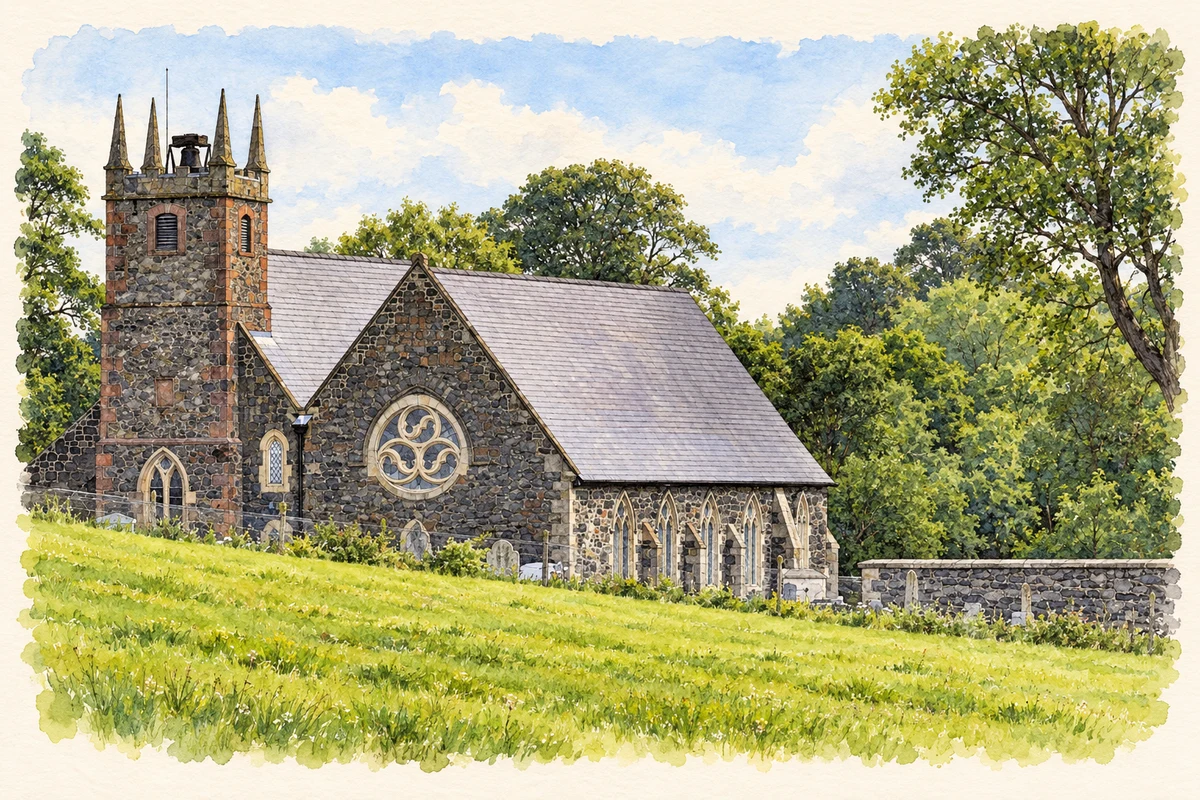
Lambeg Parish Church incorporates the tower of a church built in 1737. Most of the present building dates from 1849, with further additions in 1869. The architectural survey associates its design with William Butterfield and Welland and Gillespie. Rubblestone walls and adjoining gables give the later church a different profile from the simple earlier building shown on the first Ordnance Survey map. The tower's survival makes the sequence visible. Above Lambeg Bridge, the churchyard and its surrounding grounds retain a landmark within a district profoundly altered by industry and housing. [2]
A linen worker's career
George Orr's Living Linen interview records a working life beginning at Hilden Mills in 1941, when he was fourteen. His father Charlie managed the Lambeg Weaving Company. At Barbour's, George progressed from the spinning department to senior management and became production director in 1977. He remembered wartime manufacture of netting and threads for footwear and uniforms, followed by the growing importance of synthetic fibres. Recorded by National Museums NI in 2000, his testimony connects Lambeg's own weaving business with the larger nearby Hilden thread works and changes across the textile industry. [3]
Research at Glenmore
The Linen Industry Research Association was established at Glenmore near Lambeg in 1919. Its purpose was to improve the flax and linen industries after the First World War, giving scientific research a local institutional home beside manufacturing. A wider remit brought the name Lambeg Industrial Research Association in 1970. After it closed in 1993, its library moved to the Irish Linen Centre and Lisburn Museum. More than six thousand books, journals and reports preserved there record the technical knowledge assembled during decades of research. [4]
The instrument carrying Lambeg's name
The Lambeg drum remains a distinctive part of Ulster-Scots musical practice. The Ulster-Scots Agency describes performances with fifes, particularly in County Antrim, and competitions in which judges assess the drum's tone and sound. It also organises accredited courses for younger and adult learners. This continuing practice links instrument-making, performance and teaching. The agency's ten-hour courses place the drum alongside fifing in a programme which brings these skills into schools and community groups. [5]
Geographic information
- Place type
- Town
- County
- Antrim
- Barony
- Belfast Upper
- Coordinates
- 54.52636, -6.03816 (approximate)
- Logainm ID
- 1411591 ↗
Sources & further reading
- Logainm.ie — Lambeg. Place names and geographic record, licensed under CC BY 4.0.
- Lambeg Parish Church,HB 19/17/004 A · Department for Communities, Historic Environment Division
- Living Linen Interview LL 2_R 00/33,HOYFM.R 2000.73 · National Museums NI; George Orr interviewed2May2000
- Library and Research Enquiries: LIRA Library · Irish Linen Centre and Lisburn Museum
- Lambeg Drum · Ulster-Scots Agency
- Lambeg Parish Church illustration: based on a Lambeg (CoI) parish church (2) by Albert Bridge. AI-assisted watercolour and ink adaptation; cream paper margins added, incidental clutter omitted and fine details simplified. Licence: CC BY-SA 2.0; adapted illustration distributed under the same licence.
Name record retrieved 2026-10-25 · Source record modified 2021-05-26. How this page was prepared.