 placenames
Killyleagh
Cill Ó Laoch
Killyleagh’s skyline and churchyard connect its estate history with Hans Sloane’s collections and Edward Hincks’s work on ancient writing.
The name
These Irish name elements are associated with this record in the Logainm glossary.
An element’s translation is a clue, rather than a complete explanation of the name. Its form and meaning depend on local history and the full Irish name.
Recorded forms
- Cill Ó Laoch · Irish · main form · validated name
- Killyleagh · English · main form
Place & story
The castle above the town
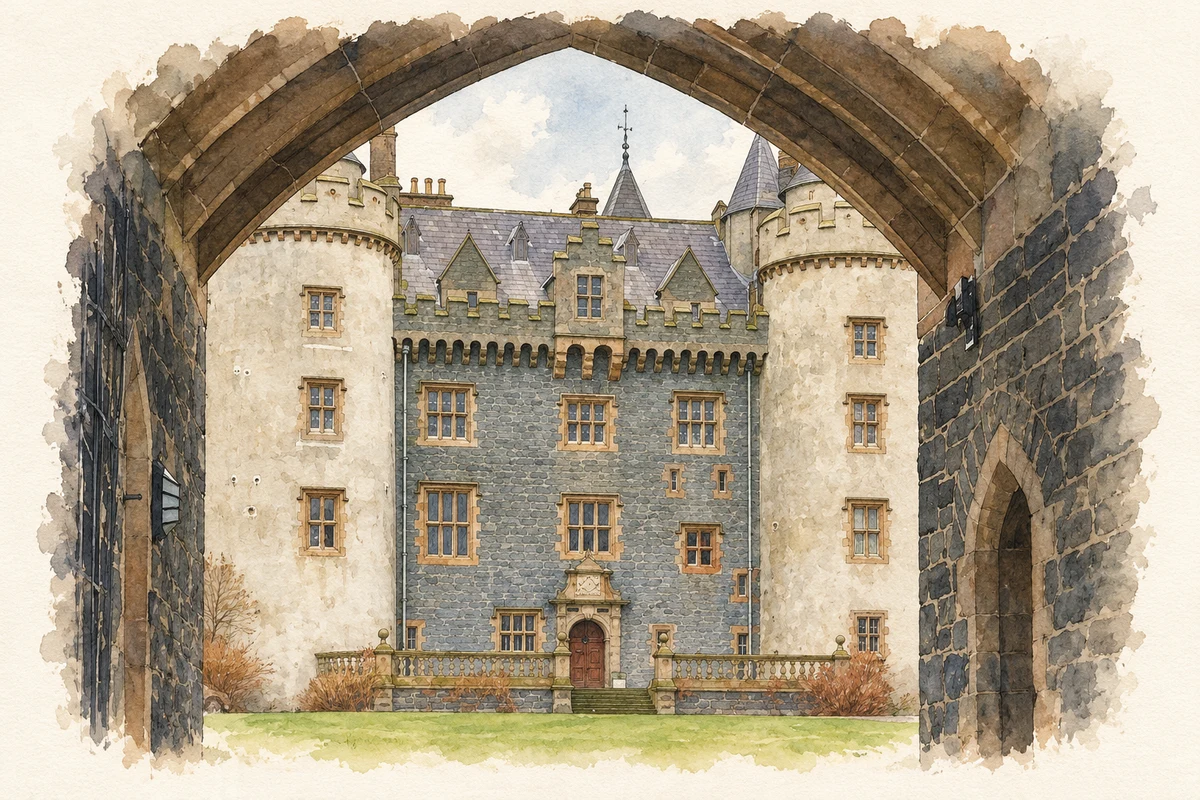
Killyleagh Castle combines a seventeenth-century house with extensive alterations made in 1847–51. Its dramatic towers belong to a building repeatedly reshaped, rather than a single unchanged medieval fortress. The historic gardens inventory records lawns within the enclosed bawn and steep terraces descending towards ponds. These grounds form part of the castle’s relationship with the surrounding town, preserving the designed setting as well as the conspicuous architecture. [2]
Hans Sloane’s wider legacy
Hans Sloane was born in Killyleagh in 1660 and left for London in 1679 to study medicine and botany. His enormous collection helped establish the British Museum, with natural-history material later transferred to the Natural History Museum. The latter’s research also explains the collection’s dependence on colonial trade: enslaved Africans helped obtain specimens in Jamaica, while wealth connected with slavery financed Sloane’s collecting. His local birthplace thus connects Killyleagh with both the achievements and difficult origins of major national collections. [3]
Edward Hincks at the rectory
Cork-born Edward Hincks was appointed rector of Killyleagh in 1825 and moved there in 1826. Alongside parish duties, he became a leading scholar of Egyptian and Mesopotamian writing. His papers of 1846–52 advanced the decipherment of cuneiform, and in 1857 he joined three other scholars in a public test of its interpretation. He died at the Killyleagh rectory in December 1866, after four decades in a parish that became the base for internationally significant research. [4]
St John’s on the hill
St John the Evangelist stands above the town and Strangford Lough. The parish records a foundation in 1640, commemorated by a surviving dated capstone. Later generations transformed the building: gas lighting arrived in 1866, followed in 1877 by an added aisle and chancel, a raised roof, stained glass and a Walker organ. Memorials link the church with local families and with naval officer Henry Blackwood, whose burial vault is in the graveyard. [5]
Geographic information
- Place type
- Town
- County
- Down
- Barony
- Castlereagh Upper
- Barony
- Dufferin
- Coordinates
- 54.39381, -5.65949 (approximate)
- Logainm ID
- 1411611 ↗
Sources & further reading
- Logainm.ie — Killyleagh. Place names and geographic record, licensed under CC BY 4.0.
- Killyleagh Castle: historic garden record D 29 · Parks and Gardens, drawing on Northern Ireland Heritage Gardens Inventory
- Hans Sloane: Physician, collector and botanist · Katie Pavid, Natural History Museum
- Hincks, Edward · Kevin J. Cathcart, Dictionary of Irish Biography
- St John the Evangelist, Killyleagh: parish history · St John the Evangelist Parish Church, Killyleagh
- Killyleagh Castle, Killyleagh, County Down illustration: based on a File:Killyleagh Castle (1) - geograph.org.uk - 322113.jpg by Albert Bridge. AI-assisted watercolour and ink adaptation; cream paper margins added, incidental clutter omitted and fine details simplified. Licence: CC BY-SA 2.0.

Name record retrieved 2026-10-25 · Source record modified 2026-09-19. How this page was prepared.