A reliable full-name meaning has not been established here. The recorded Irish and English forms are given without an unsupported translation.
Recorded forms
Balla· Irish · main form · validated name
Balla· English · main form
Place & story
A market street
Lewis describes Balla under the forms Ballagh and Bal, on the road between Castlebar and Claremorris. Its long street contained seventy-five houses and was crossed by a small river. The Tuesday market and several livestock fairs connected the town with the surrounding countryside. He judged some of those fairs among the largest in Mayo for cattle and sheep, a dated assessment of their regional importance.[2]
Land and institutions
The parish combined tillage and pasture, with limestone quarried for building and agricultural use. A courthouse also accommodated occasional Church of Ireland worship because there was then no church building for that congregation. Lewis records Catholic chapels in the town and at Belcarra, within a district covering several parishes.[2]
The older religious landscape
The directory associates the site with Cronan and records the surviving lower portion of a round tower beside church remains. It also describes a holy well and devotional gatherings. Those observations connect the nineteenth-century town with a much older sacred landscape, but do not establish the date of every surviving stone.[2]
People & connections
P. W. Nally and athletic organisation
Patrick William Nally was born at Rockstown House, Balla, in 1856. Mayo County Council describes him as an athlete and republican organiser whose sporting events in 1879 influenced the movement that became the Gaelic Athletic Association. He was sentenced to penal servitude in 1884 and died in prison in 1891, shortly before his expected release. A memorial was unveiled in Balla in 1900, and Croke Park’s Nally Stand was dedicated in his honour in 1953. His local connection is a documented birthplace and continuing commemoration, not simply a county-wide sporting association.[3]
Folklore & tradition
Devotions at the well
Lewis’s 1837 account records devotional gatherings at a well dedicated to the Blessed Virgin on 15 August and 8 September. He also describes small chapels built over the town’s stream. This is dated evidence of pilgrimage practice within Balla’s religious landscape. The account links the earlier monastery with Mochua or Cronan, but the devotional customs were being recorded many centuries later. Its pattern days show how a sacred site could continue to organise gatherings alongside the town’s commercial markets and fairs.[4]
Both counts use the 2016 settlement boundary, allowing like-for-like comparison. CSO supplies the 2022 count on this older boundary for comparison only. The official 2022 Built Up Area has different boundaries.
View population figures
Balla — Census 2016 settlement footprint — census population
These figures use different area definitions. Read the boundary note before comparing them.
Balla, Mayo
Published census settlement populations
769people · 2016
Settlement boundaries changed during this period. Differences may reflect boundary changes as well as population change. Where a 2011 legal-town-and-environs count is shown, it has not been recalculated onto the 2016 settlement boundary.
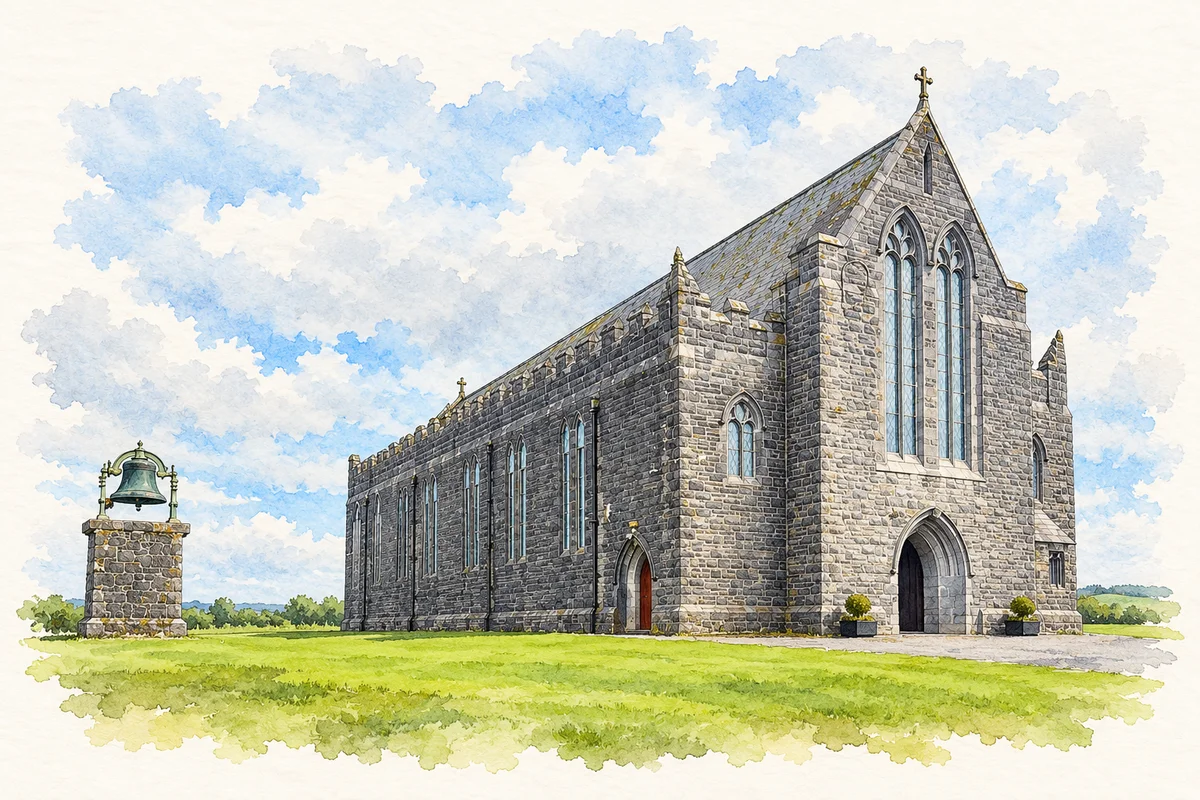
Saint Cronan's Church illustration: based on a reference by Michael Deligan. AI watercolour/ink adaptation; clutter removed, margins added and fine details simplified. Licence: CC BY-SA 4.0.
 placenames