 placenames
Camp
An Com
Camp’s place on the Tralee and Dingle railway brought a fatal accident and a parliamentary argument over its cost; nearby Killelton preserves a much older church site.
The name
These Irish name elements are associated with this record in the Logainm glossary.
An element’s translation is a clue, rather than a complete explanation of the name. Its form and meaning depend on local history and the full Irish name.
Recorded forms
- An Com · Irish · main form · validated name
- Camp · English · main form
Place & story
The runaway train of 1893
On 22 May 1893 a train ran out of control on the descent towards Curraduff Viaduct near Camp. The Board of Trade inquiry described excessive speed followed by derailment on the sharp curve beyond the viaduct. The engine and much of the train fell towards the river, while the rear van remained on the line. Three men riding on the engine died, and thirteen passengers were reported injured. The inquiry’s surviving extract records both the steep route and the difficulty of reconstructing the final minutes after the engine crew’s deaths. [2]
The burden on local ratepayers
The accident also became a question of public finance. In the House of Commons on 13 March 1894, Sir Thomas Esmonde asked for a government loan to meet the damages arising from the Camp Bridge accident. He argued that the charge fell heavily on poor agricultural communities whose baronies guaranteed the railway. John Morley replied that the Treasury lacked the necessary lending power, but agreed to consider whether the burden could be eased. [3]
The church at Killelton
Killelton, east of Camp, contains a small dry-stone church within an irregular enclosure. During conservation work in 1987, archaeologist Conleth Manning excavated parts of the building and its surroundings. He found drains and child burials inside, with two later adult burials outside on the uphill side. His report also records that much of the south wall had already been rebuilt by the Royal Society of Antiquaries of Ireland in the 1890s. The site preserves several periods of use and repair. [4]
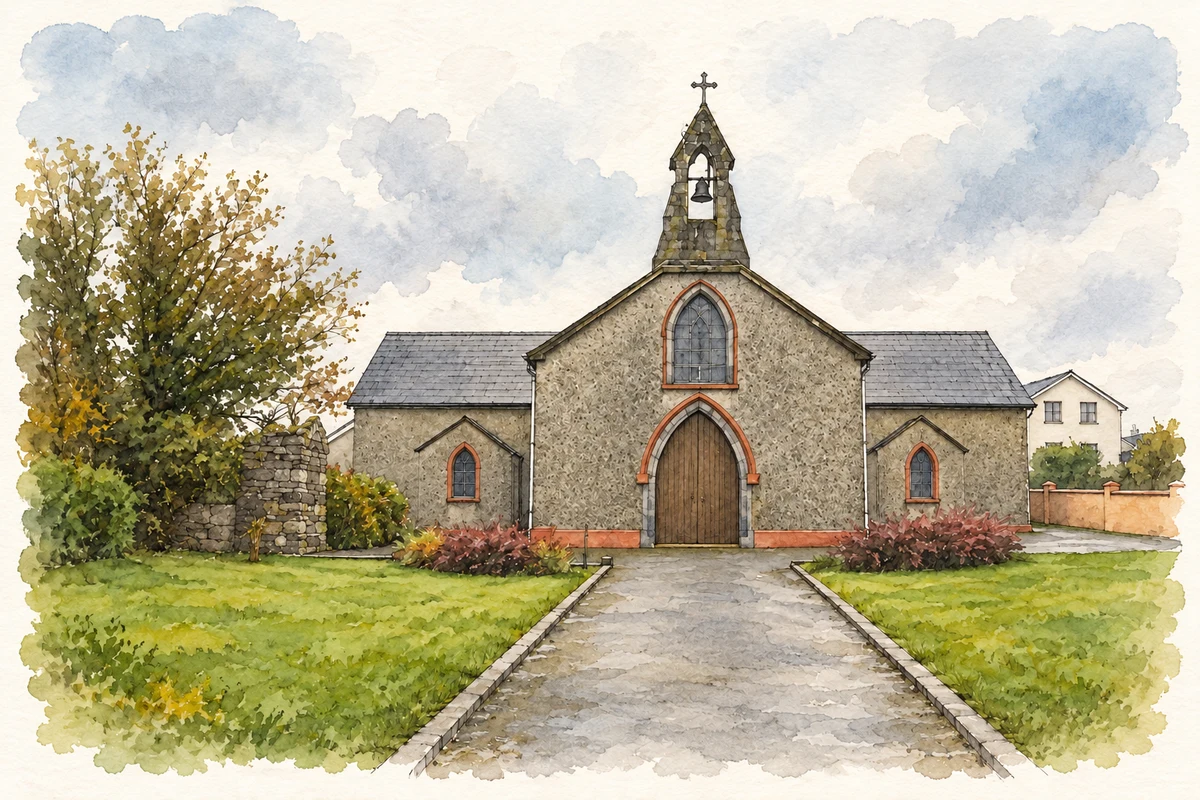
Saint Mary’s at Camp
Saint Mary’s Catholic Church belongs to the nineteenth-century development of Camp. The National Inventory of Architectural Heritage dates it to around 1830 and records a cruciform plan, with a nave and projecting transepts. Its form contrasts with the much smaller surviving church at nearby Killelton. [5]
Geographic information
- Place type
- Population centre
- County
- Kerry
- Barony
- Corkaguiny
- Civil parish
- Kilgobban
- Within
- Camp
- Coordinates
- 52.21729, -9.91702 (approximate)
- Logainm ID
- 1412427 ↗
Sources & further reading
- Logainm.ie — Camp. Place names and geographic record, licensed under CC BY 4.0.
- Report to the Board of Trade: accident at Camp on 22 May 1893, published 28 June 1893 · Major F. A. Marindin; Board of Trade; extract hosted by The Railways Archive
- Tralee and Dingle Railway, Commons debate, 13 March 1894 · UK Parliament, Historic Hansard
- 1987:24 — Killelton Oratory, Killelton, Kerry · Conleth Manning, Office of Public Works; Excavations.ie
- Saint Mary’s Catholic Church, Camp, register 21303606 · National Inventory of Architectural Heritage
- St Mary's Church, Camp, County Kerry illustration: based on a Camp: St Mary's Church by Nigel Cox. AI-assisted watercolour and ink adaptation; cream paper margins added, incidental clutter omitted and fine details simplified. Licence: CC BY-SA 2.0.
Name record retrieved 2026-10-25 · Source record modified 2025-01-10. How this page was prepared.