 placenames
Coolea
Cúil Aodha
Cúil Aodha became Seán Ó Riada’s home in 1963 and a centre for a distinctive choral tradition rooted in local singers.
The name
These Irish name elements are associated with this record in the Logainm glossary.
An element’s translation is a clue, rather than a complete explanation of the name. Its form and meaning depend on local history and the full Irish name.
Recorded forms
- Cúil Aodha · Irish · main form
- Coolea · English · main form
Place & story
The village church
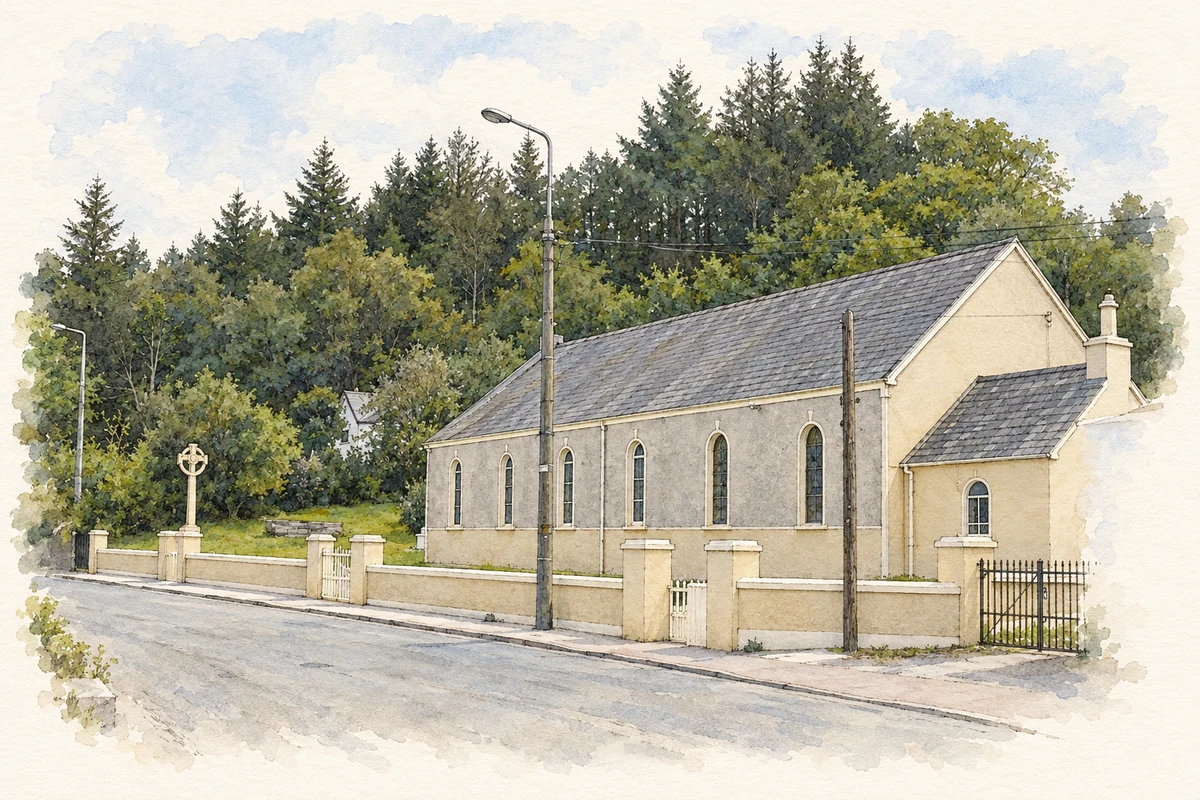
Séipéal Ghobnatan, the Catholic church in Cúil Aodha, was built in 1871. Its six-bay nave, round-headed windows and gabled entrance give it a different outline from the pointed Gothic churches common elsewhere in nineteenth-century Ireland. The National Inventory of Architectural Heritage records later extensions alongside surviving timber sash windows, stained glass and dressed limestone sills. Its position beside the road makes the church a prominent village landmark. [2]
Ó Riada makes his home here
Seán Ó Riada moved to Cúil Aodha with his family in 1963, after his appointment as a music lecturer at University College Cork. He lived here until his death in 1971. His family preserved his papers at home, and UCC acquired the collection in 2004. The archive connects his life in the village with the wider career that included his film music for Mise Éire and his work with traditional musicians. [3]
Local voices singing together
Writing from his experience of the community, singer Iarla Ó Lionáird recalled an early gathering around Ó Riada’s piano in Muirneach Bheag during the winter of 1964. The composer wanted a choir to sing an Irish-language Mass in the village church, with support from the curate, Donnchadha Ó Conchubhair. The singers brought their own experience of sean-nós, work songs and other local forms to the new collective sound. [4]
A song takes a new shape
After Ó Riada died, his son Peadar took over the choir. Ó Lionáird’s account describes how a recording collected by Seán became the starting point for the choir’s version of Mo Ghile Mear. Poet and choir member Domhnall Ó Liatháin selected and combined verses, and the song eventually replaced a humorous closing number at public performances. Its familiar place in the repertoire thus came from a particular act of local musical reconstruction. [4]
Geographic information
- Place type
- Population centre
- County
- Cork
- Barony
- Muskerry West
- Civil parish
- Ballyvourney
- Within
- Gortnatubbrid
- Within
- Coolea
- Coordinates
- 51.93007, -9.20680 (approximate)
- Logainm ID
- 1412756 ↗
Sources & further reading
- Logainm.ie — Coolea. Place names and geographic record, licensed under CC BY 4.0.
- Séipéal Ghobnatan, Cúil Aodha: NIAH20905803 · National Inventory of Architectural Heritage
- Seán Ó Riada Collection: administrative and biographical history · University College Cork Library
- Ó Riada’s Vision, 1 July2006 · Iarla Ó Lionáird
- Séipéal Ghobnatan, Coolea illustration: based on a Church of Cúil Aodha by Roman van der Krogt. AI-assisted watercolour and ink adaptation; cream paper margins added, incidental clutter omitted and fine details simplified. Licence: CC BY-SA 2.0.
Name record retrieved 2026-10-25 · Source record modified 2020-02-21. How this page was prepared.