Ballinakill's fair-day economy once supported brewing and woollen manufacture. Beside the village, Heywood combines an eighteenth-century landscape with formal gardens designed by Edwin Lutyens.
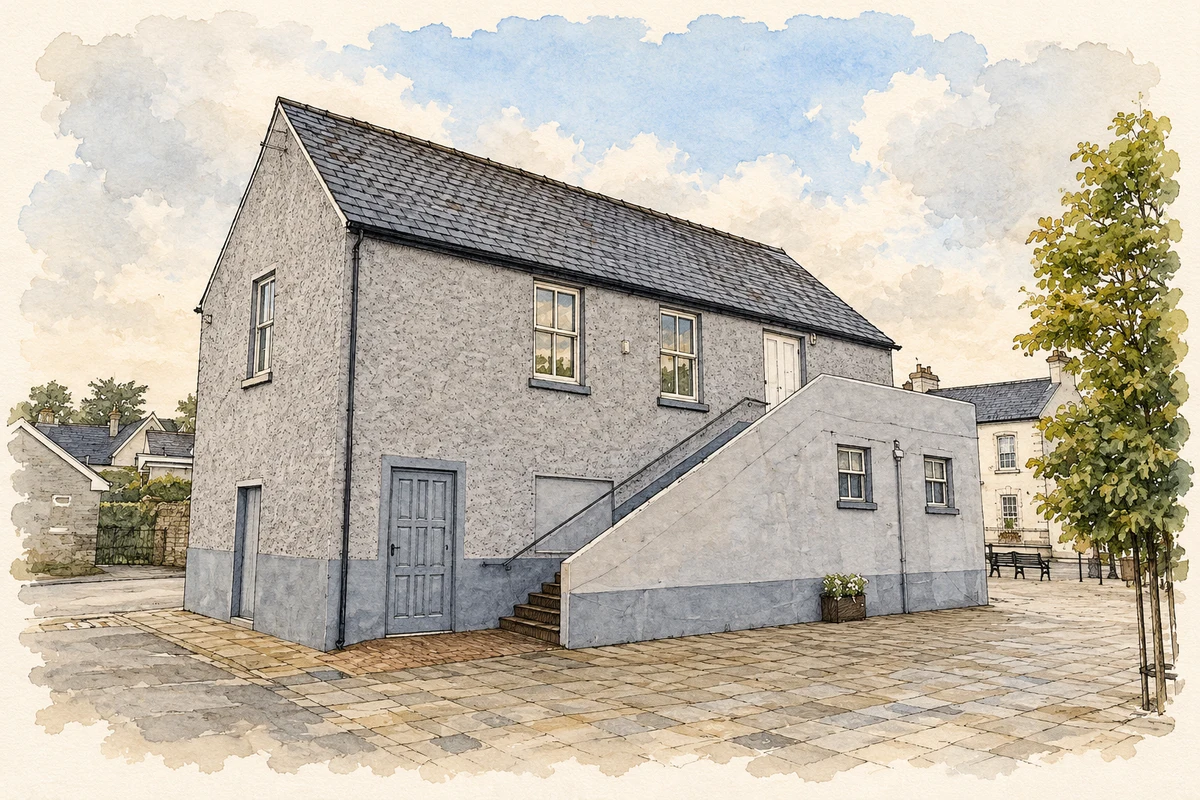
Illustration, Former Market House, Ballinakill
⊕Recorded locationBallinakill52.87451° N · 7.30788° WInteractive map supplied by OpenStreetMap.
These Irish name elements are associated with this record in the Logainm glossary.
An element’s translation is a clue, rather than a complete explanation of the name. Its form and meaning depend on local history and the full Irish name.
Recorded forms
Baile na Coille· Irish · main form · validated name
Ballinakill· English · main form
Place & story
Markets and parliamentary seats
Ballinakill received a market and fair grant in 1606. It later returned two members to the Irish parliament until the Union, when compensation for the lost representation went to the Marquess of Drogheda. By 1837 Samuel Lewis recorded 1,927 inhabitants, a brewery and a diminished woollen industry. Its Saturday market faced competition from a newer Saturday market at Abbeyleix. Fairs continued throughout the year, with the November gathering particularly associated with bullocks. These details capture both the town's commercial importance and the pressures on its trade.[2]
Lutyens within Trench's landscape
Heywood's lakes, woodland and hillside park belong to the eighteenth-century landscape shaped by Frederick Trench. Edwin Lutyens later designed the linked formal gardens near the house. Their terraces lead to a sunken garden with a pool and central fountain; circular openings in the enclosing wall frame views into the wider park. A red-tiled loggia carries an inscription from Alexander Pope. Gertrude Jekyll's involvement in the planting is considered likely by the Office of Public Works.[3]
From estate to public care
Heywood House passed to the Salesian Fathers in the 1940s and was destroyed by fire in 1950. The gardens survived. In a television report broadcast in February 1993, RTÉ recorded their transfer from the Salesians to the Office of Public Works. Park superintendent John McCullen described plans for further restoration and replanting in keeping with Lutyens's design. That report preserves a particular moment in the gardens' transition from an estate setting into public care.[4]
All Saints on Church Street
All Saints' Church is dated 1821, with a tower marking its place on Church Street. Its Georgian Gothic design acquired a chancel during renovations around 1865. The building's two principal nineteenth-century phases sit alongside the commercial streets and the neighbouring Heywood landscape, adding another part of Ballinakill's architectural history.[5]
Both counts use the 2016 settlement boundary, allowing like-for-like comparison. CSO supplies the 2022 count on this older boundary for comparison only. The official 2022 Built Up Area has different boundaries.
View population figures
Ballinakill — Census 2016 settlement footprint — census population
These are the historical areas published in the 2006 census report. Boundaries may differ between censuses and from modern settlements. Legal towns, environs and suburbs are shown separately; none has been combined into a modern settlement total.
View population figures
Ballinakill, Laois — Census town, CSO 2006 report — census population
These are the historical areas published in the 1996 census report. Boundaries may differ between censuses and from modern settlements. Legal towns, environs and suburbs are shown separately; none has been combined into a modern settlement total.
View population figures
Ballinakill, Laois — Census town, CSO 1996 report — census population
Figures cover the historical town area printed in the 1986 report. Boundaries may have changed between censuses. Legal town, environs and suburb totals remain separate and differ from modern settlement boundaries.
View population figures
Ballinakill, Laois — Census town, CSO 1986 report — census population
These figures use different area definitions. Read the boundary note before comparing them.
Ballinakill, Laois
Published census settlement populations
445people · 2016
Settlement boundaries changed during this period. Differences may reflect boundary changes as well as population change. Where a 2011 legal-town-and-environs count is shown, it has not been recalculated onto the 2016 settlement boundary.
Former Market House, Ballinakill illustration: based on a Ballinakill Market House 2 by A.-K. D.. AI-assisted watercolour and ink adaptation; cream paper margins added, incidental clutter omitted and fine details simplified. Licence: CC0 1.0.
 placenames