 placenames
Moygashel
Maigh gCaisil
From workers’ houses to laboratory-tested fabrics, Moygashel’s textile history survives in its buildings, oral testimony and museum collections.
The name
These Irish name elements are associated with this record in the Logainm glossary.
An element’s translation is a clue, rather than a complete explanation of the name. Its form and meaning depend on local history and the full Irish name.
Recorded forms
- Maigh gCaisil · Irish · main form · validated name
- Moygashel · English · main form
Place & story
A village grows around the mills
Moygashel’s mill history reaches back to Thomas Boardman’s bleach green of 1781. Later owners converted the works to flax spinning, but a fire in 1868 brought a major setback. Robert Stevenson rebuilt the mill in 1876, adding weaving and beetling sheds powered by water and a forty-horsepower engine. He also built fifteen houses for employees. By 1901, twenty-eight dwellings housed a community whose occupations included linen beetling, bobbin winding and carting for the factory. [2]
Linen becomes a tested fabric
James Brown joined Stevenson’s in 1944 and later led its laboratory and technical work. In an interview preserved by National Museums Northern Ireland, he described Moygashel’s research into blended yarns, fabric strength, durability and washing performance. Linen was combined with other fibres to alter cost, crease resistance and handling. The work linked clothing, household textiles and furnishings: laboratory tests helped the company offer defined quality standards alongside the reputation of its name. [3]
A surviving roll of Moygashel
London’s Museum of the Home preserves a roll of Moygashel furnishing fabric made by Stevenson and Son around 1960–62, still in its cardboard packaging. Its screen-printed pattern combines feathery leaves in red, orange, yellow, green and other colours on white linen. This ordinary furnishing material carries the industrial story into domestic life, showing how a Tyrone manufacturer’s name reached homes far beyond the mill village. [4]
Preserving the working village’s memory
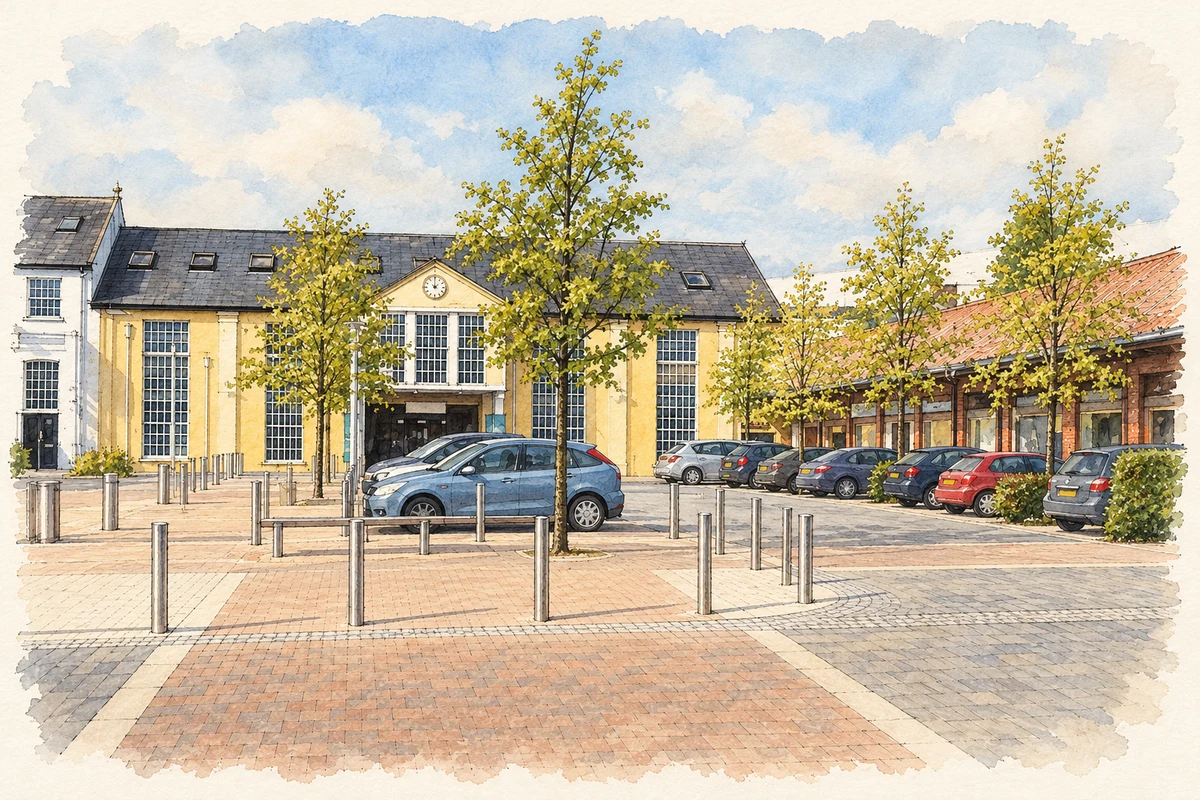
The former mill site now houses the Linen Green shopping development, while the Moygashel Linen Mills heritage charity preserves the industry’s history. Its registered activities include an exhibition of machinery, artefacts, photographs and display panels, together with restoration of historical items and educational visits. The emphasis extends beyond products to the working lives behind them, giving the village’s industrial remains a continuing role in interpretation and community use. [2] [5]
Geographic information
- Place type
- Population centre
- County
- Tyrone
- Barony
- Dungannon Middle
- Civil parish
- Clonfeacle
- Coordinates
- 54.49073, -6.73445 (approximate)
- Logainm ID
- 1414273 ↗
Sources & further reading
- Logainm.ie — Moygashel. Place names and geographic record, licensed under CC BY 4.0.
- Our History · The Linen Green, Moygashel
- Living Linen Interview LL2_R00/36: James Brown, 11 May 2000; catalogue HOYFM.R 2000.77 · National Museums Northern Ireland
- Moygashel furnishing fabric, object 25/1992 · Museum of the Home, London
- Moygashel Linen Mills charity: register 107304 · Charity Commission for Northern Ireland
- The Linen Green Centre, Moygashel, County Tyrone illustration: based on a The Linen Green Centre, Moygashel by HENRY CLARK. AI-assisted watercolour and ink adaptation; cream paper margins added, incidental clutter omitted and fine details simplified. Licence: CC BY-SA 2.0.
Name record retrieved 2026-10-25 · Source record modified 2012-01-25. How this page was prepared.