 placenames
Grange
An Ghráinsigh
Grange’s church furnishings, an older ruined church and a documented holy well preserve several layers of this west Waterford parish’s history.
The name
These Irish name elements are associated with this record in the Logainm glossary.
An element’s translation is a clue, rather than a complete explanation of the name. Its form and meaning depend on local history and the full Irish name.
Recorded forms
- An Ghráinsigh · Irish · main form · validated name
- Grange · English · main form
Place & story
Building before the Famine
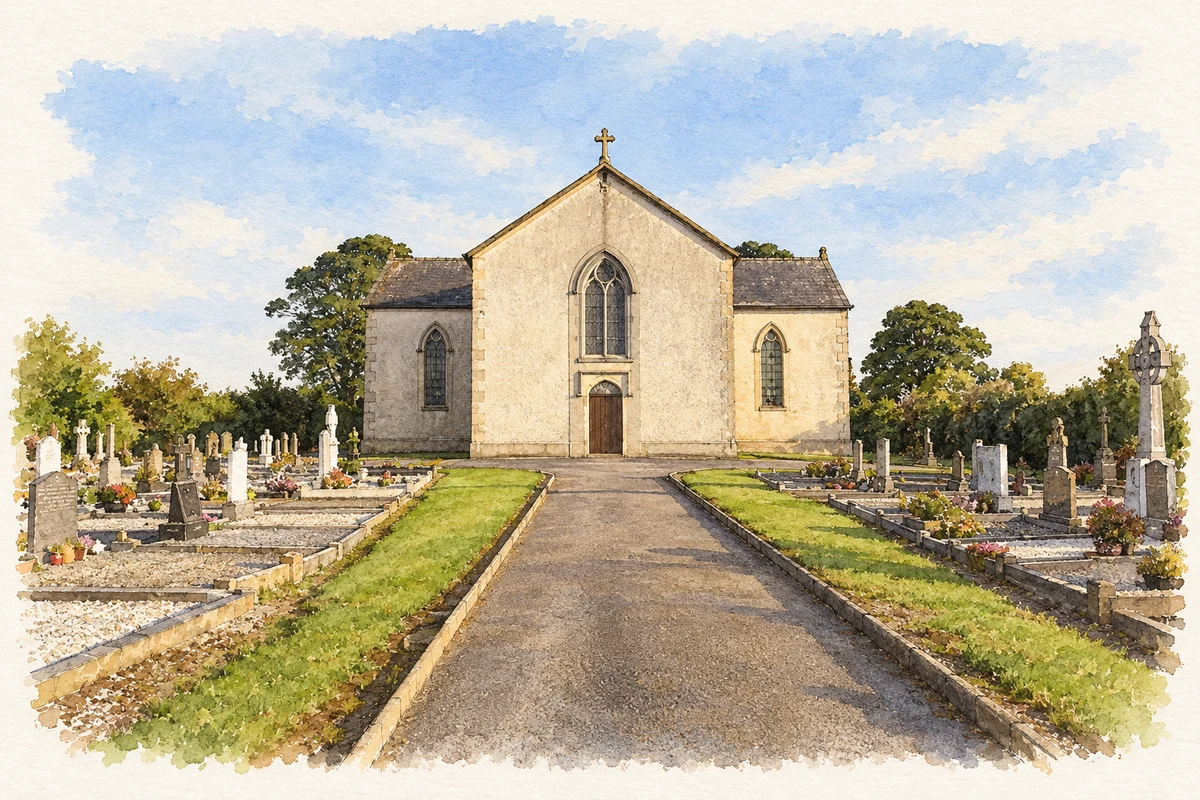
Grange’s Catholic church was one of three built during Father Patrick McGrath’s time as parish priest, from 1836 to 1846, alongside those at Ardmore and Old Parish. Waterford County Museum’s local history describes the scale of that effort in a poor rural district and notes that the new churches initially remained without furnishings for some years. The building belongs to that wider programme of parish construction before the Great Famine. [2]
A chalice and a local craftsman
The same museum account records a chalice dated 1818, presented by the housekeepers of the parish, which predates the present church. It also identifies work made for Grange Church by Patrick Troy, a wheelwright from Móin Bhaile Shiobhaín. His contributions included six funerary candelabra and a reserve tabernacle, illustrated in the Ardmore Journal in 1990. These objects give the church’s history a connection with local making and parish donations. [2]
The older church
When John O’Donovan examined Grange in 1841, the old parish church was already severely reduced. He recorded its southeast corner and fragments of the side walls, but could still trace foundations measuring sixty feet by twenty. He described walls built of slate stone with lime and sand mortar, and a graveyard still used for burials. His observations provide a dated picture of the older religious site, distinct from the nineteenth-century Catholic church. [3]
The Religious Women’s Well nearby
O’Donovan also recorded a holy well in nearby Ballylane, called Tobar na mBan Riaghalta, or the Religious Women’s Well. In his 1841 account, devotional stations were performed there on 15 August. He reported a local association with the Virgin Mary while observing that her name did not form part of the well’s own name. This is evidence of a recorded nineteenth-century devotional custom, rather than a claim about its present practice. [3]
Geographic information
- Place type
- Population centre
- County
- Waterford
- Barony
- Decies-within-Drum
- Civil parish
- Lisgenan or Grange
- Coordinates
- 51.99888, -7.73789 (approximate)
- Logainm ID
- 1414601 ↗
Sources & further reading
- Logainm.ie — Grange. Place names and geographic record, licensed under CC BY 4.0.
- Ardmore Memory and Story: church building and Grange furnishings · Waterford County Museum; Ardmore Memory and Story
- Grange: Ordnance Survey antiquarian account, 1841 · John O’Donovan, reproduced by Ardmore Waterford
- St Mary Church, Grange, County Waterford illustration: based on a St. Mary's church, Grange by Jonathan Thacker. AI-assisted watercolour and ink adaptation; cream paper margins added, incidental clutter omitted and fine details simplified. Licence: CC BY-SA 2.0.
Name record retrieved 2026-10-25 · Source record modified 2012-02-16. How this page was prepared.