These Irish name elements are associated with this record in the Logainm glossary.
An element’s translation is a clue, rather than a complete explanation of the name. Its form and meaning depend on local history and the full Irish name.
Recorded forms
Ráth Bhoth· Irish · main form · validated name
Raphoe· English · main form
Place & story
Medieval fabric within St Eunan's
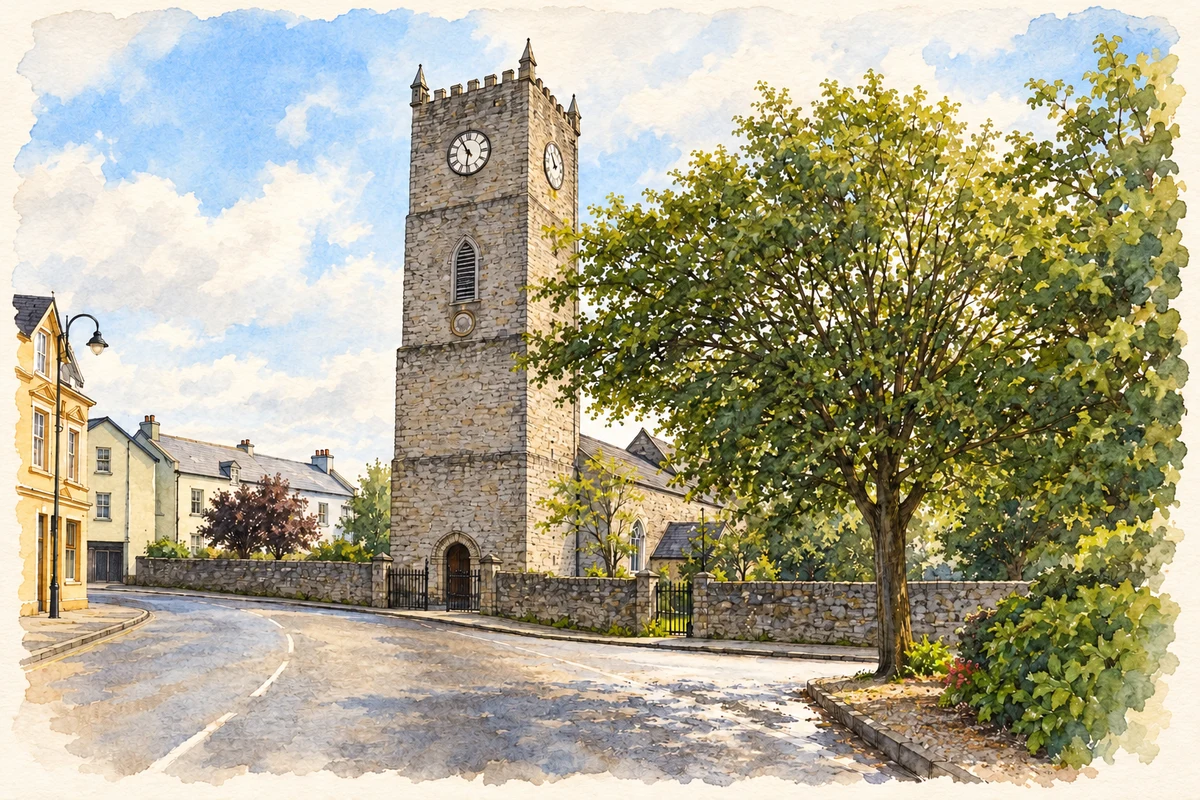
The Church of Ireland cathedral is dedicated to Adomnán, or Eunan, abbot of Iona from 679 to 704. Its south-east corner preserves twelfth-century work, but later bishops substantially reshaped the building. George Montgomery, a former chaplain to James I, undertook a major rebuilding around 1605. Nicholas Forster added the entrance tower in 1738. Architect Thomas Drew's restoration, commissioned in 1892, uncovered medieval fabric and gave other parts a medieval appearance. Inside, the chancel is longer than the nave, retaining a layout suited to the elaborate services of a large body of clergy.[2]
The bishop's fortified palace
Raphoe Castle began as the fortified residence of Bishop John Leslie. The town's heritage trail dates its construction from May 1636 to August 1637. It records that material from an older round tower was used in the building, an instance of the town's earlier religious fabric being absorbed into a new episcopal household. The palace was burned by James II's supporters in 1689, rebuilt under Bishop Cairncross in 1695 and devastated by another fire in 1838. The surviving shell belongs to this long sequence of construction and destruction.[3]
A round tower for the Catholic church
Raphoe's Catholic St Eunan's opened on 3 November 1878. Its architect and contractor were Heavey and Mac Adorey of Belfast. The round tower, designed in the manner of early Irish examples, also had practical functions: it contained a side entrance and the stairs to the organ gallery. The parish history describes its height as one hundred feet. The church employed cavity construction, with stone outside and brick inside separated by an air space. A rose window in the western gable and lancets along the sides brought light into the new church.[4]
Both counts use the 2016 settlement boundary, allowing like-for-like comparison. CSO supplies the 2022 count on this older boundary for comparison only. The official 2022 Built Up Area has different boundaries.
View population figures
Raphoe — Census 2016 settlement footprint — census population
These are the historical areas published in the 2006 census report. Boundaries may differ between censuses and from modern settlements. Legal towns, environs and suburbs are shown separately; none has been combined into a modern settlement total.
View population figures
Raphoe, Donegal — Census town, CSO 2006 report — census population
These are the historical areas published in the 1996 census report. Boundaries may differ between censuses and from modern settlements. Legal towns, environs and suburbs are shown separately; none has been combined into a modern settlement total.
View population figures
Raphoe, Donegal — Census town, CSO 1996 report — census population
Figures cover the historical town area printed in the 1986 report. Boundaries may have changed between censuses. Legal town, environs and suburb totals remain separate and differ from modern settlement boundaries.
View population figures
Raphoe, Donegal — Census town, CSO 1986 report — census population
These figures use different area definitions. Read the boundary note before comparing them.
Raphoe, Donegal
Published census settlement populations
1,089people · 2016
Settlement boundaries changed during this period. Differences may reflect boundary changes as well as population change. Where a 2011 legal-town-and-environs count is shown, it has not been recalculated onto the 2016 settlement boundary.
St Eunan's Cathedral, Raphoe, County Donegal illustration: based on a St Eunan's Church of Ireland Cathedral, Raphoe by Kenneth Allen. AI-assisted watercolour and ink adaptation; cream paper margins added, incidental clutter omitted and fine details simplified. Licence: CC BY-SA 2.0.
 placenames