 placenames
Blackrock
An Charraig Dhubh
The Dublin coastal village preserves a history of seaside recreation, civic ceremony and writing behind a shoreline reshaped by transport.
The name
These Irish name elements are associated with this record in the Logainm glossary.
An element’s translation is a clue, rather than a complete explanation of the name. Its form and meaning depend on local history and the full Irish name.
Recorded forms
- An Charraig Dhubh · Irish · main form · validated name
- Blackrock · English · main form
Place & story
The railway and the making of a park
The Dublin–Kingstown railway opened in 1834, improving access to Blackrock while separating the village from the sea. Its embankment enclosed part of the old shoreline, creating a wetland between the track and the road. In 1873, a decision was taken to fill this ground and form Blackrock Park. The park’s position therefore records a substantial change to the coast, rather than simply the preservation of an earlier seaside green. [2]
The baths and swimming galas
William Kaye-Parry designed new seawater baths that opened in June 1887. The municipal council acquired and refurbished the complex in 1928. Library accounts recall the Sandycove Galas held there and exhibitions by diving champion Eddie Heron. The baths later fell out of use and were demolished in 2013. Their history belongs to Blackrock’s long association with bathing and organised aquatic sport, although the former diving platforms are no longer a surviving attraction. [3] [4]
The cross and the city boundary
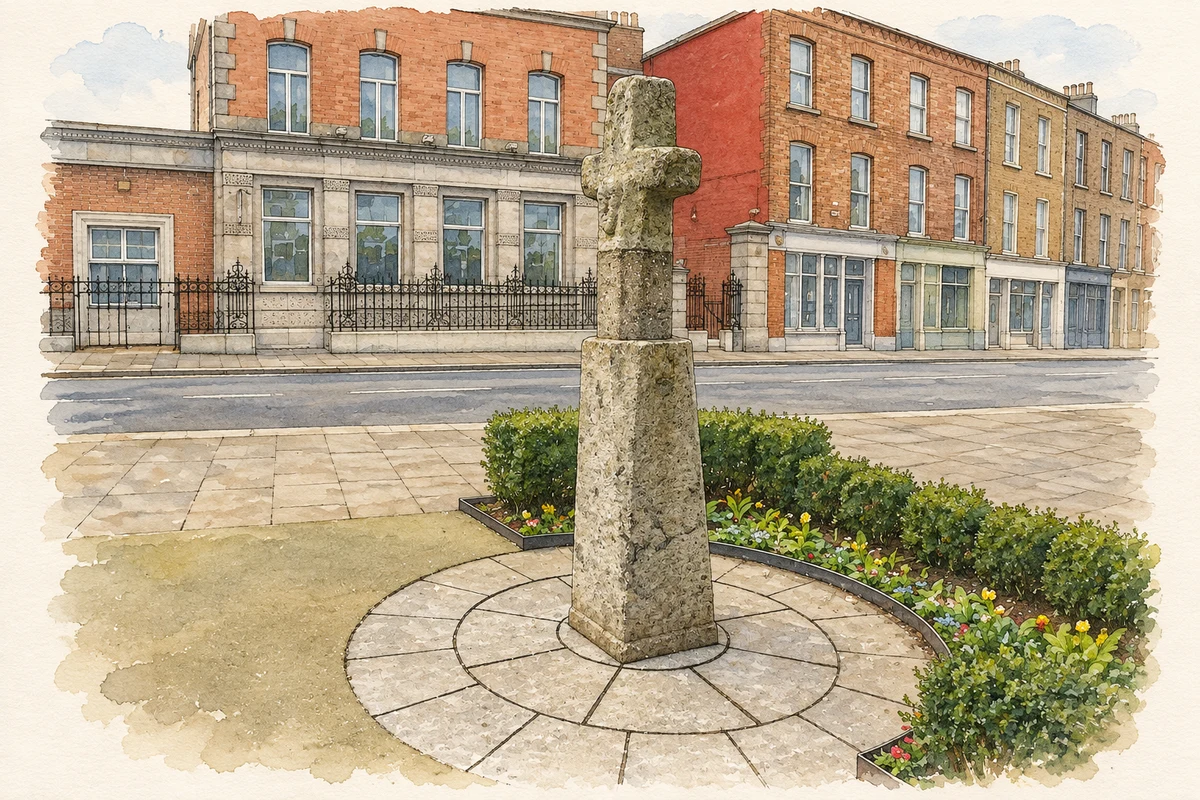
The granite cross in the village had a civic role as well as its place in the streetscape. Writing in 1837, Samuel Lewis described the lord mayor and civic authorities reaching it when formally tracing the limits of Dublin’s jurisdiction. This contemporary account places Blackrock within the ceremonial geography of the city. It also records a busy settlement of one main street, smaller avenues, boarding houses and frequent transport connections with Dublin. [5]
Flann O’Brien at Avoca Terrace
Brian O’Nolan, better known as Flann O’Brien and Myles na gCopaleen, moved with his family to Avoca Terrace in 1927 and attended Blackrock College. Later, the house became a workplace for his newspaper writing. His Dictionary of Irish Biography entry describes batches of Cruiskeen Lawn columns typed at the dining-room table on Sunday afternoons. Blackrock was thus a sustained home and working setting for the writer, rather than his birthplace, which was Strabane. [6]
Geographic information
- Place type
- Population centre
- County
- Dublin
- Barony
- Rathdown
- Civil parish
- Booterstown
- Coordinates
- 53.30647, -6.18458 (approximate)
- Logainm ID
- 17495 ↗
Sources & further reading
- Logainm.ie — Blackrock. Place names and geographic record, licensed under CC BY 4.0.
- Blackrock Local Area Plan: Heritage & Conservation, page 12 · Dún Laoghaire–Rathdown County Council
- Blackrock Baths: William Kaye-Parry commission, 1886–87 · Dictionary of Irish Architects, Irish Architectural Archive
- Blackrock Baths: bathing and gala history · Ask About Ireland, Dún Laoghaire–Rathdown local studies
- Blackrock, County Dublin, in A Topographical Dictionary of Ireland, 1837 · Samuel Lewis, reproduced by Library Ireland
- O’Nolan, Brian (Flann O’Brien), biography a 6969 · Anne Clune, Dictionary of Irish Biography
- Market Cross, Blackrock, County Dublin illustration: based on a File:THE MARKET CROSS IN BLACKROCK (MAIN STREET)-148118.jpg by William Murphy. AI-assisted watercolour and ink adaptation; cream paper margins added, incidental clutter omitted and fine details simplified. Licence: CC BY-SA 2.0.

Name record retrieved 2026-10-25 · Source record modified 2019-07-30. How this page was prepared.