 placenames
Dalkey
Deilginis
Merchant castles, quarrymen’s cottages and a strong literary connection mark the changing fortunes of this coastal town.
The name
These Irish name elements are associated with this record in the Logainm glossary.
An element’s translation is a clue, rather than a complete explanation of the name. Its form and meaning depend on local history and the full Irish name.
Recorded forms
- Deilginis · Irish · main form · validated name
- Dalkey · English · main form
Place & story
A port protected by castles
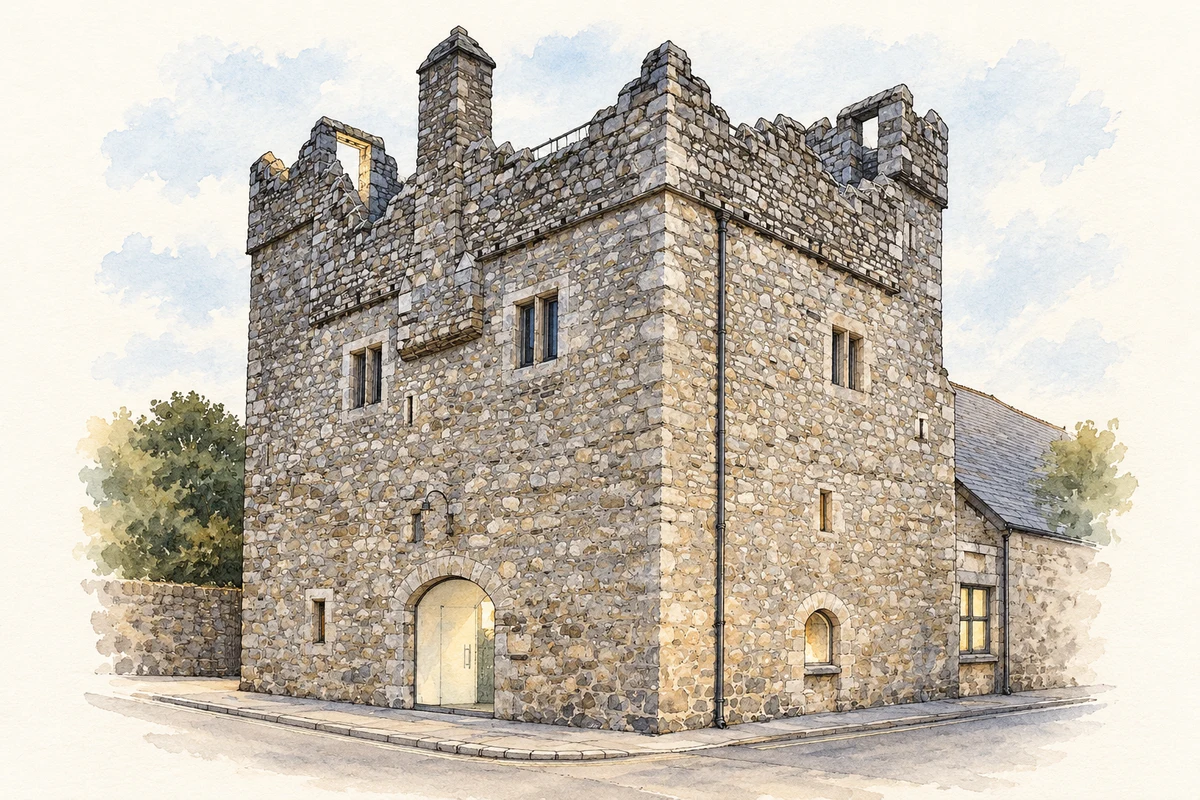
Dalkey Sound provided deep anchorage for ships whose cargoes were bound for Dublin. Merchants used the town to store goods before their onward journey, and fortified houses protected this valuable trade. Dalkey Castle, also known as Goat Castle, preserves defensive features including arrow slits, a murder hole and a projecting machicolation. Part of Archbold’s Castle also survives. A licence granted in 1482 allowed a Tuesday market, while an annual fair was held on Saint Begnet’s feast day. [2]
Quarrymen and cottages
The opening of the Dalkey Hill quarry brought workers into the area, many of whom built small, single-storey homes. The council’s architectural history identifies the low cottages around Sorrento Road and Leslie Avenue as possible survivals of this working community. Their scale offers a useful counterpoint to the larger houses which later made Dalkey a fashionable seaside address. [3]
Railway and seaside houses
An experimental atmospheric railway reached Dalkey in 1844. Improved connections helped attract professional families from Dublin, who built substantial homes on sites overlooking the sea, including land formerly belonging to Dalkey Commons. The completion of the railway between Dún Laoghaire and Bray in 1856 further strengthened the town’s connection with the city. [3]
Maeve Binchy’s Dalkey
Maeve Binchy’s family moved to Eastmount on Knocknacree Road in 1951. After a career which took her into teaching and journalism, including a London posting with the Irish Times, she returned to make Dalkey her home. She and her husband, Gordon Snell, bought Pollyvilla in 1980 and settled there permanently some years later. Her novels, beginning with Light a Penny Candle in 1982, made her one of Ireland’s most widely read writers. [4]
Geographic information
Sources & further reading
- Logainm.ie — Dalkey. Place names and geographic record, licensed under CC BY 4.0.
- About Dalkey Castle: history · Dalkey Castle and Heritage Centre
- Dalkey Village Architectural Conservation Area: historical development, page 9 · Dún Laoghaire-Rathdown County Council
- Binchy, Maeve · Margaret Kelleher, Dictionary of Irish Biography
- Dalkey Castle, Dalkey, County Dublin illustration: based on a File:Dalkey Castle.jpg by N9LXI. AI-assisted watercolour and ink adaptation; cream paper margins added, incidental clutter omitted and fine details simplified. Licence: CC BY-SA 3.0.

Name record retrieved 2026-10-25 · Source record modified 2022-02-18. How this page was prepared.