Anascaul, also commonly written Annascaul, links the Antarctic explorer Tom Crean with the sculptor Jerome Connor and a continuing local engagement with art and folklore.
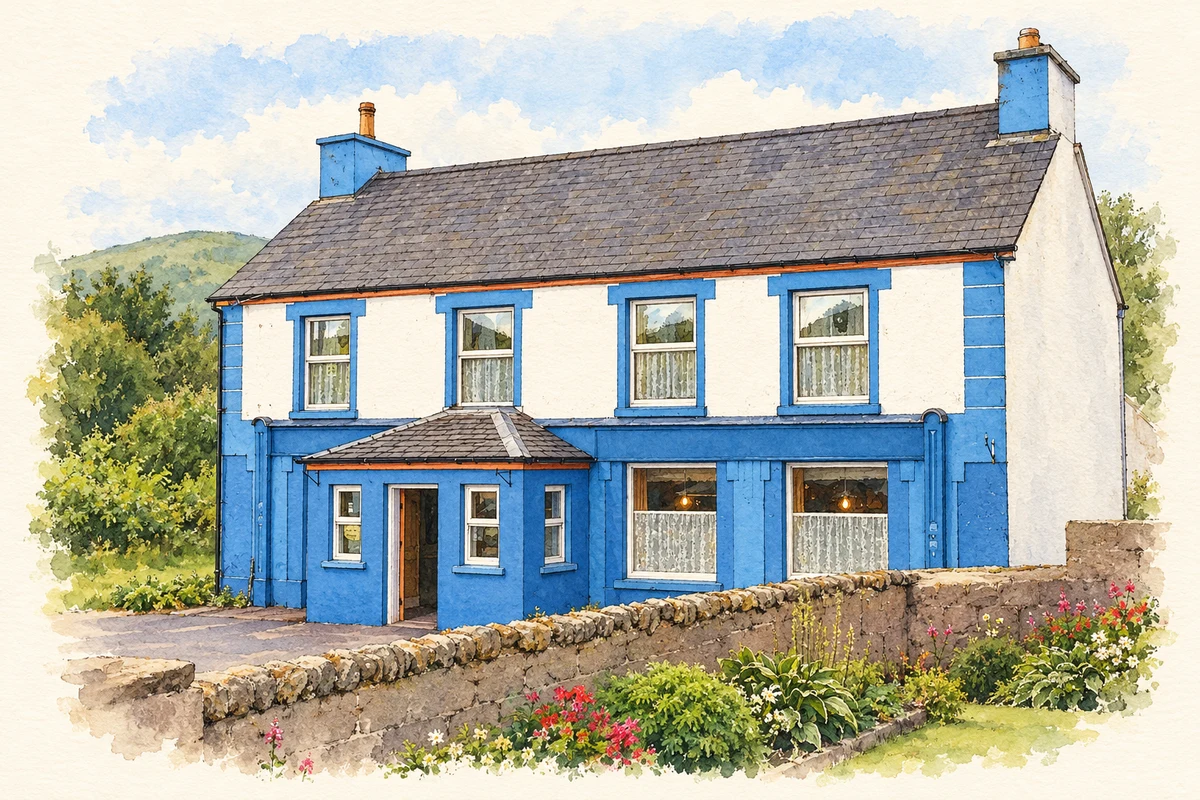
Illustration, Historic South Pole Inn building, Annascaul
⊕Recorded locationAnascaul52.15144° N · 10.05468° WInteractive map supplied by OpenStreetMap.
These Irish name elements are associated with this record in the Logainm glossary.
An element’s translation is a clue, rather than a complete explanation of the name. Its form and meaning depend on local history and the full Irish name.
Recorded forms
Abhainn an Scáil· Irish · main form · validated name
Anascaul· English · main form
Annascaul· English · main form · local name
Place & story
People & connections
Tom Crean's journeys and return
Tom Crean was born near Anascaul in 1877 and joined the Royal Navy in 1893. He served on three Antarctic expeditions, with Scott's Discovery and Terra Nova parties and Shackleton's Endurance expedition. His honours included the Polar Medal with three Antarctic clasps and the Albert Medal. After retiring from the navy, he settled locally with his wife Eileen Herlihy. He had bought pub premises in 1916; these were refurbished in 1929 and named the South Pole Inn. Crean died in 1938 and was buried in Ballynacourty graveyard. Eamon O'Doherty's statue of him was unveiled in the village in 2003.[2]
People & connections
Jerome Connor's transatlantic art
Sculptor Jerome Connor came from the Anascaul area and moved with his family to Massachusetts in 1888. His work later included a Robert Emmet memorial for the Smithsonian. Letters preserved by the National Gallery of Ireland document his dealings with commissioners and supporters. A local trust formed in 1990 to hold eight Connor bronzes, with the collection later growing to fourteen pieces. In April 2014 a permanent exhibition opened at the South Pole Inn, bringing his sculpture into the village's daily surroundings.[3][4]
Scaul's Hope in 2021
The folklore surrounding the lake above Anascaul inspired a new artwork during the pandemic. Artist Tony Owen's own account describes Scaul's Hope, made with Pat and installed beside the village river for Féile na Bealtaine in 2021. Visitors could write anonymous hopes on cards and place them inside the wooden sculpture. More than seventy cards accumulated during its five-day display. Owen described them as a record of villagers' concerns about family, love and life during lockdown. The installation connected a traditional local figure with a particular moment in the community's recent history.[5]
Both counts use the 2016 settlement boundary, allowing like-for-like comparison. CSO supplies the 2022 count on this older boundary for comparison only. The official 2022 Built Up Area has different boundaries.
View population figures
Annascaul — Census 2016 settlement footprint — census population
These are the historical areas published in the 2006 census report. Boundaries may differ between censuses and from modern settlements. Legal towns, environs and suburbs are shown separately; none has been combined into a modern settlement total.
View population figures
Annascaul, Kerry — Census town, CSO 2006 report — census population
These are the historical areas published in the 1996 census report. Boundaries may differ between censuses and from modern settlements. Legal towns, environs and suburbs are shown separately; none has been combined into a modern settlement total.
View population figures
Annascaul, Kerry — Census town, CSO 1996 report — census population
Figures cover the historical town area printed in the 1986 report. Boundaries may have changed between censuses. Legal town, environs and suburb totals remain separate and differ from modern settlement boundaries.
View population figures
Annascaul, Kerry — Census town, CSO 1986 report — census population
These figures use different area definitions. Read the boundary note before comparing them.
Annascaul, Kerry
Published census settlement populations
318people · 2016
Settlement boundaries changed during this period. Differences may reflect boundary changes as well as population change. Where a 2011 legal-town-and-environs count is shown, it has not been recalculated onto the 2016 settlement boundary.
 placenames