 placenames
Ranelagh
Raghnallach
A pioneering balloon ascent and the schools associated with Cullenswood House connect Ranelagh’s public spaces with aviation and language history.
The name
A reliable full-name meaning has not been established here. The recorded Irish and English forms are given without an unsupported translation.
Recorded forms
- Raghnallach · Irish · main form · validated name
- Ranelagh · English · main form
Place & story
The gardens and Richard Crosbie
Ranelagh’s pleasure gardens provided the launching place for Richard Crosbie’s pioneering balloon flight in 1785, which carried him across the city towards Clontarf. The gardens took their name from a London counterpart associated with Lord Ranelagh. They later passed to a religious order and were enclosed. Dublin City Council’s account dates the layout of the present small public park to the 1980s, when surrounding land was developed for housing. Today’s Ranelagh Gardens consequently preserves the name and a part of the setting of a much earlier place of public entertainment. [2]
Pearse at Cullenswood House
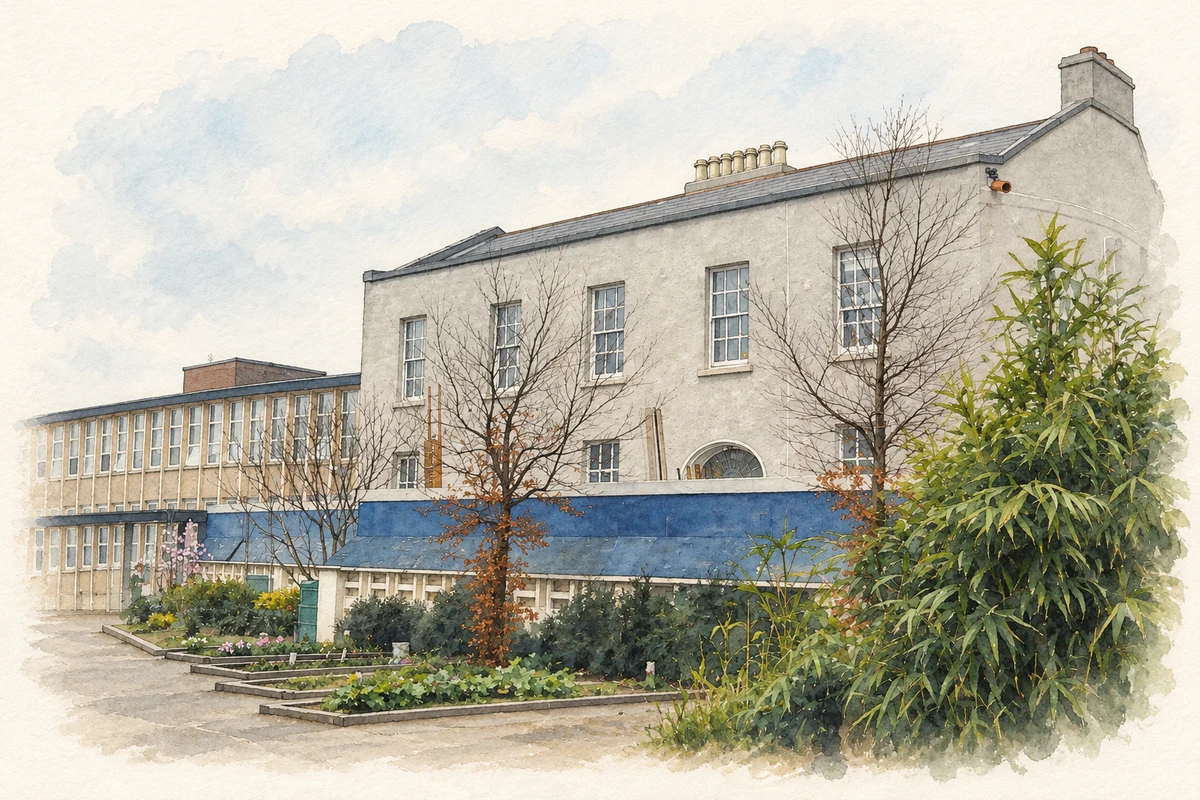
Patrick Pearse opened Scoil Éanna in Cullenswood House on Oakley Road in 1908. The Georgian house had previously been the home of historian W. E. H. Lecky. Pearse sought a bilingual education with a strong Irish cultural character, using conversation and visual teaching methods to make Irish an everyday language in the school. His brother William taught art and helped with theatrical productions. The school moved to Rathfarnham in 1910, but its first years place Ranelagh directly within Pearse’s educational work. [3] [4]
Louise Gavan Duffy and Scoil Bhríde
After Scoil Éanna moved, Pearse established the girls’ school Scoil Íde in Cullenswood House. Louise Gavan Duffy taught there from 1911, an experience which strengthened her interest in education through Irish. With Áine Nic Aoidh, she founded Scoil Bhríde in 1917, initially on Saint Stephen’s Green. Its later moves ended on Oakley Road in 1965. The school’s history thus connects its Ranelagh address with an earlier teaching experience nearby, while distinguishing Scoil Bhríde’s foundation from Pearse’s separate schools. [4]
Saving an educational landmark
Cullenswood House subsequently became homes for several families and had deteriorated badly by the 1980s. A campaign by local residents and politicians prevented its demolition. RTÉ’s report of a public reopening in January 2010 showed the restored building as the home of Gaelscoil Lios na nÓg. Among those returning was actor Deirdre Donnelly, who had lived there as a child. Its conservation kept both a historic school building and a place of later domestic memories within Ranelagh’s educational landscape. [5]
Geographic information
- Place type
- Population centre
- County
- Dublin
- Barony
- Uppercross
- Civil parish
- Saint Peter's
- Coordinates
- 53.32555, -6.25883 (approximate)
- Logainm ID
- 57180 ↗
Sources & further reading
- Logainm.ie — Ranelagh. Place names and geographic record, licensed under CC BY 4.0.
- Ranelagh Gardens · Dublin City Council
- Pearse and Education · Office of Public Works, Heritage Ireland
- Stair na Scoile – Céad Bliain faoi Bhláth · Scoil Bhríde 1917
- Ranelagh House With A Past, report broadcast 30 January 2010 · RTÉ Archives, Helen Donohue
- Cullenswood House school courtyard, Ranelagh illustration: based on a Gaelscoil Lios na nOg, Ranalagh by desomurchu archive gallery. AI-assisted watercolour and ink adaptation; cream paper margins added, incidental clutter omitted and fine details simplified. Licence: CC BY 2.0.
Name record retrieved 2026-10-25 · Source record modified 2024-06-28. How this page was prepared.