 placenames
Glynn
An Gleann
Limeworks beside Larne Lough and a mill’s changing machinery connected Glynn with wider industrial markets.
The name
These Irish name elements are associated with this record in the Logainm glossary.
An element’s translation is a clue, rather than a complete explanation of the name. Its form and meaning depend on local history and the full Irish name.
Recorded forms
- An Gleann · Irish · main form
- Glynn · English · main form
Place & story
Lime moving by rail and sea
Magheramorne’s limeworks exported large quantities to Scotland and northern England in Lewis’s 1837 account of Glynn parish. Rail and tram roads served the works, while wharfs supported loading. He recorded 459 vessels engaged in the trade during 1836, showing the scale of coastal shipping associated with this industrial shore. [2]
From bleaching to linen yarn
A bleach green at Glynn was later occupied by a cotton mill. In 1830 its machinery was adapted to spin fine linen yarn, employing about 120 people when Lewis wrote. This sequence traces changes in industrial use on one site rather than treating the parish’s textile work as a single unchanging trade. [2]
Geographic information
- Place type
- Civil parish
- County
- Antrim
- Barony
- Belfast Lower
- Coordinates
- 54.81807, -5.75951 (approximate)
- Mapped area
- 20.32 km²
- Logainm ID
- 61277 ↗
Sources & further reading
- Logainm.ie — Glynn. Place names and geographic record, licensed under CC BY 4.0.
- Glynn, Antrim — A Topographical Dictionary of Ireland (1837) · Samuel Lewis
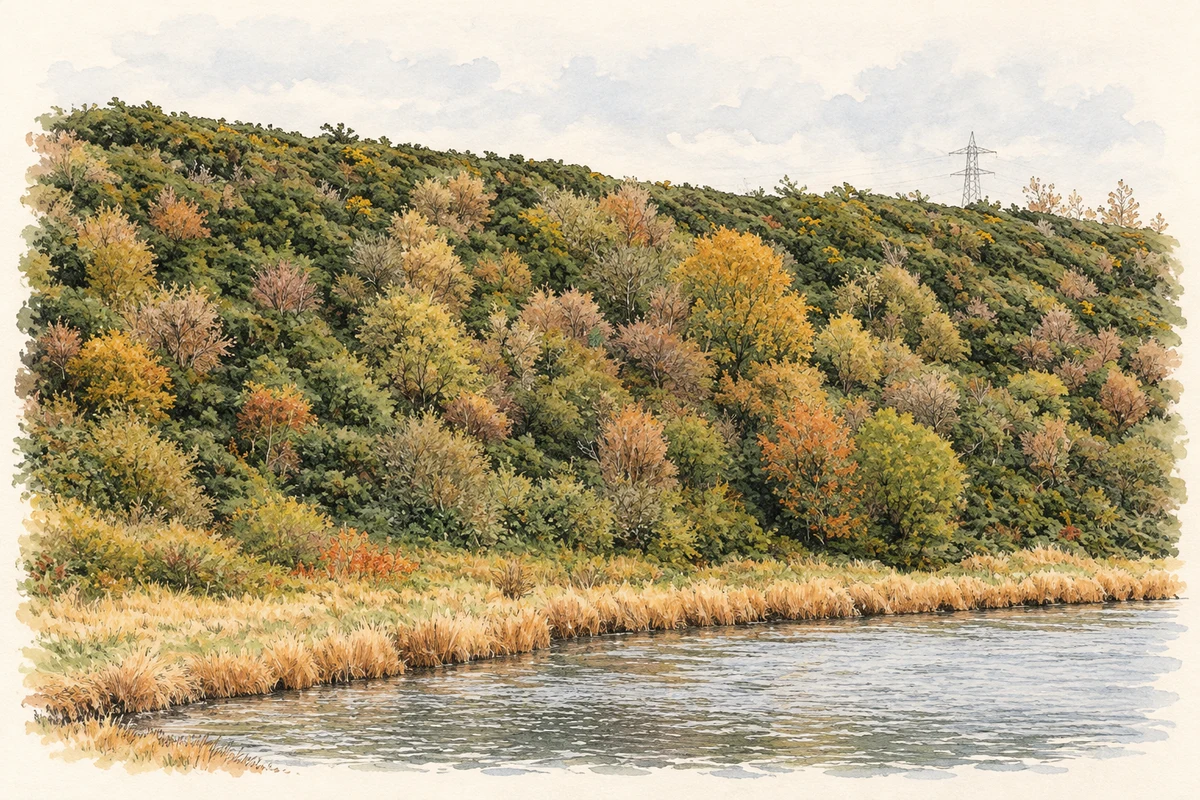
- The vegetated quarry-spoil slope at Magheramorne, County Antrim, as photographed in October 2010 illustration: based on a Magheramorne spoil heap, Larne Lough (8) by Albert Bridge. AI-assisted watercolour and ink adaptation; cream paper margins added, incidental clutter omitted and fine details simplified. Licence: CC BY-SA 2.0.
Name record retrieved 2026-10-25 · Source record modified 2021-05-26. How this page was prepared.