 placenames
Donaghmore
Domhnach Mór
Household weaving, village businesses and a plantation mansion provide distinct threads through this Tyrone parish’s history.
The name
These Irish name elements are associated with this record in the Logainm glossary.
An element’s translation is a clue, rather than a complete explanation of the name. Its form and meaning depend on local history and the full Irish name.
Recorded forms
- Domhnach Mór · Irish · main form
- Donaghmore · English · main form
Place & story
Weaving beyond the village
Samuel Lewis's 1837 account connects Donaghmore's rural households with its more concentrated industries. Farmers and cottiers wove linen, with a bleaching green near Castlecaulfield supplying a finishing stage. The village itself supported soap and candle making, brickworks and a brewery producing more than 10,500 barrels of ale and beer annually. His description places these businesses within an agricultural parish rather than treating the village as an isolated industrial settlement. [2]
Schooling and charitable support
The parish school stood at Castlecaulfield, while Lewis recorded seven other schools teaching about 870 children. An infants' school supported by A. Mackenzie attended to more than seventy pupils daily. A bequest of £200 from the Reverend George Evans in 1807 directed two-thirds of its interest towards Sunday schools and the remainder towards the parish poor, linking education with a specific arrangement for local charitable funding. [2]
The courtyard and the gateway
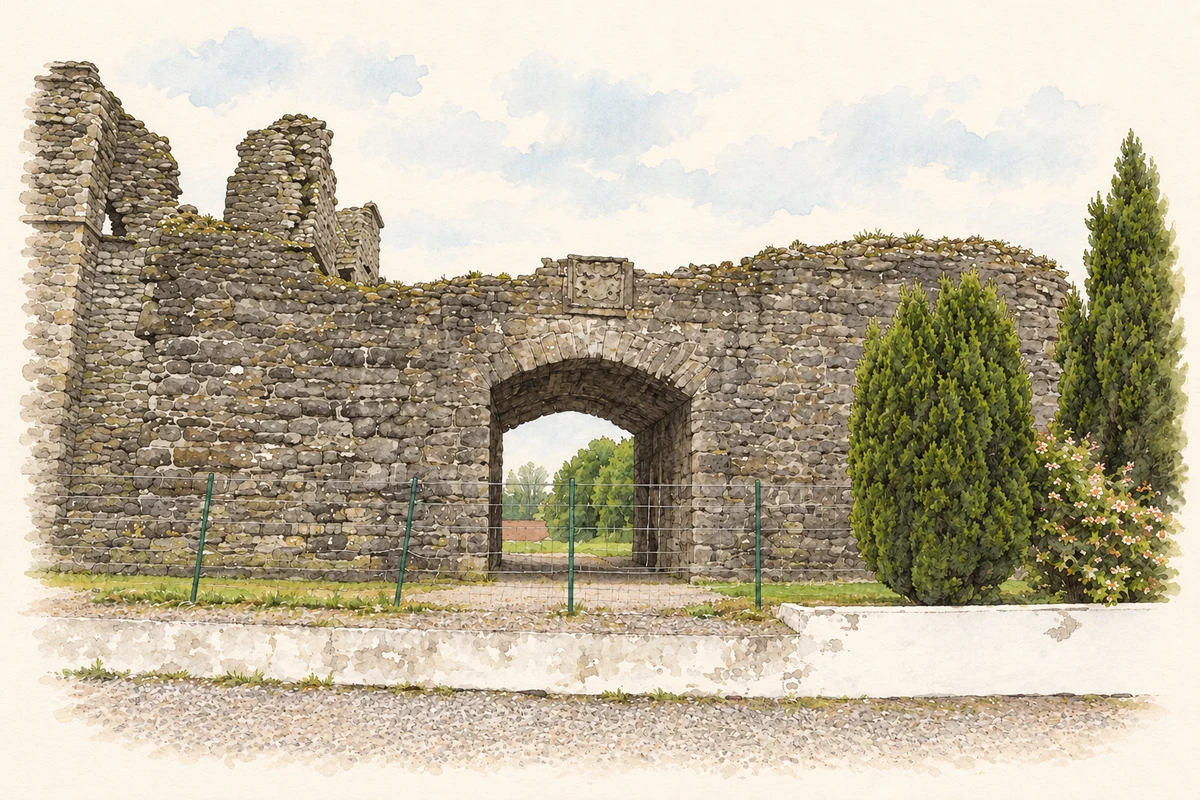
Castle Caulfield's surviving gatehouse bears the arms of the family that built its substantial early-seventeenth-century house. The Department for Communities records its burning in 1641 and subsequent repair and reoccupation. It also identifies two later religious occasions at the site: Oliver Plunkett conducted ordinations in the courtyard in 1670, and John Wesley preached before the gateway in 1767. These events give the ruined residence associations extending beyond its original plantation role. [3]
Geographic information
- Place type
- Civil parish
- County
- Tyrone
- Barony
- Dungannon Middle
- Coordinates
- 54.51381, -6.79550 (approximate)
- Mapped area
- 75.42 km²
- Logainm ID
- 63162 ↗
Sources & further reading
- Logainm.ie — Donaghmore. Place names and geographic record, licensed under CC BY 4.0.
- Donaghmore, A Topographical Dictionary of Ireland, 1837 · Samuel Lewis
- Castle Caulfield, TYR 054:001 · Department for Communities, Historic Environment Division
- The surviving entrance gateway at Castle Caulfield, County Tyrone, as photographed in May 2011 illustration: based on a Entrance, Castle Caulfield by Kenneth Allen. AI-assisted watercolour and ink adaptation; cream paper margins added, incidental clutter omitted and fine details simplified. Licence: CC BY-SA 2.0.
Name record retrieved 2026-10-25 · Source record modified 2015-07-21. How this page was prepared.