 placenames
Dysert
An Díseart
A monastic site, a decisive medieval battle and a restored tower house mark different centuries of this Clare landscape.
The name
These Irish name elements are associated with this record in the Logainm glossary.
An element’s translation is a clue, rather than a complete explanation of the name. Its form and meaning depend on local history and the full Irish name.
Recorded forms
- An Díseart · Irish · main form
- Dysert · English · main form
Place & story
The faces above the doorway
Dysert O’Dea’s church and round tower stand on the site of an early Christian hermitage associated with Saint Tola. The surviving church is chiefly twelfth-century work, with nave and choir. Its southern doorway gives the site one of its most recognisable features: nineteen carved human and animal heads along the outer arch. The round tower also belongs to the twelfth century, although it was adapted for defence in the sixteenth. [2]
A cross repaired by Michael O’Dea
The twelfth-century high cross bears a crucified Christ above a bishop on its eastern face. The bishop’s identity is uncertain: the official site account notes both Tola and Monalagh as proposed identifications. Geometric patterns, interlaced animals and human figures fill other surfaces. Michael O’Dea re-erected the cross in 1683, setting it on a base made from corner stones of the church. The monument therefore records both medieval carving and a later act of local restoration. [2]
The battle and its sources
On 10 May 1318 Richard de Clare was defeated and killed at Dysert O’Dea by forces associated with Muircheartach O’Brien and the O’Dea, O’Connor and O’Hehir chiefs. Historian Katharine Simms treats the victory as a major reversal for Anglo-Norman power in Thomond. She also cautions that the detailed battle narrative depends on the medieval Caithréim. Its claim that Bunratty was abandoned immediately afterwards conflicts with exchequer records showing a continuing garrison. The result is secure, while individual scenes require more caution. [3]
A later tower house
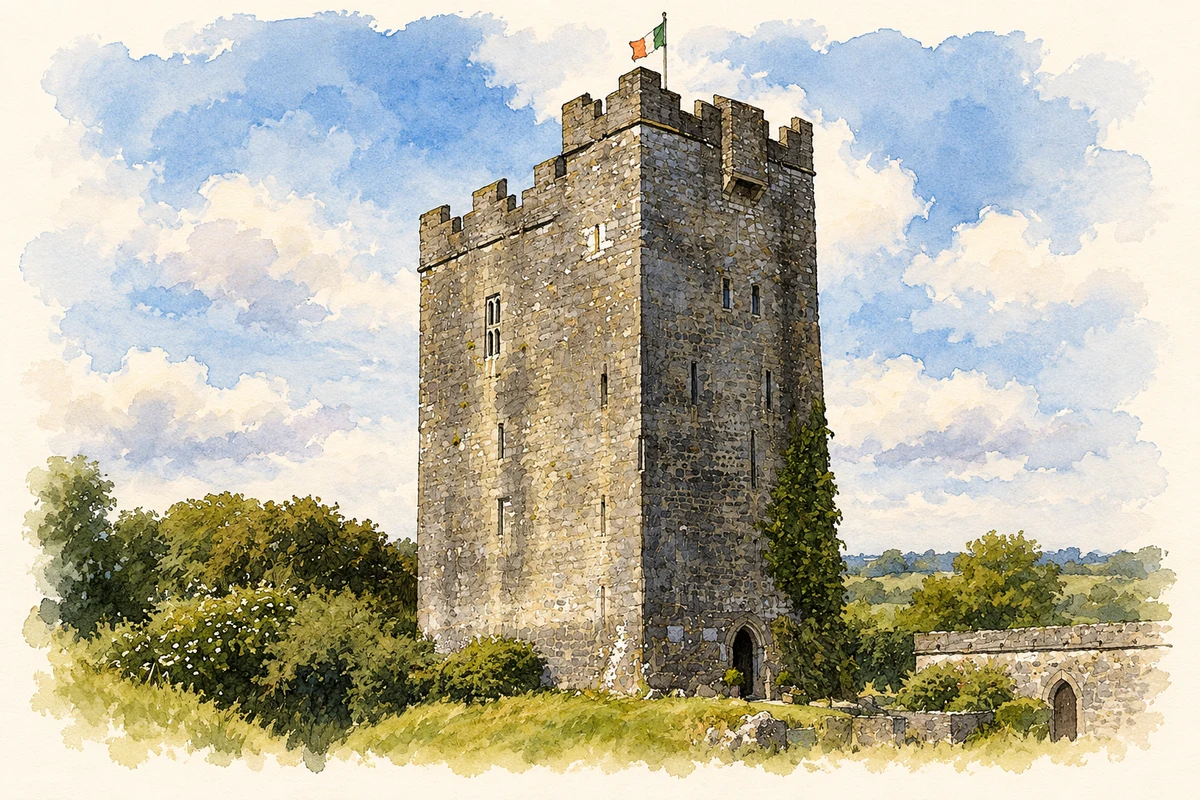
The castle belongs to a much later period than the battle. The heritage centre dates its construction to 1480 under Diarmuid O’Dea, lord of Cineal Fearmaic. Its upper floors and staircase suffered serious damage in 1651. Repairs restored those parts before the building reopened in 1986. With ten rooms arranged over four floors, the tower house preserves a domestic and defensive setting distinct from the neighbouring monastic ruins. [4]
Geographic information
Sources & further reading
- Logainm.ie — Dysert. Place names and geographic record, licensed under CC BY 4.0.
- Dysert O’Dea Church, High Cross, and Round Tower · Office of Public Works, Heritage Ireland
- The Battle of Dysert O’Dea and the Gaelic Resurgence in Thomond · Katharine Simms, Dal gCais 5 (1979), reproduced by Clare County Library
- Dysert O’Dea Castle · Dysert O’Dea Castle heritage centre
- Dysert O'Dea Castle, near Dysert, County Clare illustration: based on a Castles of Munster: Dysert O'Dea, Clare (1) by Mike Searle. AI-assisted watercolour and ink adaptation; cream paper margins added, incidental clutter omitted and fine details simplified. Licence: CC BY-SA 2.0; adapted illustration distributed under the same licence.
Name record retrieved 2026-10-25 · Source record modified 2012-12-21. How this page was prepared.