 placenames
Aghintain
Achadh an tSéin
The old castle and William Montgomery’s birthplace association connect Aghintain with seventeenth-century Ulster.
The name
These Irish name elements are associated with this record in the Logainm glossary.
An element’s translation is a clue, rather than a complete explanation of the name. Its form and meaning depend on local history and the full Irish name.
Recorded forms
- Achadh an tSéin · Irish · main form · validated name
- Aghintain · English · main form
- Aughinthin · English · main form · local name
Place & story
The castle in the Plantation landscape
Aghintain’s ruined castle belongs to the early seventeenth-century Plantation landscape west of Clogher. Samuel Lewis’s 1837 account records a castle built by Sir William Stewart before 1619 and describes its destruction in 1641. The same account already regarded it as a conspicuous ruin on elevated ground. This older fortified residence should be distinguished from the later country house also called Aughentaine, built elsewhere in the surrounding district during the nineteenth century. [2] [3]
William Montgomery’s birthplace
William Montgomery, the landowner and family historian, was born at Aghintain in October 1633. His parents were Sir James Montgomery of Rosemount and Katherine Stewart. The official Ards and North Down biography records that he was taken to Derry and then Scotland for safety during the 1641 rebellion. He later studied at Glasgow and Leiden and became associated with the Rosemount estate in County Down. His birthplace gives Aghintain a precise connection with a writer on the early Ulster-Scots settlement. [4]
A new mansion in the wider district
The nineteenth-century Aughentaine mansion was begun in 1860 for Thomas Richardson Browne, to designs by Isaac and William Robert Farrell. The architectural archive identifies it as Italianate and records plans preserved at PRONI. An earlier design had been prepared by Charles Frederick Anderson before 1849, but the eventual building followed the Farrells’ scheme. The commission records a new country-house project, distinct in character from the earlier fortified residence. [3]
Two sites with a shared name
Northern Ireland’s historic gardens register places the later Aughentaine demesne in Ballyness. It explicitly distinguishes that estate from the seventeenth-century castle ruin in Aghintain: the shared name refers to separate sites. [5]
Geographic information
Sources & further reading
- Logainm.ie — Aghintain. Place names and geographic record, licensed under CC BY 4.0.
- Five-Mile-Town or Blessingbourn, A Topographical Dictionary of Ireland, 1837 · Samuel Lewis
- Aughentaine, work record6044 · Irish Architectural Archive, Dictionary of Irish Architects
- Biographies: The Montgomerys · Ards and North Down Borough Council
- Register of Parks, Gardens and Demesnes, November2020: Aughentaine Castle T/001 · Northern Ireland Heritage Gardens Trust, historic gardens register
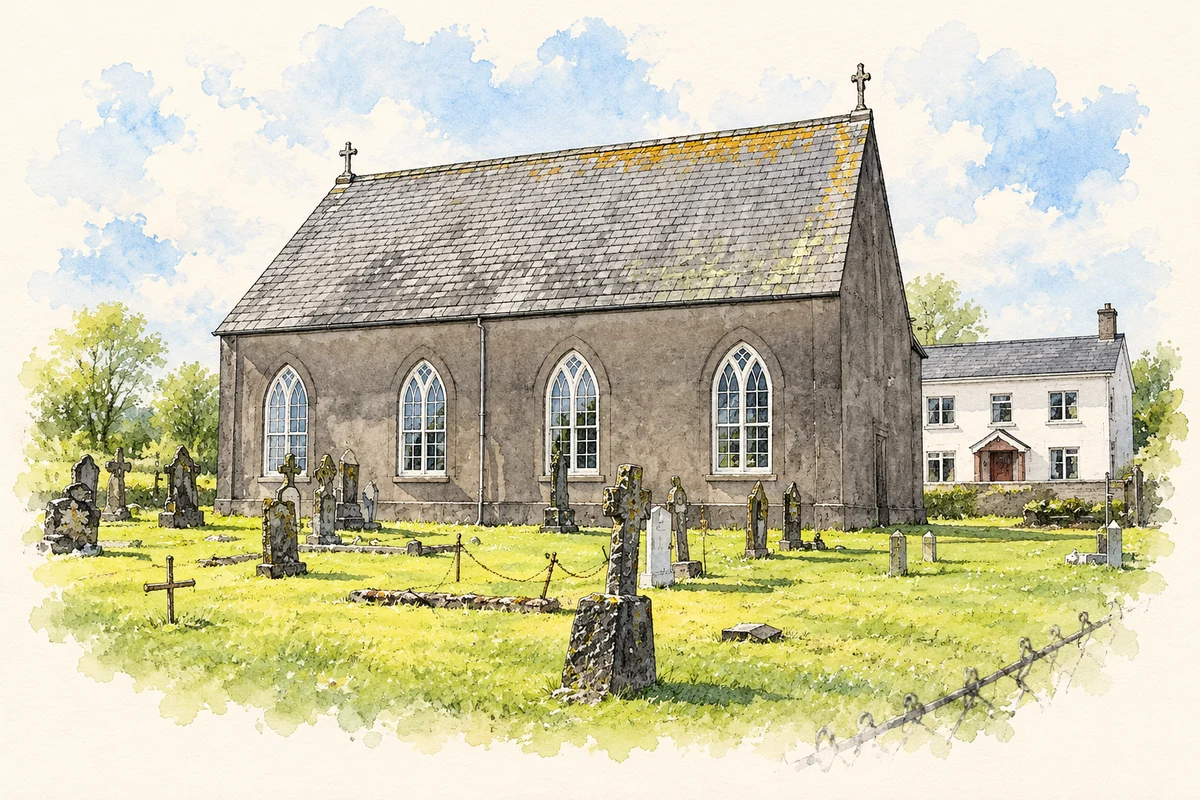
- Former chapel near Aghintain, County Tyrone illustration: based on a Former chapel near Aghintain, County Tyrone (23 April 2006) by Kenneth Allen. AI-assisted watercolour and ink adaptation; cream paper margins added, incidental clutter omitted and fine details simplified. Licence: CC BY-SA 2.0.
Name record retrieved 2026-10-25 · Source record modified 2015-11-11. How this page was prepared.