A reliable full-name meaning has not been established here. The recorded Irish and English forms are given without an unsupported translation.
Recorded forms
Fionntamhnach· Irish · main form · validated name
Fintona· English · main form
Place & story
Dick and the last horse tram
For generations a horse-drawn tram connected Fintona with the railway junction outside the town. Northern Ireland Screen's archive records that the horses were all called Dick and that the service ended in 1957. Film-maker A. H. Martin captured the tram in 1954, while horse traffic, steam trains and newer forms of transport still operated alongside one another. The archive notes the ash laid between the rails to protect the horse's hooves. Such practical details explain how this small branch service continued to function long after mechanised transport had become familiar elsewhere.[2]
A new journey to the museum
An Ulster Television film from 1960 records the tram being moved to the Transport Museum, then located in Witham Street in east Belfast. Loaded onto a lorry, the double-deck vehicle travelled over motorway flyovers before workers prepared it for display. The footage documents the transition from everyday transport to a museum object. It also preserves an important distinction for anyone following the story: the surviving tram left Fintona after the line closed. The museum's early Belfast location belongs to its preservation history, before the later transport collections at Cultra.[3]
People & connections
Alan Buchanan’s public service
Alan Alexander Buchanan was born in Fintona in 1907. Ordained in the Church of Ireland, he served as a military chaplain during the Second World War and accompanied the Arnhem airborne landing in 1944. Remaining with wounded men, he was captured and held until the war ended. Later bishop of Clogher and archbishop of Dublin, he criticised discriminatory housing policies and supported the ordination of women. His biography connects a Fintona birthplace with a career in pastoral care and public debate across Ireland, rather than implying that these later events took place in the town.[4]
Both censuses use the same 2015 settlement boundary. These exact counts cover usual residents in the settlement, rather than local government districts or historic counties. Other NISRA tables may use approximate counts.
View population figures
FINTONA — Settlement 2015 (N11000589) — census population
The census used a grid rectangle around the built-up area, rather than today’s settlement boundary. The 1981 figures are as enumerated, without adjustment for non-enumeration. These counts remain separate from later settlement totals.
View population figures
Fintona — census rectangle H430600 to H450620 — census population
The published 2001 KS01 settlement count uses an earlier geography and disclosure-control methods. It is not rebased to the 2015 settlement used for 2011 and 2021. The geographic matching file can contain a different 2001 count; the figure shown here comes from KS01.
View population figures
Fintona — KS01 Settlement (2005 geography) — census population
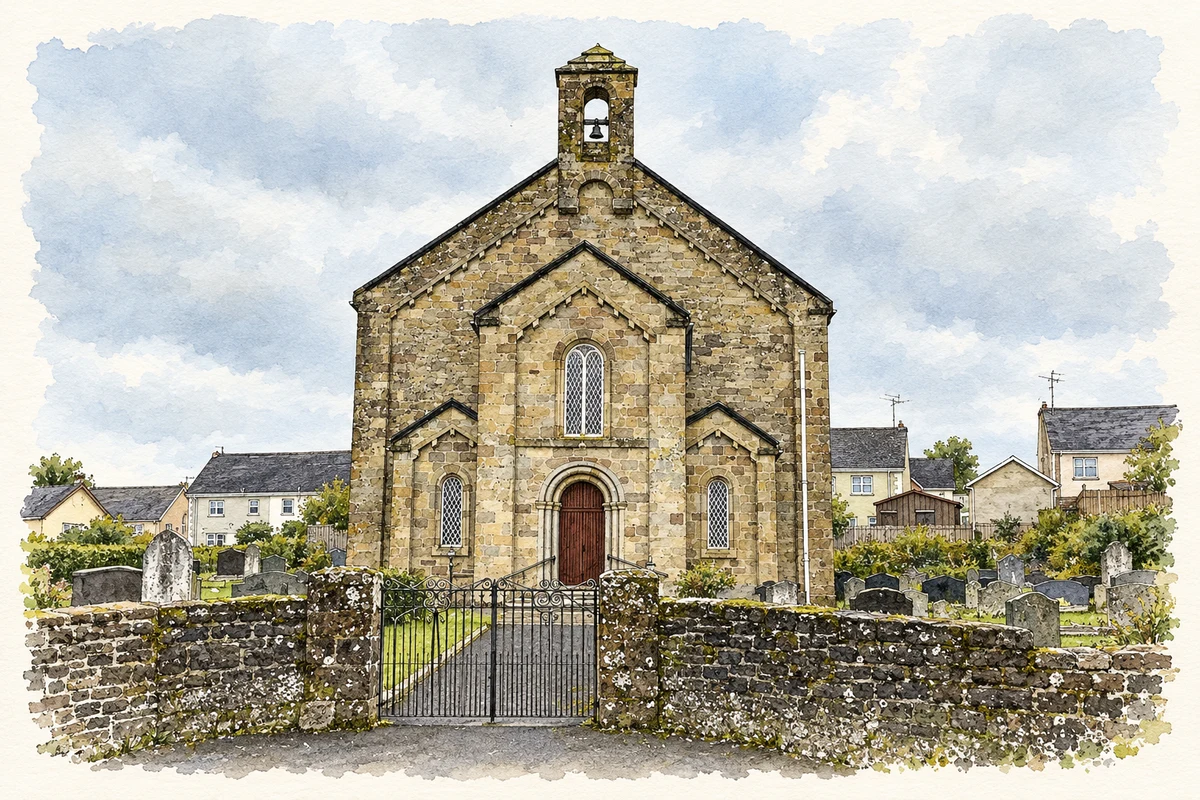
Church of Ireland, Fintona illustration: based on a Church of Ireland, Fintona by Kenneth Allen. AI-assisted watercolour and ink adaptation; cream paper margins added, incidental clutter omitted and fine details simplified. Licence: CC BY-SA 2.0.
 placenames