Wexford’s waterfront history reaches into the Slaney valley. Within the town, a medieval priory carries a romantic legend and a small theatre helped inspire an international festival.
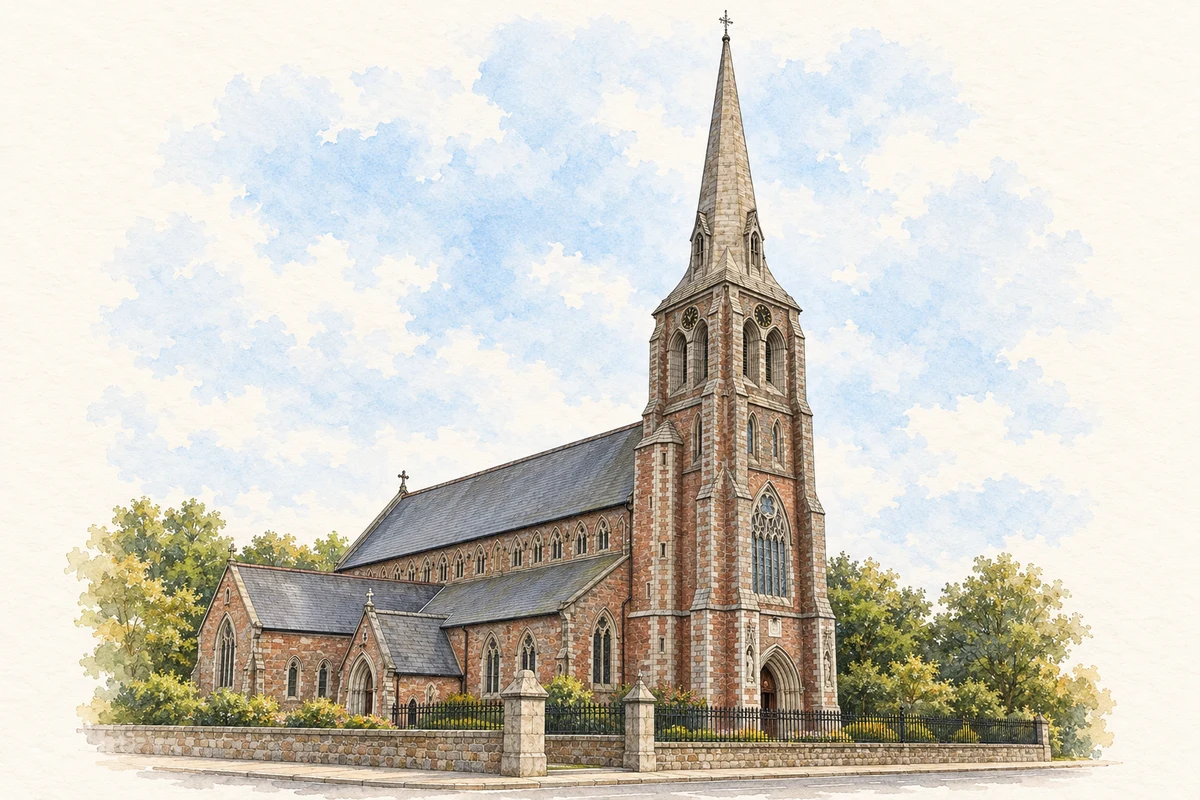
Illustration, Church of the Immaculate Conception, Rowe Street
⊕Recorded locationWexford52.33457° N · 6.46673° WInteractive map supplied by OpenStreetMap.
These Irish name elements are associated with this record in the Logainm glossary.
An element’s translation is a clue, rather than a complete explanation of the name. Its form and meaning depend on local history and the full Irish name.
Recorded forms
Loch Garman· Irish · main form · validated name
Wexford· English · main form
Place & story
A harbour at the mouth of the Slaney
Samuel Lewis’s 1837 account follows Wexford’s development as a port and describes its associations with the Norse settlement and the Anglo-Norman arrival. The harbour connected the town with a wider landscape: Bannow was a landing place farther along the coast, while Carrick lay upriver on the Slaney. The town’s own streets and waterfront formed one part of those changing routes of trade, settlement and military power.[2]
The surviving church at Selskar
Selskar was an Augustinian priory dedicated to Saints Peter and Paul. The Office of Public Works describes the surviving double-nave church, remnants of a four-arched arcade and a fortified tower probably added in the late fourteenth century. Dundry stone appears in its quoins and windows. The church survives from a much larger complex that once included domestic buildings and agricultural property around and beyond the town walls.[3]
Folklore & tradition
The knight who returned too late
A romantic legend recorded by John B. Cullen in 1895 tells of a Wexford knight who leaves his betrothed to join a crusade. A report of his death reaches home; after waiting without news, she enters a convent. When he finally returns alive, he discovers that she has become a nun and enters Selskar as a monk. The tale, reproduced in the OPW’s account, is an attested local legend about separation and religious retreat.[3]
People & connections
Tom Walsh and the Theatre Royal
Dr Tom Walsh founded Wexford Festival Opera in 1951. The festival’s archive account traces his interest to a childhood visit to Rigoletto at the old Theatre Royal in 1922. He later helped shape programmes around less familiar operas, asking audiences to discover works beyond the standard favourites. The small town theatre thus supplied both an early personal experience and a setting for the cultural venture that followed.[4]
Both counts use the 2016 settlement boundary, allowing like-for-like comparison. CSO supplies the 2022 count on this older boundary for comparison only. The official 2022 Built Up Area has different boundaries.
View population figures
Wexford — Census 2016 settlement footprint — census population
These figures use different area definitions. Read the boundary note before comparing them.
Wexford, Wexford — 2011 legal town and environs; 2016 census settlement
Published census settlement populations
20,188people · 2016
Settlement boundaries changed during this period. Differences may reflect boundary changes as well as population change. Where a 2011 legal-town-and-environs count is shown, it has not been recalculated onto the 2016 settlement boundary.
View population figures
Wexford, Wexford — 2011 legal town and environs; 2016 census settlement — census population
Church of the Immaculate Conception, Rowe Street illustration: based on a reference by Dave Kelly. AI-assisted watercolour and ink adaptation; warm cream paper margins; incidental modern clutter removed and fine details simplified. Licence: CC BY-SA 2.0.
 placenames