Clogher's cathedral preserves a long religious association, while a recorded legend and the writing of William Carleton connect the town with different kinds of storytelling.
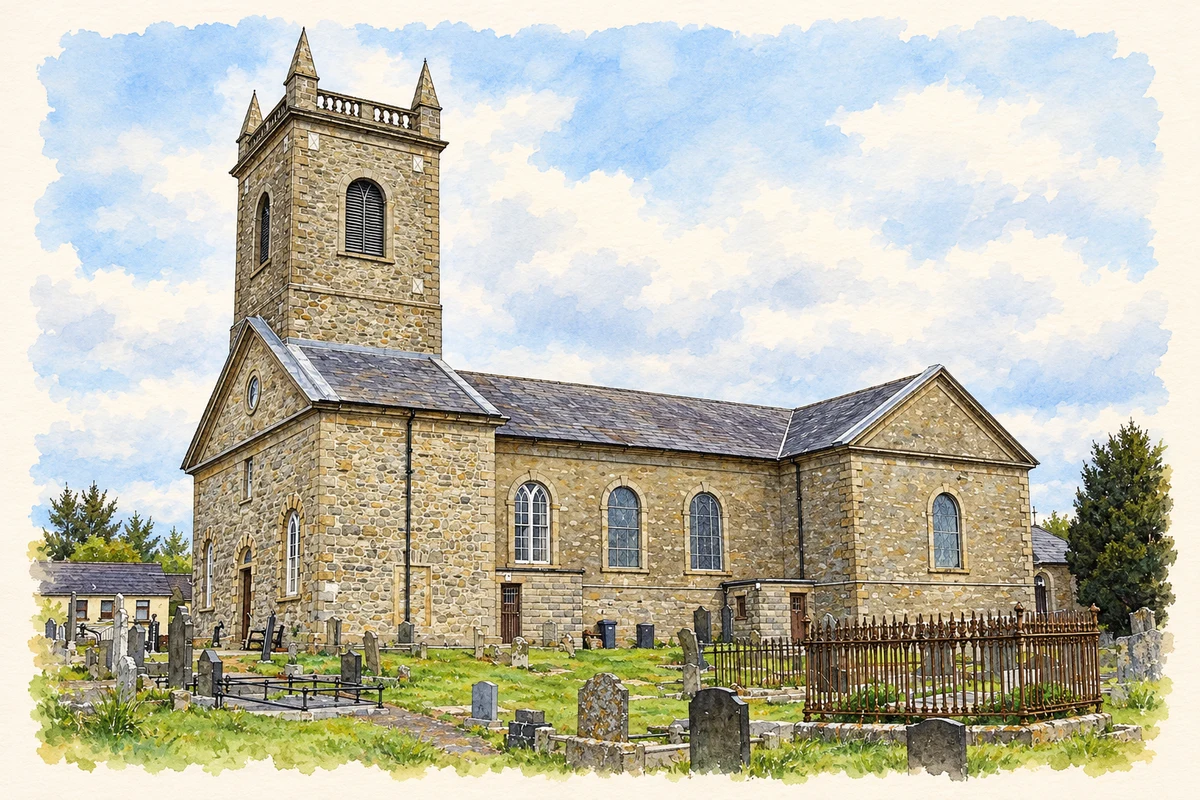
Illustration, Saint Macartan's Cathedral, Clogher, County Tyrone
⊕Recorded locationClogher54.41363° N · 7.16817° WInteractive map supplied by OpenStreetMap.
These Irish name elements are associated with this record in the Logainm glossary.
An element’s translation is a clue, rather than a complete explanation of the name. Its form and meaning depend on local history and the full Irish name.
Recorded forms
Clochar· Irish · main form · validated name
Clogher· English · main form
Place & story
Saint Macartan's Cathedral
The present Saint Macartan's Cathedral was built between 1740 and 1744 on a site with a much older history of worship. Reordering between 1816 and 1818 introduced a classical interior, chapter stalls and three galleries. Two galleries were removed in 1865; the remaining western gallery accommodates the organ and choir. An east window dates from 1862. The churchyard contains hundreds of memorials, including seventeenth-century stones. These different dates reveal successive generations adapting the cathedral and adding their own commemorations to a long-established religious setting.[2]
Folklore & tradition
The stone that answered questions
Samuel Lewis's 1837 account records a tradition of a gold-covered stone at Clogher that gave oracular answers in pagan times. He cites a fifteenth-century church writer who said the stone survived near the church entrance, still showing traces of its former gold covering. Lewis also described an old carved stone near the cathedral tower which local people associated with the story, though he identified it as a cross shaft. The account preserves both the golden-stone legend and an early antiquarian attempt to understand the carved remains found around the cathedral.[3]
People & connections
William Carleton's local world
William Carleton was born in 1794 at Prillisk near Clogher, the son of a tenant farmer who also worked as a flax-dresser. His Irish-speaking parents knew a large repertoire of songs and stories, and he received his education in hedge schools. He left the district in 1818 and eventually made a literary career in Dublin. Traits and Stories of the Irish Peasantry and later novels drew on rural life, speech and social tensions. His local upbringing therefore connects the Clogher district with a major body of nineteenth-century fiction about Irish country people.[4]
Both censuses use the same 2015 settlement boundary. These exact counts cover usual residents in the settlement, rather than local government districts or historic counties. Other NISRA tables may use approximate counts.
View population figures
CLOGHER — Settlement 2015 (N11000309) — census population
These are the town figures printed in the historical census reports, separate from the surrounding rural district and modern settlement. Some historical towns had no fixed boundary; a consistent footprint across years is not assumed.
View population figures
Clogher — historical census town — census population
The census used a grid rectangle around the built-up area, rather than today’s settlement boundary. The 1981 figures are as enumerated, without adjustment for non-enumeration. These counts remain separate from later settlement totals.
View population figures
Clogher — census rectangle H536514 to H547526 — census population
 placenames