Tyrone’s market towns and river valleys sit beside places made memorable by storytelling. At Knockmany, prehistoric stonework and a comic giant tale occupy the same hill.
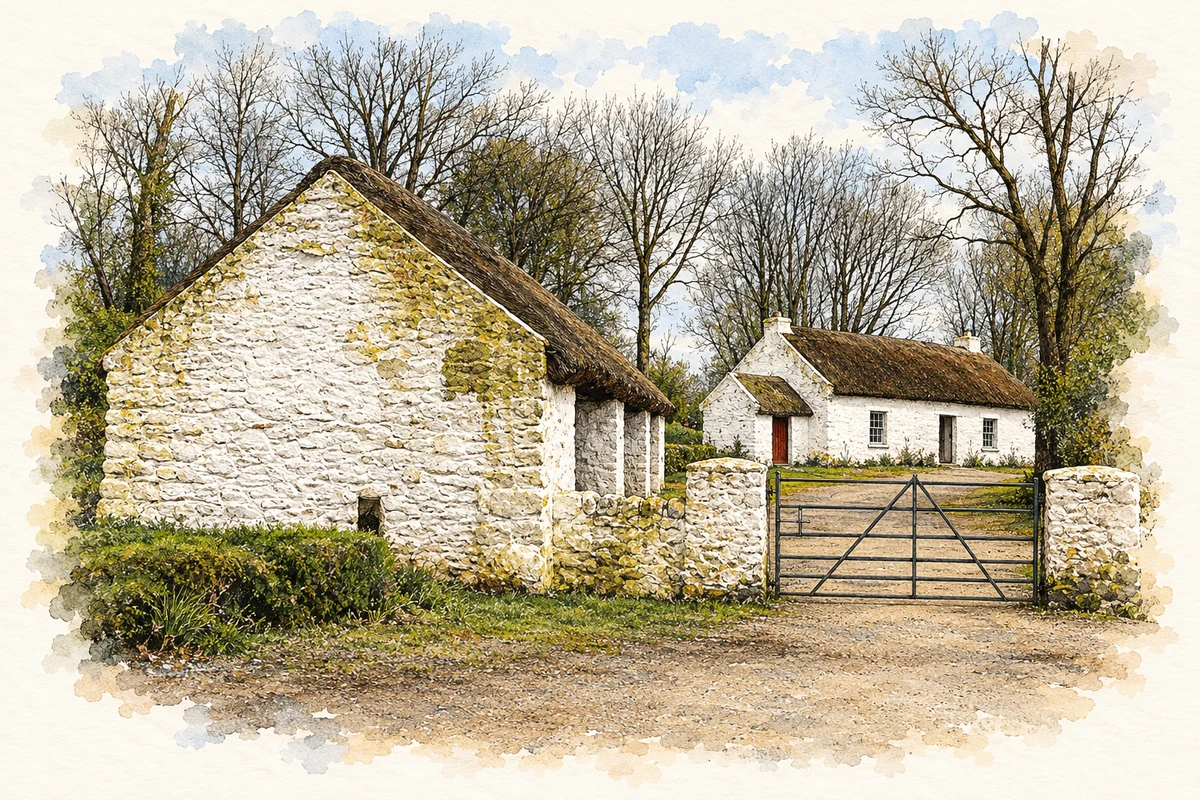
Illustration, Mellon homestead at the Ulster American Folk Park
⊕Recorded locationTyrone54.60957° N · 7.11333° WInteractive map supplied by OpenStreetMap.
These Irish name elements are associated with this record in the Logainm glossary.
An element’s translation is a clue, rather than a complete explanation of the name. Its form and meaning depend on local history and the full Irish name.
Recorded forms
Tír Eoghain· Irish · main form · validated name
Tyrone· English · main form
Place & story
Two centres of power and trade
Lewis’s nineteenth-century surveys describe distinct roles for Dungannon and Omagh. Dungannon’s history includes its association with O’Neill power; Omagh developed as a county administrative centre beside its rivers. Markets, rebuilding and changes in authority form part of both accounts. Reading them together gives the county more than one historical centre, with different routes through its political and everyday life.[2][3]
People & connections
William Carleton’s Tyrone childhood
William Carleton was born in 1794 at Prillisk near Clogher. The Dictionary of Irish Biography describes his parents as Irish speakers with a deep knowledge of oral stories and songs. He attended hedge schools before leaving home in 1818 and eventually pursuing a literary career. His Traits and Stories of the Irish Peasantry brought aspects of rural life into print. His upbringing supplies a precise Tyrone connection to that influential, sometimes contentious body of writing.[4]
Folklore & tradition
Oonagh outwits the giant
A Legend of Knockmany, printed in Joseph Jacobs’s Celtic Fairy Tales in 1892, places Fin and Oonagh’s home on the hill. When the formidable Cucullin approaches, Oonagh takes charge. She hides iron griddles inside bread and passes Fin off as the couple’s child; the visitor concludes that the absent father must be terrifying. In this comic literary version, ingenuity carries the day. Knockmany and the neighbouring hill of Cullamore anchor the fabulous action in a recognisable Tyrone landscape.[5]
The stones beneath the story
Knockmany also contains a prehistoric passage tomb overlooking the Clogher Valley. National Museums NI describes chamber stones decorated with circles, zigzags and spirals. Excavation found burnt human bone, flints and a fragment of Neolithic pottery. The protective covering is modern, dating from 1959. These archaeological remains give the hill a human history far older than the nineteenth-century printed giant tale.[6]
Published county totals use the boundaries at each census; administrative changes can affect comparisons. Early figures exclude members of the armed forces.
Mellon homestead at the Ulster American Folk Park illustration: based on a Mellon House, Castletown by Kenneth Allen. AI-assisted watercolour and ink adaptation; cream paper margins added, incidental clutter omitted and fine details simplified. Licence: CC BY-SA 2.0.
 placenames