Wexford’s coast and Slaney valley connect medieval navigation, market towns and international design. Its famous houses also carry traditions that need to be distinguished from their building histories.
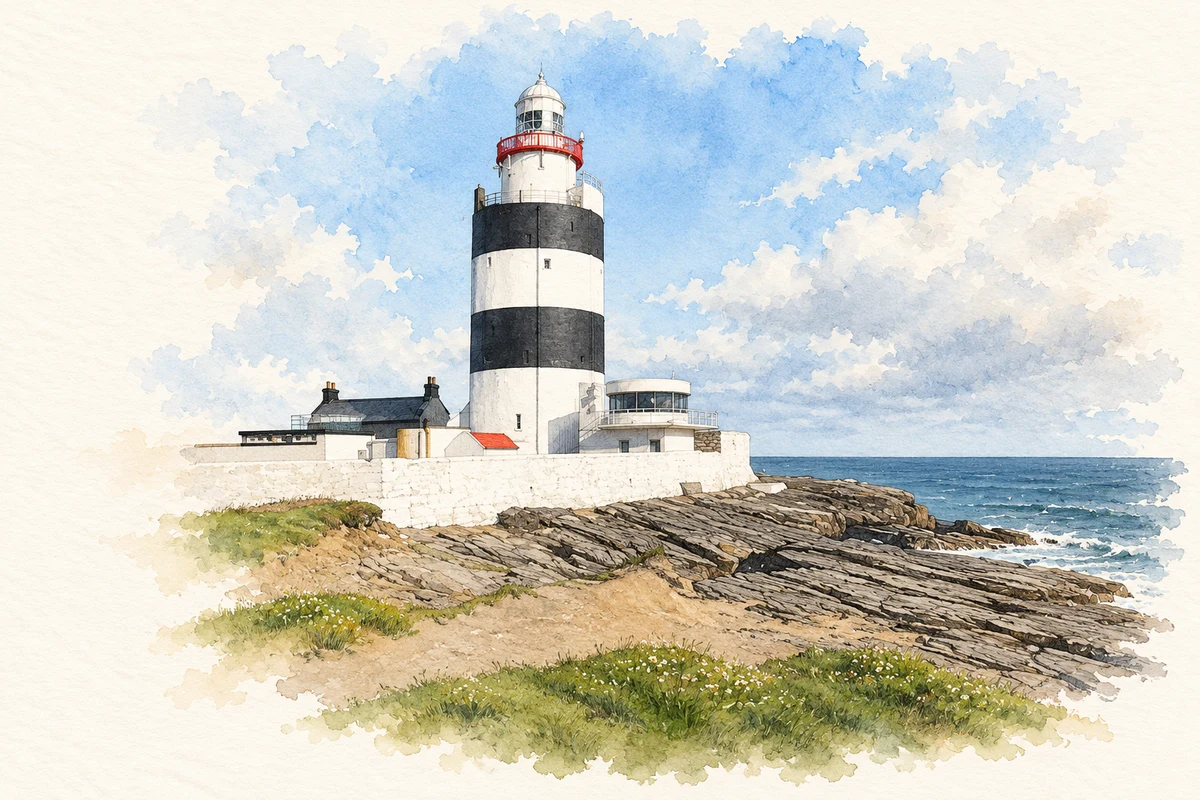
Illustration, Hook Lighthouse, County Wexford
⊕Recorded locationWexford52.35544° N · 6.62148° WInteractive map supplied by OpenStreetMap.
These Irish name elements are associated with this record in the Logainm glossary.
An element’s translation is a clue, rather than a complete explanation of the name. Its form and meaning depend on local history and the full Irish name.
Recorded forms
Loch Garman· Irish · main form · validated name
An Contae Riabhach· Irish · main form · historical name
Wexford· English · main form
Place & story
Coast and river routes
Lewis’s county survey gives the Slaney a central geographical role and describes long southern and eastern sea boundaries. Wexford town developed around its harbour, while Enniscorthy occupied a crossing farther upriver.[2][3][4]
The tower that guided ships to New Ross
Hook Lighthouse’s own historical account places the construction of its medieval tower in the early thirteenth century, as part of the development of shipping to William Marshal’s port of New Ross. The tower acted as a landmark by day and a light at night. Its position at the entrance to Waterford Harbour links a Wexford headland with river trade farther inland. The operator distinguishes the early tradition of monastic beacon-keeping from the later historical references to the tower’s custodians.[5]
People & connections
Eileen Gray from Brownswood
Eileen Gray was born at Brownswood near Enniscorthy in 1878. After studying in London she made her working life largely in France, becoming known for furniture, lacquer work and architecture. Enniscorthy Castle’s exhibition places that international career alongside her local origins.[6]
Folklore & tradition
Loftus Hall: legend and rebuilding
Loftus Hall on the Hook peninsula is associated with a famous supernatural legend and with a separate story that it was rebuilt in expectation of a royal visit. The National Inventory of Architectural Heritage explicitly calls both accounts apocryphal. Its building record dates the surviving country house to 1870–71 while noting remains of an earlier house. That distinction matters: a tale set in the eighteenth century cannot simply be assigned to every room of the later mansion.[7]
Figures cover the whole county including its cities. CSO recommends this series for long-term comparison, although minor boundary changes have occurred.
View population figures
County Wexford, including its cities — census population
Hook Lighthouse, County Wexford illustration: based on a Hook Head Lighthouse by Oliver Dixon. AI-assisted watercolour and ink adaptation; cream paper margins added, incidental clutter omitted and fine details simplified. Licence: CC BY-SA 2.0.
 placenames